
Living Room Curtain Ideas: The Expert Guide to Dressing Your Windows in Style
Few things transform a living room faster than the right window treatment. Living room curtain ideas span a surprisingly wide range — from floor-grazing velvet panels that make a small room feel like a boutique hotel suite to breezy linen sheers that flood a space with soft morning light. The curtain you choose controls privacy, light, temperature, and the overall visual weight of your room, all at once. It’s arguably the most underrated design decision in the entire home.
Living room curtain ideas refer to the various styles, fabrics, and hanging methods used to dress windows in a lounge or sitting area. The best choice depends on your ceiling height, natural light levels, window size, and the mood you want to create — from cozy and intimate to airy and modern. A well-chosen curtain can visually raise ceilings, widen narrow windows, and anchor a room’s color palette in one move.
In my experience helping friends and readers refresh their spaces on a budget, curtains are consistently the highest-impact, lowest-cost upgrade available. A pair of floor-length linen panels from IKEA (around $30–$50 per panel) can make a room look like it was designed by a professional — especially when hung correctly, which we’ll cover in detail below. Whether you’re exploring curtain ideas for living room spaces large or small, this guide covers every style, fabric, and technique worth knowing in 2026.
Best Living Room Curtain Styles in 2026
Curtain trends shift slowly, which is actually good news — a style choice you make today should still look current five years from now. That said, 2026 has brought a clear shift away from heavy, formal drapes toward relaxed, textural fabrics that feel lived-in and warm. Linen, cotton-linen blends, and lightweight velvet are all having a major moment, while blackout curtains with a linen-look face fabric have become a genuinely elegant option for rooms that need both light control and style.
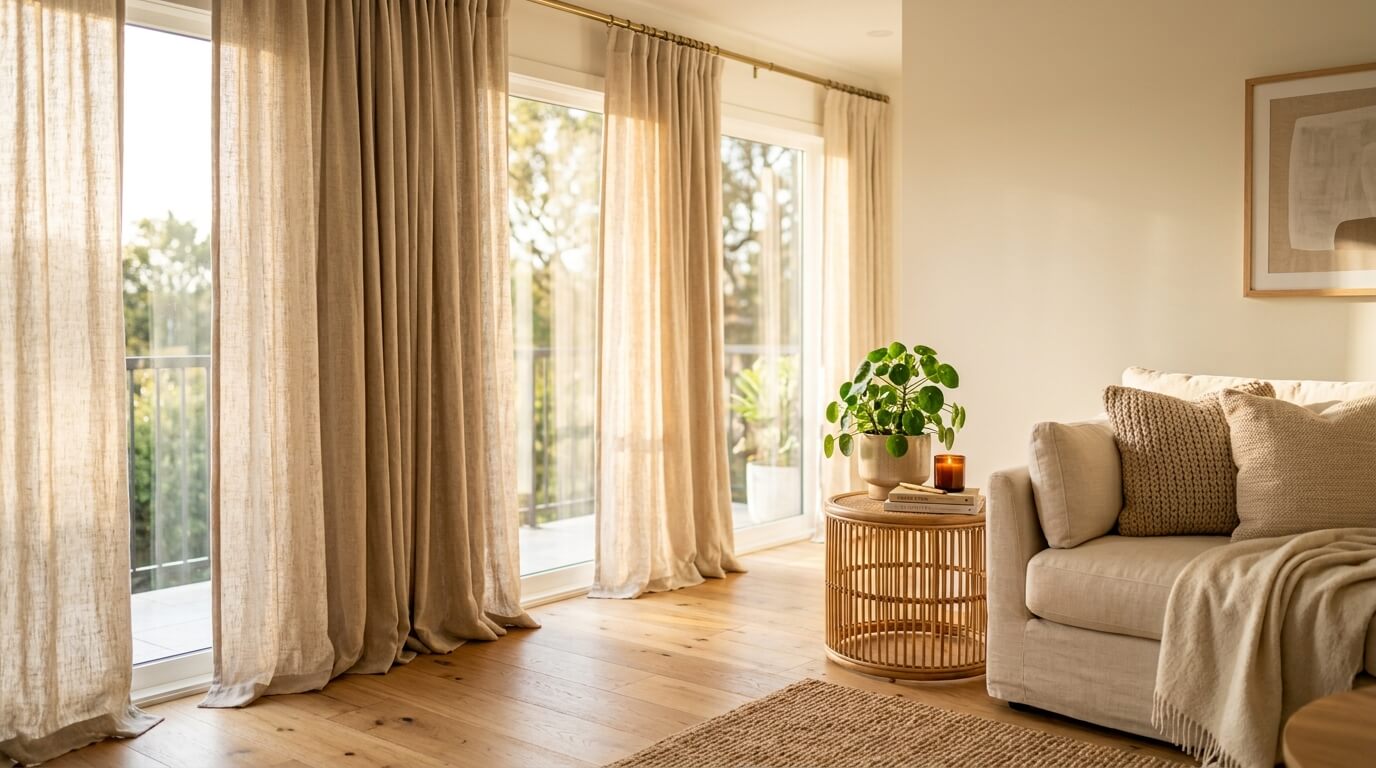
The most versatile curtain idea for living rooms right now is the floor-length panel in a neutral texture. Think oatmeal linen, warm white cotton, or even a muted sage. These work in virtually every decorating style — Scandinavian, modern farmhouse, transitional, and even maximalist rooms where the curtain acts as a calm visual anchor. Pair them with minimalist wall decor and you’ve got a space that feels curated without being overdone.
Always hang your curtain rod 4–6 inches above the window frame (or closer to the ceiling in rooms with low ceilings) and extend it 8–12 inches on each side of the window. This simple trick makes windows look dramatically larger and rooms feel taller — no renovation required.
Beyond the classic panel, popular curtain ideas for living rooms in 2026 include tab-top curtains for a casual, relaxed feel; pinch-pleat drapes for a more tailored, traditional look; and eyelet (grommet) panels that slide smoothly and suit modern or Scandi interiors. Sheer curtain layering — a sheer inner panel with a heavier outer drape — remains one of the most functional approaches, giving you daytime privacy with light diffusion while the outer panel provides full blackout when drawn.
What Are the Best Curtain Ideas for Sliding Doors?
Sliding door curtain ideas require a different approach than standard windows because the treatment needs to clear the full door opening without blocking it. The most practical solutions are vertical blinds, panel track systems, or wide grommet-top curtains on an extra-long rod that extends well beyond the door frame on both sides. For a more polished look, floor-to-ceiling curtain panels on a ceiling-mounted track system completely hide the door mechanism and create a seamless wall of fabric. I’ve seen this done with IKEA’s KVARTAL track system ($60–$90) and the results genuinely look high-end.
Window Curtain Ideas by Fabric Type
The fabric you choose determines almost everything: how the curtain hangs, how much light it filters, how it feels in the room, and how much maintenance it needs. Window curtain ideas really come down to understanding the trade-offs between each material.
Linen and linen-cotton blends are the current gold standard for living rooms. They have a natural texture that photographs beautifully, drape with a relaxed elegance, and age gracefully — small wrinkles just add to the lived-in charm. Pure linen is breathable and temperature-regulating, which is genuinely useful in rooms that get afternoon sun. The downside is cost: quality linen panels can run $80–$200 each, though H&M Home and IKEA offer convincing alternatives at $20–$40 per panel.
Velvet is having a real resurgence, and not just in deep jewel tones. Dusty rose, sage green, warm terracotta, and steel blue velvet curtains add incredible depth and sound absorption to a room. A pair of sage velvet panels ($60–$120 per pair from Amazon or Target) can transform a basic living room into something that looks genuinely expensive. The caveat: velvet shows dust and pet hair, so factor that into your maintenance routine.
According to the U.S. Department of Energy, insulating window treatments like heavy drapes can reduce heat loss through windows by up to 10% in winter — making curtain selection a genuine energy-efficiency decision, not just an aesthetic one.
Sheer fabrics (voile, chiffon, lightweight polyester) are indispensable for living rooms where natural light is the priority. They filter harsh midday sun into soft, diffused glow while maintaining daytime privacy from outside. Sheers work beautifully layered under heavier panels — hang them on a double rod so you can control the light level throughout the day. Double rod curtain ideas are especially effective in living rooms with large east- or west-facing windows.
Blackout curtains have improved dramatically in terms of style. The days of ugly hotel-room blackout drapes are over — you can now find blackout-lined panels in every fabric finish imaginable, including linen-look, velvet, and even botanical prints. For media rooms or any living room used as a home theater, blackout curtains are genuinely worth the investment. Add some led lights for living room ambiance behind the TV and you have a setup that rivals a dedicated home cinema.
Bay Window and Specialty Window Solutions
Bay window curtain ideas are among the most searched curtain questions online — and with good reason. Bay windows are beautiful architectural features, but dressing them well requires some thought. You have two main approaches: treat each window section individually with its own rod and panel, or use a curved curtain track that follows the bay’s shape and hangs one continuous run of fabric around the entire bay.
The individual-panel approach is simpler and cheaper — you just need three standard rods (typically 36–48 inches each) and three pairs of panels. Hang them all at the same height and use matching fabric to keep the look cohesive. The curved track approach is more expensive ($80–$200 for a quality flexible track system) but looks more dramatic and professional, especially in formal living rooms or period homes.
For bay windows, always measure each window section individually — bay windows are rarely perfectly symmetrical, and even a 2-inch difference in width will be visible if you use the same panel size across all three sections.
Corner windows present a similar challenge. The cleanest solution is a wrap-around curtain rod that turns the corner, available from specialist hardware suppliers for $40–$120. Alternatively, two separate rods meeting at the corner with panels that overlap slightly creates a seamless look when the curtains are closed.
Curtain Ideas Beyond the Living Room
While this guide focuses on the living room, it’s worth noting that bedroom curtain ideas and kitchen curtain ideas follow their own logic — and understanding those differences helps clarify what makes living room curtains unique.
Bedroom curtain ideas prioritize light blocking and privacy above all else. Blackout lining is almost always the right call, even in sheers (double-layer sheers with a blackout backing are widely available). Length tends to be longer than in kitchens — floor-length panels are standard — and fabric choices lean toward calm, sleep-friendly tones: navy, grey, forest green, or warm white.
Kitchen curtain ideas, by contrast, prioritize practicality and washability. Cafe curtains (half-length panels that cover only the lower portion of the window) are a classic kitchen choice because they allow light in at the top while maintaining privacy. Cotton and cotton-blend fabrics that can be machine-washed are the sensible choice over linen or velvet in a high-humidity, cooking-splash environment.
Shower curtain ideas are an entirely different category — waterproof or water-resistant fabric, a liner, and rust-resistant rings — but worth mentioning because a well-chosen shower curtain can genuinely anchor a bathroom’s design the same way a window curtain anchors a living room.
Hardware, Rods, and Hanging Techniques
The rod is not an afterthought — it’s part of the design. Brass and brushed gold rods are having a strong moment in 2026, particularly in warm-toned, eclectic, or maximalist living rooms. Matte black rods pair beautifully with white, cream, or natural linen panels in modern or industrial spaces. Chrome and nickel remain popular in contemporary and transitional rooms.
Avoid tension rods for heavy curtain panels — they’re designed for lightweight sheers and will sag or fall within weeks under the weight of velvet or lined linen. For any panel over 3 lbs per pair, use wall-mounted brackets with proper wall anchors, especially in plaster or drywall.
Ring-top and eyelet (grommet) curtains slide most smoothly on a round rod and are forgiving of rod diameter variation. Pinch-pleat and pencil-pleat curtains require hooks and a traverse or track system — they don’t work well on a standard decorative rod without an adapter. Tab-top curtains work on almost any rod but slide slowly, making them better suited for curtains that aren’t opened and closed daily.
When it comes to doorway curtain ideas and door curtain ideas, the hanging method matters even more. A doorway curtain needs to slide easily, clear the opening completely, and ideally be weighted at the hem so it doesn’t billow when a door opens. A heavy rod with ring clips (rather than sewn rod pocket) makes it much easier to push panels fully to one side.
To complement your curtain setup, consider layering your window treatments with artificial plants for home decor positioned near the window — the combination of soft fabric and greenery creates a genuinely inviting corner.
Budget Breakdown: Curtain Costs in 2026
Curtains have an enormous price range, from $8 IKEA panels to $800+ custom drapes. Understanding what drives cost helps you make smart decisions about where to spend and where to save.
| Option | Price Range (per pair) | Best For | Longevity |
|---|---|---|---|
| IKEA HILJA / VIVAN sheers | $8 – $20 | Rentals, kids’ rooms, layering | 2–4 years |
| H&M Home / Target linen-look | $30 – $80 | Everyday living rooms, budget upgrades | 3–6 years |
| West Elm / Pottery Barn mid-range | $100 – $250 | Quality-focused buyers, dining room curtain ideas | 6–10 years |
| RH / Serena & Lily premium | $250 – $600 | Formal living rooms, bay windows | 10–15 years |
| Custom made-to-measure | $400 – $1,500+ | Specialty windows, high ceilings, perfect fit | 15–20+ years |
For most living rooms, the sweet spot is the $80–$200 per pair range — enough to get quality fabric and construction without the premium markup of designer brands. If budget is tight, IKEA’s linen-look panels at $30–$40 per pair are genuinely impressive when hung correctly at ceiling height. Add a set of horse rugs for the home cheap as a layered textile and you have a room that looks far more expensive than it is.
Common Curtain Mistakes to Avoid
Even beautiful, expensive curtains can look wrong if hung incorrectly. These are the mistakes I see most consistently — and they’re all easily avoidable once you know what to look for.
Hanging the rod too low. This is the single most common curtain mistake. A rod at window-frame height makes ceilings feel lower and rooms feel smaller. The rod should always go as high as possible — ideally 2–4 inches below the ceiling or crown moulding.
Curtains that don’t reach the floor. Floating curtains (those that stop 6–12 inches above the floor) have a dated, unfinished look that’s hard to style around. Aim for panels that just graze the floor (1/2 inch clearance) or deliberately “puddle” 2–4 inches for a more dramatic effect.
Panels that are too narrow. Each panel should be 1.5 to 2.5 times the width of the window for adequate fullness when closed. A common mistake is buying one pair of 54-inch panels for a 60-inch window — the result looks skimpy and pulls tight when drawn. For a 60-inch window, look for panels that total at least 90–120 inches of fabric width.
Ignoring the rod extension. The rod should extend 8–12 inches beyond the window frame on each side so that when the curtains are open, they sit entirely off the glass. This maximizes daylight and makes the window look wider.
Before buying, always order a fabric swatch and hold it up to the window in your actual room at different times of day. Colors look dramatically different in morning sun versus artificial evening light, and what reads as “warm white” online can look yellow or grey in your specific space.
Mismatched fabric weight for the function. Sheer curtains in a room that needs privacy. Heavy velvet in a sunny breakfast nook. Delicate linen in a bathroom. Matching the fabric to the practical requirements of the room is just as important as getting the aesthetic right. For ideas on tying curtains into a broader room scheme, check out our guide to modern home decor for the living room.
Frequently Asked Questions About Living Room Curtains
What length curtains are best for a living room?
Floor-length curtains are almost always the best choice for living rooms — panels should reach within 1/2 inch of the floor for a tailored look, or puddle 2–4 inches for a more romantic, luxurious effect. Shorter curtains (sill-length or apron-length) can work in casual cottage-style spaces but tend to make a room feel smaller and less polished in most modern interiors. The key rule: never stop a curtain awkwardly mid-wall if you can avoid it. If your ceilings are unusually high (10 feet or above), floor-length panels with a slight puddle actually help bring the scale of the room down to a human level, making it feel cozier rather than cavernous.
How wide should curtain panels be for a standard living room window?
Each curtain panel should provide 1.5 to 2.5 times the window width in fabric for a full, gathered look when closed. For a standard 48-inch living room window, you’d want two panels totaling at least 72–120 inches of combined fabric width — so look for panels labeled 54 inches wide or wider. Skimping on fabric width is one of the most common curtain mistakes, resulting in panels that look flat and sparse when drawn and barely cover the window when closed. If you’re unsure, always size up rather than down — excess fabric creates beautiful, rich folds, while too-narrow panels look like they’re struggling to cover the window.
What are the best curtain fabrics for a sunny living room?
For rooms with intense or prolonged sun exposure, linen and linen-cotton blends are the most practical choice — they’re naturally UV-resistant to some degree and won’t fade as quickly as synthetic fabrics. Sheer voile or cotton muslin works beautifully as a light-filtering inner layer, diffusing harsh light into a soft glow without blocking it entirely. Avoid dark-colored polyester in very sunny rooms, as it can fade unevenly and sometimes smell when heated by direct sun. If you need blackout functionality in a sunny room, look for linen-look panels with a thermal blackout lining — they handle both the aesthetic and the practical demands without compromise.
What type of curtain rod works best for heavy drapes?
For heavy drapes — velvet, lined linen, or any panel over 3–4 lbs per pair — you need a sturdy metal rod (steel or iron) at least 1 inch in diameter, mounted with proper wall anchors into studs wherever possible. Avoid hollow aluminum rods for heavy fabric, as they can bow in the center with a pair of substantial panels. A center support bracket is essential for any rod spanning more than 66 inches to prevent sagging. Traverse rods and ceiling-mounted track systems actually handle heavy fabric the best, as the weight is distributed along multiple suspension points rather than just two end brackets.
Can curtains make a small living room look bigger?
Yes — and curtains are one of the most effective visual tricks for making a small room feel larger. The key techniques are: hanging the rod as high as possible (close to the ceiling), extending the rod well beyond the window frame on both sides, and choosing light-colored or sheer fabric that allows maximum light in. Vertical stripes in curtain fabric can also visually raise ceiling height. Avoid busy patterns or very dark colors in small rooms, as they tend to advance visually and make walls feel closer. A well-hung pair of floor-to-ceiling linen panels can make a small living room look genuinely spacious in a way that’s difficult to achieve with any other single decorating move.
What is the difference between curtains and drapes?
Technically, curtains are unlined or lightly lined fabric panels that are typically lighter in weight and hung from a rod with rings, grommets, or a rod pocket — they’re generally more casual and versatile. Drapes are fully lined (sometimes interlined) and designed to hang in formal, structured pleats — pinch pleat, goblet pleat, or box pleat — giving them a more tailored and formal appearance. In everyday usage, most people use the terms interchangeably, and that’s fine. The practical distinction is that drapes offer better light blocking and insulation due to their lining, while curtains offer more flexibility in terms of washing, moving, and casual styling.
How do I hang curtains without drilling holes?
Several no-drill options exist for renters or anyone who wants to avoid wall damage. Tension rods work well for lightweight sheers or cafe curtains in narrower windows (up to about 48 inches). Adhesive wall hooks rated for the weight of your panels can support lighter curtains — look for Command brand hooks with a weight rating of at least 5 lbs per hook. Magnetic curtain rods work on metal window frames or doors. For heavier panels, the most reliable no-drill option is a freestanding curtain rod floor stand, which supports floor-to-ceiling panels without any wall attachment at all — these have become widely available and look genuinely elegant in the right room.
How often should I wash living room curtains?
Most living room curtains benefit from washing or dry cleaning once or twice a year — more often if you have pets, cook with the windows open, or live in a dusty environment. Between deep cleans, a monthly gentle vacuum (using the soft brush attachment on low suction) removes surface dust and keeps curtains looking fresh. Always check the care label before washing — linen curtains may shrink in hot water, velvet typically requires dry cleaning, and most polyester or poly-blend panels are machine washable on a gentle cycle. Hang curtains back up slightly damp to let gravity pull out wrinkles as they dry, saving you the effort of ironing.
More Questions Answered
What are the best door curtain ideas for a living room entryway?
For a living room entryway or internal door, floor-length panels on a rod that extends 10–12 inches beyond the door frame on each side are the most effective solution — they provide a soft visual divide without permanently closing off the space. Heavyweight linen or velvet works best for door curtain ideas as the weight prevents billowing when the door opens and closes.
How do double rod curtain ideas work in practice?
A double curtain rod holds two layers of curtains on a single bracket system — typically a sheer inner panel and a heavier outer panel — allowing you to independently control light filtering and room darkening. Double rod curtain ideas work particularly well in east-facing living rooms where morning sun is intense: the sheers stay closed to diffuse daylight, while the outer panels are drawn open until evening privacy is needed.
What are doorway curtain ideas that don’t require permanent installation?
Tension rods work well for lightweight doorway curtains in openings up to 36 inches wide, requiring no drilling or hardware at all. For wider doorways or heavier fabric, freestanding curtain rod stands or ceiling-mounted tension systems provide a more stable solution while still being completely removable.
What are the best dining room curtain ideas to match a living room?
In open-plan homes where the living and dining areas share a space, using the same curtain fabric in both zones creates a cohesive, designer look — even if the panel lengths or fullness vary between windows. Dining room curtain ideas that work particularly well alongside living room drapes include tab-top linen in the same colorway, or a subtle coordinating pattern that shares one color with the solid living room panels.
Conclusion: Choosing the Right Curtain for Your Living Room
The right living room curtain ideas aren’t about following trends — they’re about understanding your room’s light, proportions, and the atmosphere you want to live in every day. Start with the practical requirements: how much light control do you need, what’s your ceiling height, and what windows are you working with? From there, the style choices become much clearer and easier to narrow down.
If you take nothing else from this guide, remember the three rules that make the biggest visual impact: hang the rod high, extend it wide, and use enough fabric width for full, generous panels. Get those three things right and almost any curtain will look better than it would otherwise. Beyond that, invest in the best fabric quality you can reasonably afford — curtains are touched and seen every single day, and quality pays dividends in both longevity and visual pleasure.
For a complete living room refresh, curtains work best as part of a broader approach to the space. Consider exploring ideas around led lights for living room setups that complement your new window treatments, or look at how modern home decor principles can help you build a cohesive room scheme from the ground up. The right curtain is just the beginning.