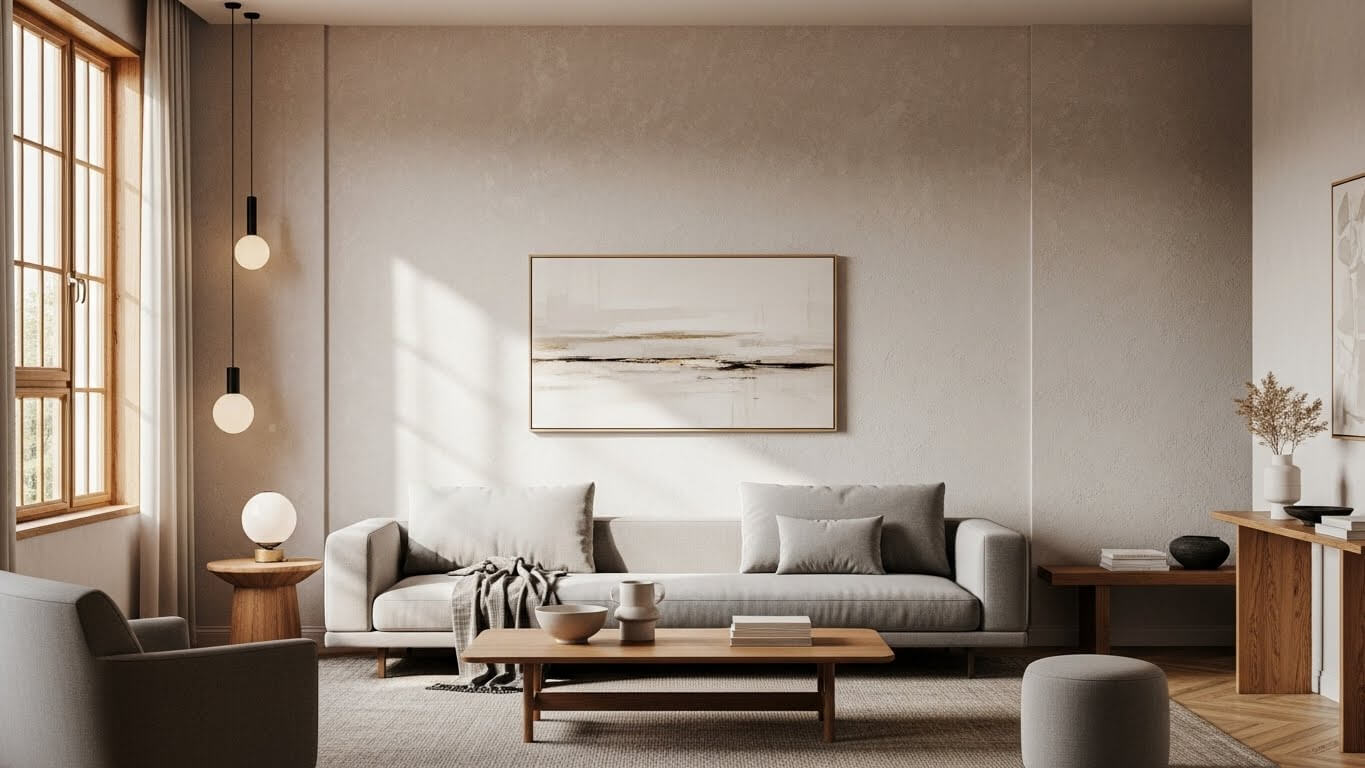

The Ultimate Guide to Minimalist Wall Decor
Minimalist wall decor is one of the most powerful ways to transform any room without overwhelming it. At its core, minimalism in interior design is about intention — choosing pieces that carry genuine meaning, visual weight, and purpose rather than filling space for the sake of it. Whether you’re starting from bare white walls or you’re tired of cluttered gallery arrangements that never feel quite right, this guide will walk you through everything you need to know to build a wall aesthetic that’s calm, confident, and unmistakably modern.
In my experience redesigning both small apartments and larger family homes, walls are almost always the last thing people address — and yet they’re the first thing guests notice. There’s something quietly powerful about a single, well-chosen piece of art above a sofa, or a trio of slim black frames arranged with breathing room between them. Minimalist wall decor for living rooms, bedrooms, hallways, and home offices each comes with its own set of considerations, and understanding those nuances is what separates a space that feels curated from one that simply feels empty.
Throughout this guide, you’ll explore different styles, materials, budgets, and placement strategies for achieving that effortlessly clean look. We’ll cover minimalist wall decor ideas for every room type, talk about what to avoid, how to maintain your walls looking fresh over time, and where to source pieces that genuinely stand out. By the time you finish reading, you’ll have all the knowledge you need to make confident, beautiful decisions — one wall at a time.
What Is Minimalist Wall Decor — And Why It Works
Minimalism as a design philosophy emerged prominently in the 1960s and 1970s, drawing from Japanese wabi-sabi aesthetics and the Bauhaus movement’s principle that form follows function. When applied to wall decor, it means stripping away decorative excess and letting a curated selection of pieces breathe. According to the Design Council, environments with reduced visual clutter have measurable effects on cognitive load, helping people feel calmer and more focused.
What wall decor minimalist design isn’t, however, is bare or boring. The biggest misconception is that fewer pieces means less thought. In reality, it means more thought — every nail hole matters, every frame choice carries weight. The restraint itself becomes the statement. A single large-format print in muted earth tones, properly lit and thoughtfully framed, communicates far more sophistication than a chaotic mix of fifteen small prints.
The reason minimalist interiors photograph so well and perform so strongly on Pinterest is simple: negative space is a design element, not a failure. When your eye has room to rest, each intentional piece becomes more impactful. This is the fundamental principle behind every great minimalist wall display, from a single sculptural shelf to a gallery wall of just three matching frames.
The concept of “ma” in Japanese design refers to the meaningful pause between objects — the empty space itself is considered as important as what fills it. This principle is the foundation of all great minimalist wall decor.
The Best Minimalist Wall Decor Ideas for Every Style
There’s no single recipe for minimalist wall decor ideas that works universally — the best approach depends on your existing furniture, the room’s natural light, and the emotional atmosphere you’re trying to create. That said, certain approaches tend to perform exceptionally well across a wide range of spaces, and these are the ones worth knowing inside and out.
Single Statement Art Pieces
One large, well-chosen artwork is perhaps the most classic minimalist wall decor idea. Think an oversized abstract canvas (24″ × 36″ or larger), a black-and-white architectural photograph, or a botanical print in a simple oak or black metal frame. The piece should span roughly two-thirds the width of the furniture it sits above — so for a standard 84-inch sofa, aim for artwork that’s at least 56 inches wide, either as a single canvas or a diptych.
Floating Shelves with Intentional Curation
A pair of floating shelves — staggered at different heights — can function as a living gallery wall without a single nail hole dedicated to traditional art. The key is the “one rule”: no more than one item per visual category on each shelf. One small plant, one book, one sculptural object. This prevents the shelf from reading as clutter while keeping the wall dynamic. If you love the look of artificial plants for home decor, a single trailing pothos-style faux vine draped over a floating shelf can add organic softness to an otherwise stark arrangement without requiring a green thumb.
Woven Wall Hangings and Textile Art
Woven macramé and loom-woven wall hangings have made a strong comeback in minimalist interiors, particularly in bohemian-minimalist hybrid spaces. A neutral-toned hanging — cream, oatmeal, or soft grey — in natural cotton or jute adds texture without visual noise. Keep the palette restrained: stick to two tones maximum, and let the weave itself provide the visual interest.
Sculptural Wall Objects
Not all wall decor needs to be flat. Ceramic wall discs, abstract metal sculptures, and architectural plaster reliefs are all trending strongly right now — and for good reason. They introduce depth and shadow play that changes throughout the day as the light shifts, giving your wall a living quality that flat prints simply can’t achieve.
When layering multiple minimalist wall decor ideas on a single wall, use the rule of odds: group items in threes or fives rather than even numbers. Odd groupings feel organic and curated rather than symmetrical and corporate.
Minimalist Wall Decor for Living Rooms That Actually Feel Alive
The living room is typically the first space people address when reimagining their walls — and for good reason. It’s the room where you spend the most social time, so it needs to work aesthetically for both yourself and for guests. Minimalist living room wall decor faces a particular challenge: the space needs to feel warm and inviting, not sterile or cold, while still maintaining that clean, uncluttered aesthetic.
The most successful minimalist living room wall setups I’ve seen all share a few key traits. First, they anchor the room with a single dominant focal point — usually the wall directly opposite the entryway or behind the main sofa. Second, they use at most two walls for decor, leaving the others entirely clear. Third, they pull colors directly from the room’s existing palette, so art and furnishings feel unified rather than assembled separately.
Where Can I Find Minimalist Wall Decor?
This is one of the most common questions from readers who are just starting to explore the style. The good news is that minimalist wall decor is widely available at a huge range of price points. For budget-friendly options, Society6, Desenio, and Etsy are goldmines for downloadable digital prints you can print and frame yourself — often for under $10 per image. Mid-range options include IKEA’s BILD collection, H&M Home, and West Elm’s gallery frames. For investment pieces, look toward independent artists on Artfinder or local gallery open studios, where you can often find original works under $300 that bring genuine uniqueness to your space. Don’t overlook thrift stores either — a beautiful frame found for $4 and repainted matte black can house any print you choose.
Lighting matters enormously in the living room context. If you’re considering how LED lights for living room can complement your wall arrangements, picture lights and recessed spotlights directed at artwork create museum-quality drama even in everyday spaces. Warm-toned LEDs (2700K–3000K) will enhance natural earth tones in your art; cooler tones (4000K+) work better with black-and-white or grey-palette pieces.
For minimalist living room wall decor, stick to the “one focal wall” principle. Choose your most prominent wall, give it a single standout piece or thoughtfully composed arrangement, and leave all other walls bare or with minimal accents. This decision alone transforms a room from feeling scattered to feeling intentional.
Color palette coordination is also critical in the living room. If you haven’t yet defined your overall home color palette, now is the time — because your wall art should serve as an extension of that palette, not contradict it. Neutral-based rooms (whites, creams, warm beiges) pair beautifully with artwork in terracotta, sage green, or dusty rose. Darker, moody rooms in charcoal or navy blue gain depth from wall art with metallic accents or high-contrast black-and-white imagery.
Minimalist Bedroom Wall Decor: Creating a Restful Retreat
The bedroom operates under different rules than the living room. Here, the priority is psychological calm — the visual environment directly affects sleep quality, mood upon waking, and the sense of sanctuary that a good bedroom should provide. Research published by the Sleep Foundation confirms that cluttered, visually stimulating environments can elevate cortisol levels and interfere with the natural wind-down process before sleep.
Minimalist bedroom wall decor, therefore, should lean softer, quieter, and more personal than living room choices. Think muted watercolor prints rather than bold graphic abstracts. Think single words in hand-lettered calligraphy rather than busy typographic posters. Think woven textiles in organic creams rather than brightly colored tapestries.
The Headboard Wall: Your Bedroom’s Focal Point
The wall directly behind your bed is where minimalist bedroom wall decor should concentrate almost all of its energy. A popular and endlessly effective approach is to hang a pair of matching prints — identical frames, identical sizes — positioned symmetrically on either side of an imaginary center line, sitting about 8–10 inches above the headboard. This creates visual balance without complexity. Another option gaining significant traction is the single oversized canvas, which sits behind and above the entire headboard like a soft painting, often in abstract soft washes of color.
What doesn’t work in a minimalist bedroom? Gallery walls with many different frame styles, mixed media, or busy patterns. These create the visual scatter that the bedroom should specifically avoid. One thing I’ve learned from redecorating many bedrooms on a budget is that restraint in the bedroom always yields better results than abundance.
Avoid hanging art directly opposite a window in the bedroom — the glare will wash out the piece during daylight hours and create an eyesore you’ll notice every morning. Instead, position artwork on walls that receive indirect, ambient light for the most flattering display all day long.
If you’re furnishing a bedroom with a tighter budget, don’t be discouraged. Some of the most beautiful minimalist bedroom wall decor setups I’ve seen used inexpensive pieces — a single pressed botanical framed in a $12 IKEA RIBBA frame, or a length of decorative fabric from a fabric store (horse rugs for the home cheap can even be repurposed as textile wall hangings in bohemian-minimalist bedrooms, adding handcrafted texture at a fraction of art print prices). Creativity and restraint cost nothing.
Minimalist Line Art Wall Decor: The Trend That Isn’t Going Away
If you’ve spent any time on home decor platforms over the past three years, you’ve almost certainly encountered minimalist line art wall decor. These simple, single-continuous-line drawings — typically of faces, figures, botanical forms, or abstract shapes — have become one of the defining visual motifs of contemporary minimalism. And unlike many design trends, this one has real staying power.
Why? Because line art is inherently quiet. A delicate figure drawn in a single unbroken black line on cream paper communicates elegance without effort. It references fine art traditions (Matisse’s late line drawings are a direct ancestor of this trend) while remaining accessible and affordable. Minimalist line art wall decor works in virtually any room — living room, bedroom, bathroom, home office — and pairs with almost any color palette because the artwork itself contains so little color.
Choosing the Right Line Art for Your Space
Subject matter matters more than most people realize. Facial profiles and figurative line art work beautifully in bedrooms and living areas where they add a personal, humanist quality. Botanical line art — botanical outlines of leaves, stems, or flowers — reads as fresher and more suitable for kitchens, bathrooms, or spaces with natural materials. Abstract gestural line art (sweeping arcs, geometric forms) suits home offices and modern living rooms where the aesthetic is sharper and more graphic.
For framing line art, the cleanest approach is a thin black metal frame or an oak/walnut wood frame with a wide white mat. The mat is non-negotiable — it gives the delicate lines room to breathe and amplifies the minimalist effect. A standard approach: for an 8″ × 10″ print, use a 12″ × 16″ frame with a mat that reveals the full print surrounded by generous white space.
You don’t need to spend money to get high-quality minimalist line art. Search for “SVG line art free download” on sites like Freepik or Vecteezy, scale the file to your preferred print size, and have it printed at a local print shop or on Canva. A 16″ × 20″ print often costs under $5 at a print shop — frame it yourself and you have a premium-looking piece for under $25 total.
Choosing Colors, Textures, and Materials for a Cohesive Look
One of the most frequently underestimated aspects of minimalist wall decor is the role of material and texture. When your wall arrangement is intentionally simple, the materials you choose carry enormous weight. The difference between a canvas print and a fine art giclée on cotton rag paper is subtle in photos but immediately apparent in person — and in a minimalist room where that piece is the focal point, “immediately apparent” matters a lot.
Frame Materials and Finishes
For a cohesive minimalist aesthetic, stick to a maximum of two frame finishes across your entire home. The most universally successful combinations are: matte black + natural oak, all-white + all-black, or brushed brass + warm walnut. Mixing too many frame finishes — even in a single room — fractures the clean visual line that minimalism depends on.
Wall Color as a Canvas
Your wall color is as much a part of your decor as the art itself. White walls are the obvious choice for minimalist spaces, but they’re not the only option. Warm off-whites (think Benjamin Moore’s “White Dove” or Sherwin-Williams’ “Alabaster”) feel more livable than stark pure whites. Greige tones (grey-beige) are exceptionally flattering for both art and skin tones. Dark accent walls in charcoal, forest green, or deep navy can make minimalist art pop dramatically — particularly gold-framed line art or pale botanical prints on a dark green wall. Whatever you choose, a well-considered modern home decor palette begins with the walls, and every piece you hang should feel like it grew from that color rather than being placed on top of it.
For more inspiration on pulling your whole interior together, exploring modern home decor principles can give you a framework that extends well beyond wall art into furniture, lighting, and accessories — creating a truly unified space.
Placement, Scale, and Arrangement Principles
Even the most beautiful piece of wall decor can fall flat if it’s hung at the wrong height, in the wrong location, or at the wrong scale. These technical considerations are where a lot of DIY decorators stumble — not because they have bad taste, but because they skip the planning stage.
The 57-Inch Rule
The standard gallery hanging height is 57 inches from the floor to the center of the artwork — this approximates average eye level and is the standard used by most professional galleries. In practice, this means measuring 57 inches up from the floor, then subtracting half the artwork’s height to find where your nail or hook goes. For a 24″ × 30″ canvas, that’s 57″ minus 12″ = 45″ from the floor to the top nail position. Apply this consistently across all pieces in a room and everything will feel visually unified.
Scaling to Furniture
Art should span roughly 60–75% of the width of the furniture it’s displayed above. A 72-inch sofa calls for artwork between 43 and 54 inches wide, either as a single piece or a grouping. Artwork that’s too small floats awkwardly above furniture; artwork that’s too large competes with the piece below it. Getting the scale right is one single change that transforms the entire perception of a wall.
Spacing Between Pieces
In minimalist arrangements, spacing between individual pieces in a grouping should be consistent — typically between 2 and 4 inches. More than 4 inches starts to feel like you’re hanging separate, unrelated pieces rather than an intentional arrangement. Less than 2 inches can look crowded and defeat the purpose of a minimal approach. Use painter’s tape on the floor to mock up groupings before committing to wall holes — this simple step saves enormous frustration.
Budget Breakdown: What to Spend at Every Price Point
One of the great joys of minimalist wall decor is that it scales beautifully across every budget. Because the philosophy emphasizes fewer, more intentional pieces over volume, you can achieve a stunning wall for far less than you might expect. Here’s a realistic breakdown of what’s achievable at different investment levels.
| Budget Level | Estimated Spend | What You Get | Best For |
|---|---|---|---|
| Ultra-Budget | $0 – $30 | DIY digital downloads, thrift frame repaints, pressed botanicals from your garden | Renters, students, first apartments |
| Budget-Friendly | $30 – $100 | IKEA frames + Society6 prints, single canvas from HomeGoods, simple macramé hanging | First-time decorators, temporary spaces |
| Mid-Range | $100 – $300 | West Elm or CB2 prints + frames, Desenio premium prints, ceramic wall discs, woven hangings | Long-term living spaces, home offices |
| Investment | $300 – $800 | Original art from Artfinder or local galleries, custom framing, hand-thrown ceramic wall pieces | Feature walls, open-plan living areas |
| Premium | $800+ | Limited edition prints, commissioned artwork, architectural plaster reliefs, museum-quality framing | Luxury spaces, long-term investment pieces |
Don’t let budget constraints discourage creativity. Some of the most visually striking minimalist walls I’ve ever photographed for CraftsnComforts.com were assembled for under $50. The key is always intentionality — one great piece chosen thoughtfully beats ten mediocre pieces chosen quickly, regardless of spend level.
Common Mistakes to Avoid with Minimalist Wall Decor
Understanding what not to do is just as valuable as knowing what to do — especially in a style where every element is scrutinized. These are the most common pitfalls that undermine otherwise well-executed minimalist wall arrangements.
- Hanging art too high — the 57-inch center-of-art rule exists for a reason; art hung near the ceiling looks disconnected from the room
- Choosing artwork that’s too small for the wall — undersized art looks timid and unanchored
- Mixing too many frame styles — inconsistent frames create visual fragmentation in a style that depends on cohesion
- Over-decorating in the name of minimalism — a wall with seven “simple” pieces is still cluttered
- Ignoring negative space — empty wall is a design choice, not a failure
- Selecting art purely online without considering room lighting — colors and tones often appear very different in person
- Using purely decorative art with no personal resonance — minimalism should feel personal, not like a showroom
- Matching art to furniture too literally — coordination should be a conversation, not a copy
One of the most damaging mistakes in minimalist decorating is treating it as a trend to replicate rather than a philosophy to interpret. Copy-pasting the exact same gallery wall you saw on Instagram without considering your own space’s proportions, lighting, and existing elements almost always results in something that feels generic rather than genuinely minimal.
Longevity and Maintenance of Your Minimalist Wall Decor
Because minimalist wall decor relies on so few pieces, each one needs to remain in excellent condition — there’s no volume of items to distract from a faded print or a dusty frame. Proper maintenance is straightforward but worth taking seriously.
Daily
- Check that hanging hardware is level (quick visual check)
- Note any direct sunlight hitting prints or canvases
Weekly
- Dust frames with a dry microfibre cloth
- Wipe glass-fronted frames with a clean lint-free cloth
- Check and adjust any shelf-displayed objects
Monthly
- Inspect hanging hardware for loosening
- Rotate prints away from direct UV exposure
- Clean canvas art with a barely damp soft cloth
- Reassess — remove anything that no longer brings joy
Protecting Prints from Fading and Damage
UV exposure is the number-one enemy of wall art longevity. According to the Getty Conservation Institute, even indirect UV light can cause significant color fading in paper-based prints within just a few years. Solutions include UV-protective glass in frames, strategic placement away from direct window light, and choosing pigment-based ink prints over dye-based ones (pigment inks have dramatically longer archival life). Canvas prints fare slightly better due to their coating but should still be kept out of direct sunlight where possible.
For textile wall hangings — macramé, woven pieces, or fabric art — occasional spot cleaning with a damp cloth and mild soap is usually sufficient. Avoid soaking or machine washing anything mounted on a dowel rod. If a woven piece accumulates dust, a gentle blast with a hairdryer on cool setting works surprisingly well without disturbing the fibers. These small habits, maintained consistently, will keep your minimalist wall decor looking fresh and intentional for years.
Frequently Asked Questions About Minimalist Wall Decor
Where can I find minimalist wall decor?
Minimalist wall decor is widely available across a broad range of price points and platforms. For affordable digital downloads you can print at home or at a local shop, Etsy, Society6, and Desenio are excellent starting points — many prints cost under $10 to download. Mid-range physical pieces can be found at IKEA, West Elm, H&M Home, and HomeGoods. For more unique or original pieces, Artfinder, Saatchi Art, and local gallery open studio events are worth exploring. Don’t overlook thrift stores and estate sales, where well-made frames can be found for a few dollars and repurposed with any print you choose.
If you’re after truly unique pieces, commissioning an independent artist through Instagram or Etsy is increasingly affordable — many emerging artists offer original work for $100–$250, and you get something no one else has.
What is the best minimalist wall decor for a living room?
The best minimalist wall decor for a living room depends on the room’s scale, lighting, and existing palette, but the most universally successful approach is a single large-format statement piece above the sofa or main focal wall. This could be a large abstract canvas, a black-and-white photography print, or a diptych (two matching panels) in coordinating tones. The piece should span approximately 60–75% of the width of the sofa below it.
Floating shelves with curated objects, architectural wall sculptures, and simple woven textiles also work beautifully in living rooms. The key principle for minimalist living room wall decor is to designate one primary focal wall and resist the urge to decorate all four walls — restraint is the defining quality of the style.
How do I choose minimalist bedroom wall decor without making it feel cold?
Warmth in a minimalist bedroom comes from material and tone choices, not from volume of decor. Opt for artwork with organic, soft tones — watercolor washes, warm neutral photography, hand-lettered calligraphy in earthy ink tones, or botanical prints in muted greens and browns. Natural materials in frames — oak, walnut, bamboo — add warmth that metal frames can’t achieve.
Textile elements also introduce warmth without clutter: a single macramé hanging or a woven fabric panel brings texture and visual softness that art prints alone can’t provide. Keep the headboard wall as your sole decorative focus and leave the remaining walls clear — this concentrated approach feels intimate rather than cold.
What sizes work best for minimalist wall decor?
For living rooms, aim for a single piece that’s at least 24″ × 30″ or, ideally, 30″ × 40″ or larger for the main focal wall. Smaller prints (8″ × 10″ or 5″ × 7″) look lost on a typical living room wall unless grouped deliberately. For bedrooms, a pair of matching 11″ × 14″ or 16″ × 20″ prints flanking the headboard is a reliable formula. For hallways, vertical formats work best — a tall, narrow print (18″ × 24″ or 12″ × 36″) suits the proportions of corridor walls far better than landscape-format pieces.
Always scale your art to your furniture first, then to the wall. The furniture is the visual anchor; the wall art should relate to it proportionally before worrying about the wall dimensions themselves.
Is minimalist line art wall decor a passing trend?
Minimalist line art wall decor has roots in fine art traditions that predate the current trend by decades — Matisse’s brush line drawings, Picasso’s gestural sketches, and Japanese sumi-e ink painting all share the same DNA. This means the aesthetic has genuine cultural depth behind it, which is why it continues to feel relevant rather than dated. While the specific “single continuous line” iteration popularized on social media may evolve, the broader category of simple, elegant line-based art is here to stay.
If you’re concerned about longevity, choose line art with subject matter that feels personal and timeless to you — botanical forms, figurative portraits, or abstract gestures — rather than art that references pop culture or a specific moment in time. Timeless subject matter + minimal execution = art that ages gracefully.
How many pieces of wall decor should a minimalist room have?
There’s no universal number, but a useful guideline for a standard living room or bedroom is between one and three pieces per wall designated for decor — and not all walls need to have anything on them. A truly minimalist living room might have just one large piece above the sofa and nothing else on any other wall. A bedroom might have a pair of prints above the headboard and a single small piece near the door.
The question to ask yourself is not “does this wall need something?” but “does this wall benefit from something?” Walls that don’t need a visual anchor are often better left bare. Trust negative space — it does more work in a minimalist interior than most people initially believe.
Can I mix minimalist wall decor with other interior styles?
Absolutely — minimalist wall decor is one of the most versatile design approaches precisely because it doesn’t compete with other elements. In a bohemian room, a single large-format black line art print provides a calming counterpoint to colorful textiles. In a maximalist space, a designated “minimal” accent wall with one carefully chosen piece offers the eye a place to rest. In industrial lofts, minimalist canvas art softens the rawness of exposed brick and concrete without clashing.
The key to successfully mixing minimalism with other styles is intention. Choose wall pieces that share at least one quality with the room’s dominant aesthetic — a color, a material, a tone — and let that single shared quality serve as the bridge between styles. When in doubt, go simpler rather than more complex.
What’s the difference between minimalist and modern wall decor?
Modern and minimalist wall decor overlap significantly but aren’t identical. “Modern” in interior design typically refers to a specific mid-century period (roughly 1930s–1960s) characterized by clean lines, functional forms, and a rejection of ornamentation — but it can include bolder colors, graphic patterns, and more decorative volume than pure minimalism allows. Minimalism is a more extreme philosophy that prioritizes reduction to the absolute essentials, often with a more neutral palette and even fewer decorative elements.
In practical terms: a modern wall might feature several prints in matching frames with graphic, high-contrast imagery. A minimalist wall would have the same quality of framing but likely just one or two pieces, in softer or more neutral tones, with more deliberate negative space around them. Both are valid and beautiful approaches — and many of the best contemporary interiors blend elements of both.
Final Thoughts: Building a Wall You’ll Love for Years
Minimalist wall decor is not about having less. It’s about having exactly the right things — pieces that earn their place on your wall through beauty, resonance, or both. The approach asks more of you as a decision-maker, but it gives back tenfold in the form of spaces that feel genuinely restful, curated, and personal. Whether you’ve been drawn to the clean elegance of minimalist line art wall decor, the warmth of a single large canvas above your sofa, or the organic texture of a woven wall hanging in your bedroom, the principles in this guide give you the framework to make confident choices.
As you continue developing your home’s aesthetic, remember that wall decor rarely exists in isolation — it interacts with your lighting, furniture, textiles, and accessories. Exploring how all of these elements work together is part of the ongoing pleasure of creating a home you love. If you’re ready to go deeper, consider reading about how your overall approach to modern home decor can unify every room from floor to ceiling, or how the right home color palette can make even the simplest wall piece look extraordinary. And for those who want to keep the natural, organic element alive in their spaces without the upkeep, pairing your wall decor with thoughtfully chosen artificial plants for home decor is one of the smartest combinations in contemporary interior styling.
Start with one wall. Choose one piece — or one grouping. Hang it at the right height, give it room to breathe, and live with it for a week before adding anything else. That single act of restraint will tell you more about minimalist wall decor than any article ever could. Your walls, and the life you live between them, are worth the intention.