
Closet Organization Ideas: Expert Guide to Transforming Every Closet in Your Home
If you’ve ever opened a closet door and immediately felt a wave of overwhelm, you’re not alone. Finding the right closet organization ideas can genuinely change how your home feels — not just how it looks. An organized closet means less time hunting for that one specific shirt, fewer frustrated mornings, and a home that actually functions the way you need it to. Whether you’re dealing with a cramped bedroom wardrobe, a linen closet stuffed to the ceiling, or a sprawling walk-in that somehow still feels chaotic, the principles of great closet organization are the same: maximize every inch, group like items together, and make it easy to put things back.
One thing I’ve learned after years of reorganizing closets — both my own and helping friends with theirs — is that the biggest mistake people make is buying organizers before they have a plan. It’s tempting to head to the store, grab some bins and baskets, and hope for the best. But without a system, those new tools just become part of the clutter. The best closet makeovers start with a clear-eyed assessment of what you have, what you need, and how much space you’re actually working with.
In this guide, we’re covering every type of closet: small reach-in closets, linen closets, walk-in wardrobes, bathroom closets, and coat closets. For each one, you’ll find specific, actionable strategies — not generic advice you’ve already seen a hundred times. Let’s get into it.
Small Closet Organization Ideas That Actually Work
Small doesn’t have to mean cramped. The key to tackling a small closet is thinking vertically. Most people use maybe 60% of their closet’s actual storage potential because they only focus on the hanging rod and the floor. When you start treating every wall surface — from floor to ceiling — as usable real estate, a small closet can suddenly feel surprisingly spacious.
Start by adding a second hanging rod below your existing one. If your closet holds mostly shirts, jackets, or folded items, two shorter rods stacked can double your hanging capacity in one move. Pair this with shelf dividers to stack sweaters and jeans without them toppling over, and you’ve already made a major impact without spending much.
Use the back of the closet door. Over-the-door organizers are perfect for shoes, accessories, cleaning supplies, or anything that tends to pile up on shelves. A good over-door shoe pocket can hold 12–24 pairs while taking up zero floor space.
Matching storage bins make a huge difference visually. Mismatched containers in different colors and sizes make a small space feel more chaotic than it actually is. Switching to uniform storage bins in one or two neutral tones can make a small closet feel calm and intentional instead of cluttered. Go for stackable options so you can build upward on shelves.
For hanging items, slim velvet hangers save an enormous amount of rod space compared to bulky plastic ones. Switching an entire closet to velvet hangers can free up 30–40% more hanging room. It sounds small, but when you’re working with a 36-inch rod, every inch counts.
Dollar Tree Closet Organization Ideas on a Tight Budget
You don’t need to spend a fortune to get your small closet under control. Dollar Tree carries a surprising range of useful organizers — clear stackable bins, magazine holders that double as shelf dividers, mesh baskets, and drawer organizers that work beautifully in small spaces. The trick is going with a clear plan: measure your shelves before you go, know exactly what items you’re trying to contain, and stick to one color palette. A closet full of matching white Dollar Tree bins looks intentional and clean, even though each piece cost $1.25. Spray-painting mismatched baskets the same color is another easy trick for a pulled-together look on a minimal budget. With a little creativity, small closet organization ideas don’t have to involve expensive systems at all.
Walk-In Closet Organization Ideas for Every Budget
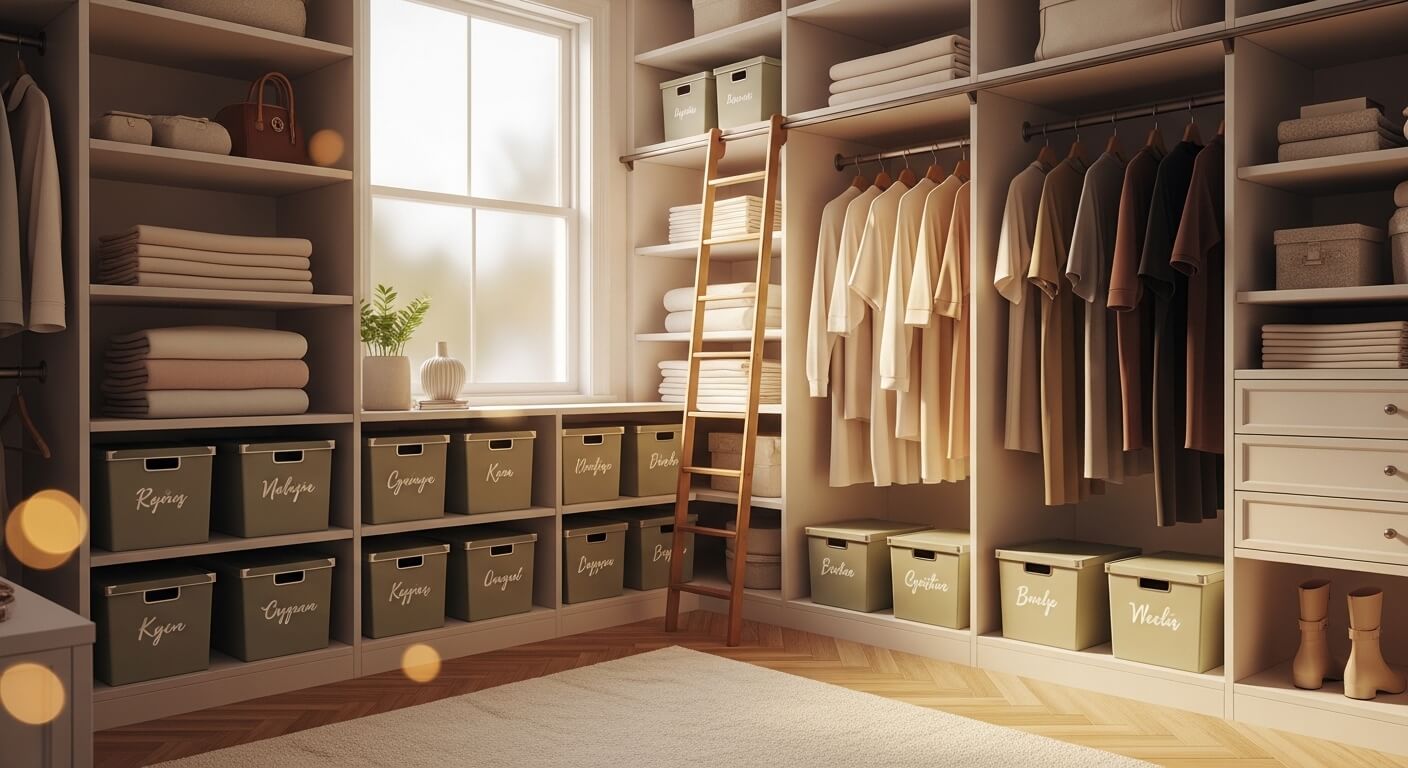
A walk-in closet is a luxury — and one that’s surprisingly easy to squander. Plenty of people with large walk-ins still can’t find anything because the space was never properly planned. The difference between a beautiful, functional walk-in and a chaotic one usually comes down to zoning: designating specific areas for specific categories so everything has a home.
Start with a zone map. Divide your walk-in into sections: long hang (dresses, coats, full-length items), double hang (shirts, jackets, pants folded over hangers), shelving for shoes, and drawer space for folded items and accessories. Even if you have a large walk-in, this structure prevents the space from becoming a free-for-all.
According to the National Association of Productivity and Organizing Professionals, most people regularly use only 20% of what they own. A closet audit before organizing can cut your storage needs nearly in half — and make the whole system much easier to maintain.
Shoe organization is often the biggest challenge in a walk-in. Slanted shoe shelves display your collection and make it easy to see everything at a glance. If floor space is limited, consider a floor-to-ceiling shoe tower on one wall, or clear shoe boxes stacked on shelves — you get visibility without the chaos of an open pile. For heels specifically, a rack mounted at eye level keeps pairs together and prevents them from getting crushed.
Lighting matters more than most people realize. A poorly lit walk-in closet will always feel disorganized, even when it isn’t. Battery-powered LED strip lights under shelves or motion-activated lights inside the closet make a significant difference. This is one of the simplest, least expensive upgrades with the biggest payoff.
Double Closet Organization Ideas for Shared Spaces
Sharing a double closet with a partner requires a slightly different approach: clear territory. Dividing the rod, shelves, and drawers into two distinct zones — even informally — prevents the slow creep where one person’s items gradually colonize the other’s space. In a double hang rod configuration, one person gets the left side and one gets the right. For shelving above and below, consider using different colored storage bins so it’s immediately obvious whose is whose without labeling everything. A shared drawer unit in the center of the closet can hold items that belong to both people (extra hangers, seasonal accessories, and so on). The key with a double closet is making the boundary clear without it feeling rigid.
Before investing in a custom walk-in system, spend one week tracking what you actually reach for daily. This tells you exactly what needs to be front-and-center and what can live on higher shelves or in deeper zones.
Linen Closet Organization Ideas for a Tidy Home
Linen closets are notoriously difficult to keep organized because they hold such a variety of items: bed sheets, towels, extra pillowcases, blankets, and often overflow items from the bathroom or bedroom. Without a clear system, sheets get shoved in wherever they fit and you end up with a messy avalanche every time you open the door.
The single best strategy for linen closet organization ideas is the “pillowcase pocket” method. Fold your fitted sheet and flat sheet, then tuck both pieces inside one of the matching pillowcases. This keeps each set together as a single tidy bundle, which can be stored standing upright like a file rather than stacked horizontally. No more unraveling an entire stack to find the right sheet set.
Group items by frequency of use. The things you reach for most often — guest towels, everyday sheets — should be at eye level. Seasonal items like heavy winter blankets or extra holiday bedding go on the highest shelves. Rarely used items (mattress protectors, duvet covers for unused bedrooms) belong at the bottom or in labeled bins at the back.
Never store damp towels or sheets in a closed linen closet. Even slightly damp linens can develop mildew within 24–48 hours in an enclosed space. Always ensure linens are fully dry before folding and storing — and add a small cedar block to naturally discourage musty smells.
For shelf organization, wire shelf dividers are a game-changer in a linen closet. They keep stacks of towels from leaning and toppling, so you can grab one towel from the middle of a stack without collapsing the whole pile. Pair this with labeled baskets for smaller items — washcloths, hand towels, spare toiletries — and you’ve created a system that’s genuinely easy to maintain. For a well-organized home overall, the same principles that apply to your pantry organization work just as well in the linen closet: group like items, use consistent containers, and label everything.
Bathroom Closet Organization Ideas
Bathroom closets — whether a full linen closet in the hallway or a small cabinet inside the bathroom itself — present unique challenges. Products come in wildly different shapes and sizes, the inventory changes constantly as things get used up, and moisture from the bathroom can affect how you store certain items. The good news is that bathroom closets are usually small enough to completely reorganize in an afternoon.
Lazy Susans (turntables) are one of the most useful tools for a bathroom closet. A two-tier turntable on a shelf lets you access products at the back without moving everything in front. This is especially useful for skincare, medications, or hair products that tend to build up in layers. One spin and you can see everything.
Under-shelf baskets are another excellent tool — they clip onto an existing shelf from below and create an additional storage row for lightweight items like cotton balls, makeup sponges, or small first aid supplies. They cost almost nothing and require no tools or drilling.
For under-bed storage of seasonal bathroom linens — like extra beach towels or holiday guest sets — pairing your bathroom closet system with a good under bed storage setup can take significant pressure off an already tight bathroom closet.
Double Door Closet Organization Ideas for Bathroom Spaces
A double door bathroom closet gives you more width than a standard single-door cabinet, and that extra space is easy to misuse. The most effective approach is to treat each half of the double door closet as its own zone. One side can hold personal care products for one person, the other for another — ideal for a shared bathroom. Alternatively, zone by category: one side for daily-use products at accessible height, the other for backup stock, cleaning supplies, or items used less frequently. Adding a small tension rod near the bottom of the cabinet to hang spray bottles by their triggers is a great space-saving trick that keeps the floor of the cabinet clear and easy to wipe down.
Use magnetic spice jars mounted inside the cabinet door for small bathroom items like bobby pins, cotton swabs, and medication packets. It’s a clever repurpose that frees up shelf space for larger items.
Coat Closet Organization Ideas for Year-Round Use
The coat closet is one of the first things guests see when they walk into your home — and one of the most frequently neglected spaces. Most coat closets end up as catch-alls for everything that doesn’t have a proper home elsewhere: old umbrellas, random bags, sports equipment, seasonal decorations, and a pile of coats only some of which actually get worn.
A good coat closet organization starts with a purge. Pull everything out, evaluate what actually belongs at the front door (coats, bags, shoes, umbrellas) versus what migrated there out of laziness. Everything that doesn’t belong gets relocated. Once you’re working with only what should actually be in the coat closet, you’ll probably find you have far more room than you thought.
For the main rod, organize coats by person or by season. If you rotate seasonal coats, keep the current season’s jackets at the front and push off-season coats to the back or into labeled storage bags on a higher shelf. Hooks on the side walls of the closet — or on the back wall if your closet is deep enough — are invaluable for bags, scarves, and dog leashes.
The floor of the coat closet is prime real estate. A small boot tray with a rubber mat keeps muddy shoes contained and the floor clean. Stackable shoe cubbies can hold 6–8 pairs without taking up much room. And for managing the tangle of cables or chargers that often ends up in entryway drawers and closets nearby, a cable management solution in an adjacent drawer or shelf keeps things tidy beyond just the coats.
Research from the U.S. Department of Housing and Urban Development shows that clutter near entryways significantly affects perceived home cleanliness and can even impact your mood as you arrive home each day. A tidy coat closet makes a real psychological difference.
Closet Organization Cost Breakdown
One of the most common questions around closet organization is: how much should I spend? The answer depends entirely on your closet type, how much you’re starting from scratch versus building on what you have, and whether you want a custom built-in system or an off-the-shelf solution. Here’s a realistic breakdown across three budget tiers.
| Closet Type | Budget ($20–$80) | Mid-Range ($80–$300) | Premium ($300+) |
|---|---|---|---|
| Small Reach-In Closet | Velvet hangers, over-door organizer, shelf dividers | Modular shelving unit, matching bins, second rod kit | Custom closet insert with drawers and adjustable shelves |
| Walk-In Closet | Matching hangers, turntables, clear shoe boxes | Freestanding shelving system, shoe tower, LED lighting | Custom built-in system (ClosetMaid, IKEA PAX, or professional) |
| Linen Closet | Shelf dividers, labeled baskets, cedar blocks | Wicker baskets, uniform bins, under-shelf organizers | Full shelf replacement, drawer inserts, pull-out organizers |
| Bathroom Closet | Lazy Susan, under-shelf baskets, door hooks | Tiered shelving, matching clear canisters, drawer inserts | Custom cabinet inserts, pull-out shelves, vanity organizer system |
| Coat Closet | Boot tray, wall hooks, slim hangers | Shoe cubbies, hanging organizer, seasonal garment bags | Entryway system with bench, hooks, and built-in shoe storage |
In my experience, the mid-range tier delivers the best value for most homeowners. You get a noticeably transformed closet without the cost or commitment of custom built-ins, and off-the-shelf modular systems are flexible enough to move if you relocate. That said, for a primary walk-in or built-in wardrobe, the premium investment pays off over years of daily use.
Common Closet Organization Mistakes to Avoid
Even well-intentioned closet projects can go sideways. Here are the most common mistakes I see — and how to sidestep them before you’ve spent time and money going in the wrong direction.
- Buying organizers before decluttering. No amount of bins and baskets will fix too much stuff. Always declutter first — donate, discard, relocate — then measure what remains and shop accordingly.
- Ignoring vertical space. Most people organize only at eye level and below. Shelves reaching to the ceiling, stacked bins, and high-mounted hooks can dramatically increase usable storage.
- Choosing style over function. A beautiful wicker basket is useless if the weave snags delicate fabrics or the size doesn’t fit your shelf. Always measure and test before committing.
- No labeling system. Even if you know where everything goes today, you’ll forget in a month — and so will everyone else in your household. Labels (even simple masking tape and a marker) make a system sustainable.
- Organizing everything at once. Trying to reorganize your entire home in a weekend is exhausting and rarely works long-term. Tackle one closet at a time, get it fully set up, and live with it for a few weeks before moving on.
- Forgetting the kitchen overlap. Many items that drift into bedroom or hallway closets belong in a better-organized kitchen instead. Pairing closet organization with a fresh look at your kitchen drawer organizers often resolves the root cause of closet overflow.
Keeping Your Closet Organized Long-Term
The hardest part of closet organization isn’t the initial setup — it’s the maintenance. Life gets busy, and a few weeks of not putting things back in the right place can undo months of careful organization. The secret is building systems that make it easier to put things away correctly than to just shove them somewhere.
One habit that genuinely helps is the “one in, one out” rule. Every time a new clothing item, towel, or product comes into your home, something old leaves. This keeps the total volume of your belongings roughly constant, which means your organizational system continues to work without needing a complete overhaul.
Schedule a 15-minute closet reset every season — four times a year. Rotate out off-season items, refresh labels, and donate anything that didn’t get used in the past three months. Small, regular resets are far easier than annual overhauls.
According to Purdue University’s home organization research, households that maintain consistent storage zones and labeling systems spend significantly less time searching for items and report lower daily stress levels. That’s a real, measurable benefit from what might seem like a small lifestyle change.
Finally, revisit your system when your life changes — a new baby, a move, a job change, or even just a new hobby can shift your storage needs significantly. A good closet organization system should evolve with you, not stay static. Don’t be afraid to rearrange zones, add new bins, or remove organizers that are no longer working. Flexibility is the hallmark of a truly functional system.
Frequently Asked Questions
What are the best dollar tree closet organization ideas?
How do I organize a double closet that two people share?
What are the best double door closet organization ideas?
How do I organize a small reach-in closet with limited space?
What’s the best way to keep a linen closet organized long-term?
How should I organize a bathroom closet to maximize space?
How do I prevent my coat closet from becoming a catch-all?
Is it worth investing in a custom closet system?
Final Thoughts on Closet Organization
Great closet organization isn’t about having the most products or spending the most money — it’s about creating a system that works for your actual life and that you can realistically maintain. Whether you’re working with a 24-inch reach-in closet or a generous walk-in, the same fundamentals apply: declutter first, use vertical space, group like items together, and label everything. A system that’s clear and intuitive is one you’ll actually use.
Start with the closet that frustrates you most right now. Don’t try to overhaul your entire home at once. Get one space fully set up, live with it for a few weeks, and then move on to the next. You’ll build momentum, learn what works for your household, and find that the skills transfer naturally from closet to closet.
Once you’ve tackled your closets, you might find yourself looking at other areas of the home with fresh eyes. Room organization, smart storage solutions throughout the bedroom, and even reorganizing your garage follow many of the same principles you’ve applied here. The habits you build in your closet are the foundation of a genuinely organized home.