
Bathroom Cleaning Tools: A Complete Guide to Keeping Every Surface Spotless
Having the right bathroom cleaning tools can be the difference between a quick wipe-down that actually works and an exhausting scrub session that leaves half the grime behind. Most people underestimate how much their tool choices affect both the effort required and the cleanliness they achieve. A well-stocked cleaning arsenal — paired with the right technique — turns what most people dread into a surprisingly fast routine.
Over the years I’ve tried nearly everything: sponges that fell apart after a week, mop heads that spread soap scum rather than lifting it, and brushes with handles so flimsy they bent mid-scrub. In my experience, the tools that consistently deliver results share a few qualities — durable construction, ergonomic grip, and purpose-built bristle patterns designed for specific bathroom surfaces. Whether you’re tackling a tiled shower wall, a grout-lined floor, or a porcelain toilet bowl, there’s a specific tool engineered for that job.
This guide covers every category of cleaning tools for bathroom spaces — from hand scrubbers and toilet brushes to microfiber mops and extendable dusters. By the end, you’ll know exactly what to keep under your sink and why each piece earns its place there.
Essential Bathroom Cleaning Tools You Actually Need
Walk into any cleaning aisle and you’ll be overwhelmed by options. The reality is that most bathrooms can be kept immaculate with a focused set of maybe eight to ten tools. The key is understanding which tasks each tool handles and why a dedicated tool outperforms a generalist one. Cleaning tools for bathroom use differ from kitchen equivalents — they’re designed to handle soap scum, limescale, mildew, and the wet environments that bathrooms constantly produce.
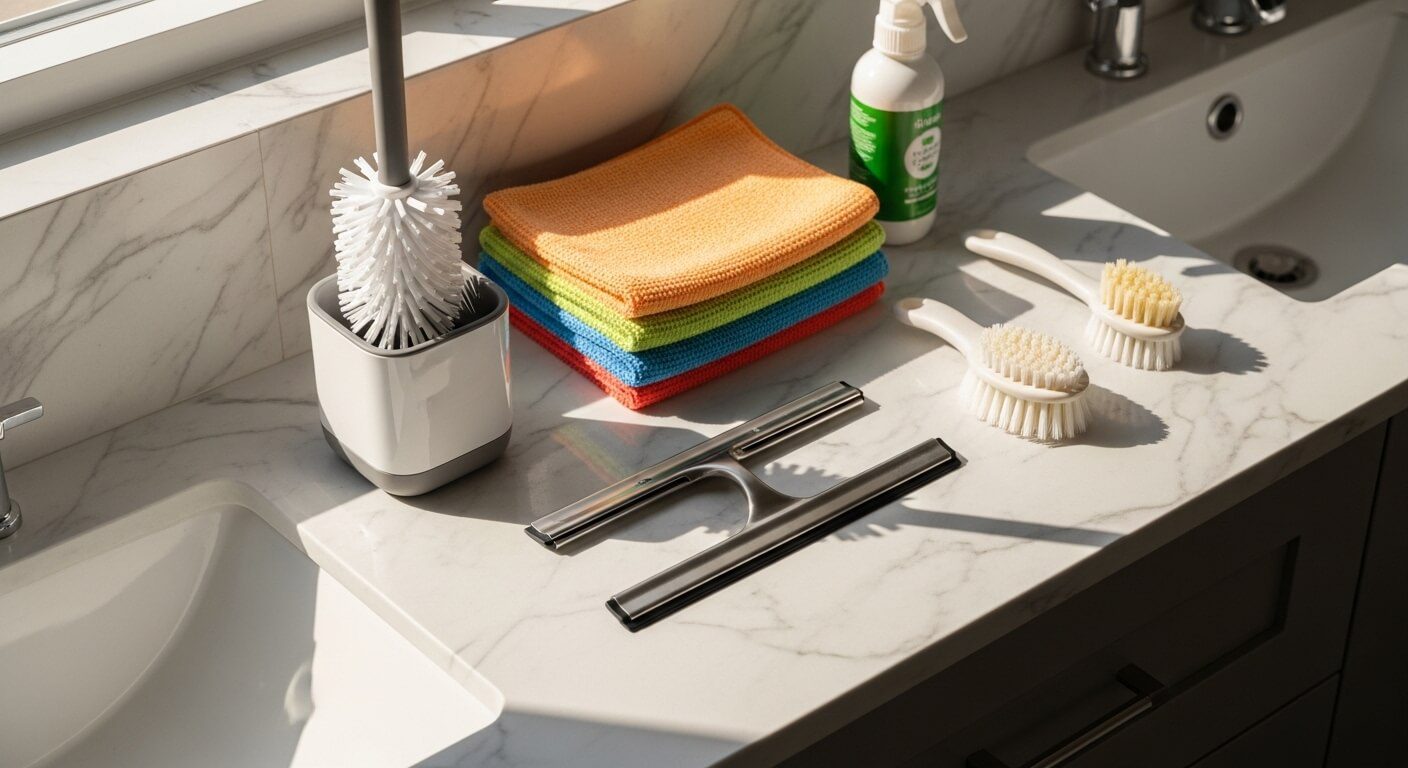
At the foundation, every bathroom needs a toilet brush, a scrubbing sponge or pad, a microfiber cloth set, a grout brush, a small squeegee, a long-handled duster for vents and ceiling corners, and a floor mop suited to tile. If you’ve been relying on a single sponge for every surface — counters, tub, sink, and toilet — you’re not just working harder than necessary, you’re also cross-contaminating surfaces without realizing it. Color-coding tools by zone (toilet, sink, shower) is a practice professional cleaners swear by, and it’s one of the simplest habits you can adopt right now.
Beyond the basics, a few specialty tools dramatically cut your effort — like a powered scrubber drill attachment for periodic deep-cleans, or a pumice stone for tackling hard water rings in the toilet bowl. You don’t need these every week, but having them available makes monthly deep-cleaning far less daunting. Think of your tool kit as having everyday tools and deep-clean tools, each earning its place for specific tasks.
Best Tools for Cleaning a Toilet — Inside and Out
The toilet demands dedicated tools and a dedicated mindset. For the bowl interior, a toilet brush with stiff, angled bristles is non-negotiable. Look for brushes with a tapered tip that can reach under the rim — that’s where limescale and mildew colonies tend to establish themselves unseen. Silicone toilet brushes have grown popular in recent years because they don’t harbor bacteria the way traditional bristle brushes do, and they’re far easier to rinse clean.
For the exterior — the tank, seat, lid, and base — microfiber cloths outperform paper towels in every measurable way. They capture particles rather than just pushing them around, they’re reusable, and they won’t scratch porcelain or chrome fittings. Keep a dedicated set for toilet exterior use only and wash them after every session at 60°C or above to kill bacteria.
For stubborn hard water stains inside the bowl, a pumice stone on a handle is the most effective non-chemical solution available. It works by gently abrading calcium deposits without scratching vitreous china — but always keep it wet while using it. According to the U.S. EPA WaterSense program, hard water mineral deposits are one of the leading causes of early fixture degradation in bathrooms, making regular descaling an investment in your plumbing’s lifespan, not just aesthetics.
Shower and Tub Cleaning Tools That Cut Through Soap Scum
Soap scum is essentially the result of soap reacting with calcium and magnesium ions in hard water — it clings to glass, tiles, and acrylic surfaces and becomes increasingly difficult to remove the longer it’s left. The right cleaning tools for bathroom shower use are ones that combine mild abrasion with ergonomic reach. A stiff-bristle scrub brush with a long handle lets you apply real pressure to tiled walls without contorting yourself into the tub.
For glass shower doors and enclosures, a rubber squeegee is indispensable. Running a squeegee over glass panels after every shower takes about fifteen seconds and prevents virtually all soap scum buildup — making your deep-clean sessions dramatically faster. A quality squeegee has a stainless steel arm, a pivot head that maintains contact across curved glass, and a rubber blade wide enough to cover the panel in two to three strokes.
For acrylic tubs and bases, avoid highly abrasive pads that can scratch the surface and create microscopic grooves that trap dirt more aggressively over time. Non-scratch scrubbing pads — the white or blue variety rather than green — combined with a cream cleanser do the job without damaging the finish. If you struggle with mildew caulking around the tub, a pointed grout brush loaded with a baking soda paste reaches into those edges far better than a wide scrubber. You might also want to explore cleaning hacks with vinegar — white vinegar is particularly effective on soap scum and mineral deposits without harsh chemicals.
Bathroom Floor Cleaning Tools: What Works Best on Tile
Bathroom floors present a unique challenge: small-format tiles with extensive grout lines, wet conditions, tight corners around the toilet base and vanity, and the constant foot traffic that distributes bacteria from one area to another. Standard kitchen mops are poorly suited for this environment. The best bathroom floor cleaning tools are compact, highly maneuverable, and capable of reaching into corners and around fixtures.
A flat microfiber mop is the gold standard for regular bathroom floor maintenance. The flat head pivots to follow the floor angle, the microfiber pad traps particles rather than redistributing them, and most models have washable pads that last for hundreds of cleaning cycles. For a small bathroom, a 28–32cm head size is ideal — large enough to cover ground efficiently but small enough to navigate around toilet bases and vanity feet without getting stuck.
For deeper floor cleans where grout lines need attention, a stiff-bristle floor brush or a handheld electric scrubber comes into its own. The best cordless vacuum for pet hair can also be surprisingly effective for dry-sweeping bathroom floors before mopping — capturing hair and dust particles that would otherwise clump and drag across the floor when wet.
Steam mops deserve a mention for bathrooms with natural stone or sealed grout — they sanitize without any chemical residue, which matters if you have children or pets using the bathroom frequently. The steam penetrates grout pores and kills bacteria and mold spores at the root rather than just on the surface.
Grout Brushes, Sink Scrubbers, and Detail Cleaning Tools
What are the best tools for cleaning bathroom grout?
Grout cleaning is one of those tasks that most people defer until the discolouration becomes impossible to ignore. The right tool makes an enormous difference here. A stiff-bristle grout brush — typically about the width of your finger — applies concentrated pressure exactly where it’s needed along narrow grout channels. The bristles need to be stiff enough to dislodge embedded dirt but not so hard that they scratch the tile face. Nylon bristles at medium stiffness hit this balance well.
For large areas of grout, a drill-attachment grout brush is a genuine game-changer. You mount it on a standard power drill, apply a baking soda and hydrogen peroxide paste to the grout, and let the oscillating brush do the work in a fraction of the time manual scrubbing would take. According to research published by the UK’s National Health Service, mold and mildew in bathroom grout can contribute to respiratory irritation — another reason to keep on top of it rather than letting it build.
How do I choose the right scrubber for my bathroom sink?
Bathroom sinks accumulate toothpaste residue, soap deposits, and hard water staining around the drain. For ceramic and porcelain sinks, a soft-bristle brush with a narrow head cleans around the drain and faucet base better than any sponge. Microfiber cloths work brilliantly on sink surfaces — they buff away the film left by cleaning products and leave a streak-free finish. If you’re interested in reducing chemical exposure, using eco friendly cleaning products alongside the right mechanical tools delivers results that rival conventional cleaners without the residue.
For chrome fixtures — faucets, towel bars, toilet paper holders — a dedicated microfiber cloth is the safest choice. The kind used for microfiber car cloths works perfectly on bathroom chrome, too — it polishes without scratching and picks up water spots and fingerprints in one pass.
Best Bathroom Cleaning Tools by Budget
You don’t need to spend a fortune to clean your bathroom brilliantly. The best cleaning tools for bathroom use span every price bracket — the key is knowing what to invest in and where a budget option performs just as well as a premium one. Here’s a practical breakdown.
| Tool Category | Budget (Under $15) | Mid-Range ($15–$40) | Premium ($40+) |
|---|---|---|---|
| Toilet Brush | Basic bristle brush with caddy | Silicone toilet brush, anti-drip holder | Self-cleaning silicone set with deodorizer |
| Floor Mop | Basic sponge mop | Flat microfiber mop with washable pads | Steam mop with grout tool attachment |
| Scrubbing Brush | Handled grout brush, 2-pack | Stiff-bristle bath brush set | Electric drill scrubber kit with attachments |
| Squeegee | Plastic-handle basic squeegee | Stainless pivot-head squeegee | Ergonomic shower squeegee with wall mount |
| Microfiber Cloths | 6-pack basic microfiber | Premium 8-pack color-coded set | Professional-grade 300 GSM cleaning cloths |
| Duster / Vent Brush | Basic extendable duster | Flexible microfiber wand duster | Washable flexible duster system |
One general rule worth following: invest more in tools you use every single week (toilet brush, microfiber cloths, floor mop) and spend less on tools used monthly or seasonally (drain snake, pumice stone, electric scrubber attachments). The return on a well-made daily-use tool compounds over time in both cleaning results and durability.
You can also find excellent value by exploring new-generation cleaning gadgets that combine multiple functions — like a sonic scrubber that handles grout, tiles, and faucets in one rechargeable unit — rather than buying individual single-purpose brushes for every task.
Common Mistakes When Choosing and Using Bathroom Cleaning Tools
Even experienced cleaners make tool-selection errors that add effort rather than reduce it. The first and most common: using one sponge for every surface. A sponge that touches the toilet bowl should never touch the sink or counter — full stop. If you have a habit of “rinsing it out,” understand that standard rinse cycles don’t remove the bacteria embedded in sponge foam. Dedicated, color-coded tools per zone are the only reliable safeguard.
Second mistake: storing tools in ways that trap moisture. A toilet brush left sitting in standing water at the bottom of its caddy is a bacteria incubator. After use, let the brush drip-dry suspended across the toilet rim for a few minutes before returning it to the caddy. Same principle applies to sponges and scrub pads — hanging them to air-dry extends their useful life dramatically and reduces bacterial buildup between uses.
Third: buying cheap microfiber cloths that don’t actually perform. Not all microfiber is equal. Low-quality microfiber cloths have coarser fibres that smear rather than trap, leaving streaks on mirrors and chrome. A genuine high-GSM microfiber cloth should feel almost “grabby” against dry skin — that texture is what makes it effective. For bathroom surfaces, 250–300 GSM cloths offer the right balance of absorbency and abrasion.
A fourth mistake: neglecting the cleaning tools themselves. Grout brushes clog with paste and residue, squeegee blades develop micro-tears, and mop heads accumulate grime that gets deposited back onto your floor. Rinse tools thoroughly after every use, inspect them monthly, and replace them on schedule. Most brushes have a useful life of two to four months with regular use — don’t push them past the point where bristles splay outward and lose their scrubbing geometry.
Longevity and Maintenance of Your Bathroom Cleaning Tools
Tools that are looked after last longer and perform better — obvious in theory, often ignored in practice. Microfiber cloths and mop pads should be machine-washed separately from regular laundry, without fabric softener (which coats the fibres and destroys their electrostatic cleaning properties) and at 60°C to sanitize them properly. Line-dry rather than tumble-dry where possible — high heat degrades microfiber faster than anything else.
For bristle brushes, periodic disinfection is important. Soaking brushes in a diluted bleach solution (one tablespoon of bleach per litre of water) for ten minutes monthly kills bacteria colonies that build up in bristle roots. Rinse thoroughly after soaking and allow to dry fully before storage. Silicone tools can be run through the dishwasher on a standard cycle — one of their most practical advantages over traditional bristle alternatives.
Squeegee blades are worth checking every few months — run your fingernail along the rubber edge and feel for nicks or tears. A damaged blade leaves streaks no matter how skilled the user. Replacement blades for most quality squeegees cost a fraction of replacing the entire unit. Similarly, mop heads and toilet brush heads should be treated as replaceable parts of a long-term tool investment, not the tool itself.
Extendable dusters used for bathroom vents and ceiling corners should be shaken out outdoors after every use and washed periodically according to their care label. Vent covers accumulate significant dust and mold spores — according to the CDC’s indoor air quality guidelines, inadequate vent maintenance is a leading contributor to bathroom mold growth that eventually spreads to walls and ceilings. A quick monthly dusting of vents takes thirty seconds but saves hours of mold remediation later.
Frequently Asked Questions About Bathroom Cleaning Tools
What are the best bathroom cleaning tools for a complete clean?
Which cleaning tools for bathroom use work best on soap scum?
What bathroom floor cleaning tools are best for tile with grout lines?
How often should I replace my bathroom cleaning tools?
Are electric or battery-powered bathroom cleaning tools worth it?
What tools are best for cleaning bathroom tiles without scratching them?
How do I keep my bathroom cleaning tools hygienic between uses?
What is the best tool for removing hard water stains in the bathroom?
Final Thoughts: Building Your Bathroom Cleaning Tool Kit
The right set of bathroom cleaning tools turns one of the most dreaded household chores into something manageable, even fast. It really comes down to having purpose-built tools for each zone and surface type, storing them properly between uses, and replacing them before performance degrades. A silicone toilet brush, a high-quality flat microfiber mop, a pivoting squeegee, a stiff grout brush, and a full set of color-coded microfiber cloths will cover 90% of everything your bathroom demands — and they’ll do it faster and more effectively than a drawer full of multi-purpose sponges ever could.
As you refine your cleaning routine, it’s worth exploring the wider world of home cleaning strategies. Topics like building a full eco-friendly cleaning kit, understanding which cleaning gadgets genuinely cut effort versus just adding clutter, and mastering grout cleaning techniques all connect naturally to what we’ve covered here. The bathroom is a great place to start building cleaning discipline because the results are immediately visible — and there’s real satisfaction in a properly cleaned space.
One last thought: consistency matters far more than occasional marathon cleans. Fifteen minutes of weekly maintenance with good tools beats a two-hour monthly overhaul every single time. Equip yourself well, develop a rhythm, and your bathroom will stay genuinely clean rather than clean-ish in perpetuity.