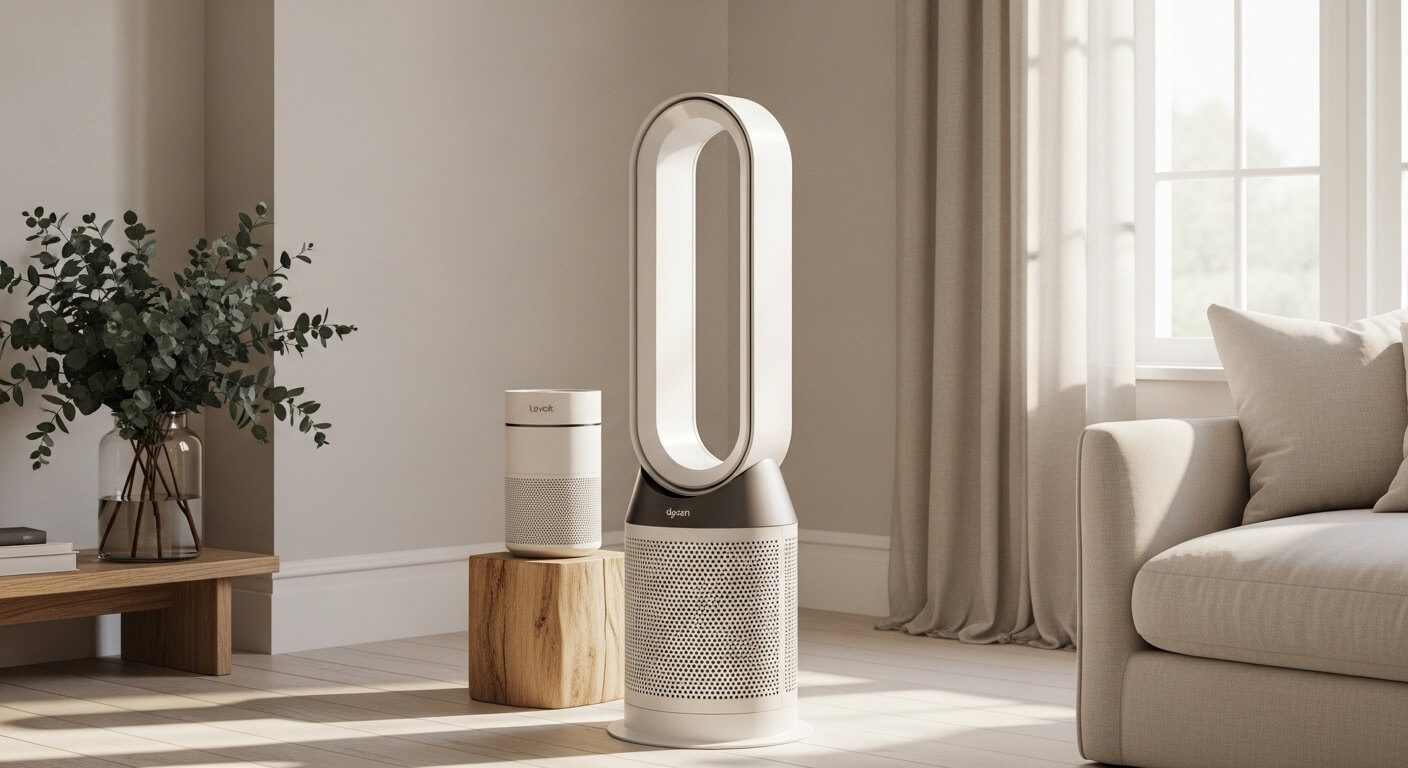

Dyson Air Purifier Review: Complete Guide to Cleaner Indoor Air in 2026
Every home has invisible problems. Dust mites, pollen, pet dander, VOCs from fresh paint and cleaning products, cooking particles, mould spores — they circulate silently through the air you breathe every day, and most people have no idea how significant the accumulation can be. Reading a thorough dyson air purifier review is one of the most popular ways people begin researching their options, and for good reason: Dyson’s machines are genuinely impressive, beautifully engineered, and among the most talked-about air purifiers on the market. But they’re also expensive, and the question of whether that expense is justified — and whether competing brands offer comparable results for less — is exactly what this guide is designed to answer.
The air purifier category has expanded dramatically over the past three years. Where Dyson once operated in a category almost by itself, brands like Winix, Levoit, Shark, and Xiaomi have all released genuinely capable machines that deserve serious consideration. A complete dyson air purifier review in 2026 has to grapple with this context: Dyson’s engineering and design remain class-leading in several respects, but the value equation is more complicated than it used to be.
Below, we’ve evaluated Dyson’s flagship purifiers alongside the most relevant competition — with honest assessments of real-world performance, filter costs, room coverage, noise levels, and the features that actually make a difference versus the ones that are primarily marketing. Whether you’re managing allergies, dealing with pet odours, or simply want fresher air in a home office, this is the guide to read first.
What to Know Before Buying an Air Purifier
Before comparing brands, it helps to understand the core technology and specifications that determine how well any air purifier actually performs. Marketing language around air purifiers is particularly creative, so grounding yourself in a few key metrics makes the rest of the comparison much more useful.
HEPA filtration: True HEPA filters capture 99.97% of particles at 0.3 microns — the size considered most difficult to capture. This includes dust, pollen, most bacteria, and many mould spores. “HEPA-style” or “HEPA-like” filters are not the same thing and don’t meet the same standard. When evaluating any air purifier, confirm it uses a sealed True HEPA filter, not a marketing variant.
CADR (Clean Air Delivery Rate): This is the single most useful spec number. CADR measures how many cubic feet of clean air a purifier produces per minute, separately rated for dust, pollen, and smoke. A CADR of 200+ is suitable for most standard living rooms; larger open-plan spaces need 300+. Most manufacturers publish CADR figures — brands that don’t are usually hiding underperformance.
Room coverage: Manufacturer-stated coverage figures are typically calculated at one air change per hour. For allergy sufferers or households with pets, two to three air changes per hour is more appropriate, which effectively halves the stated coverage area. A machine rated for a 500 sq ft room may only perform optimally for allergy management in a 200–250 sq ft space.
Did You Know?
According to the US Environmental Protection Agency, indoor air can be two to five times more polluted than outdoor air — and in some cases, up to 100 times worse. Given that most people spend around 90% of their time indoors, the case for a capable air purifier is stronger than many people realise.
Activated carbon filters: HEPA handles particles, but gases and odours — cooking smells, VOCs from furniture and paint, pet odours — require an activated carbon layer. Some budget machines include a thin carbon layer that exhausts quickly; quality machines use substantial carbon beds that last months. This distinction matters a great deal if odour control is a priority for you.
Noise levels: Air purifiers need to run continuously to be effective, which means noise matters significantly. Decibel ratings on product pages are usually measured at the lowest fan speed. Check the noise level at the highest speed too — some machines that are whisper-quiet on low become intrusive on high. For bedrooms, look for machines rated below 50 dB at their highest setting.
If you’re approaching this as part of a broader home improvement project — upgrading cleaning tools, reducing chemical use, and improving indoor air quality together — our guide to the best eco friendly cleaning products is a natural companion read. Reducing the chemical load of your cleaning routine directly reduces the VOC content of your indoor air, which makes any air purifier’s job significantly easier.
Dyson Air Purifier Review: The Flagship Range Assessed in Full
Dyson Purifier Hot+Cool Formaldehyde (HP09)
The HP09 is Dyson’s most capable all-in-one unit — combining air purification, heating, cooling, and now formaldehyde detection and destruction in a single tower. It’s a remarkable piece of engineering, and a dyson air purifier review wouldn’t be complete without examining what makes their top-tier machines genuinely different from the competition.
What consistently emerges in any thorough dyson air purifier review is the quality of the air quality sensing and reporting. Dyson’s machines show you real-time PM2.5, PM10, VOC, NO₂, and (on formaldehyde models) HCHO levels in the companion app, with historical graphs and room-by-room comparisons. This transparency is genuinely useful — knowing exactly which pollutants are present and when levels spike (cooking, cleaning, having the windows open during high pollen days) helps you use the machine more effectively.
The HEPA H13 filter is sealed within the machine body, preventing purified air from leaking past the filter — a genuine engineering detail that matters for performance and that many competitors simply don’t match. The activated carbon layer is substantial rather than tokenistic, providing real odour and VOC removal that lasts months rather than weeks.
The downsides are real, though. Replacement filters cost £49–£70 per year depending on use. The machine’s tower form factor works beautifully in certain spaces and awkwardly in others. And the price premium over well-reviewed competitors like Winix and Levoit is substantial enough that, for many households, the extra money buys design and smart features more than it buys meaningfully better clean air.
Pro Tip
Dyson’s Auto Mode is genuinely useful — the machine adjusts fan speed based on real-time air quality sensor readings. Run it in Auto Mode during the day and set a quiet Night Mode schedule from 10pm onwards. You’ll get responsive purification during active hours without sleep disruption, and the energy consumption stays reasonable.
Winix Air Purifier Review: Serious HEPA Performance Without the Premium Markup
Winix 5500-2
The Winix air purifier review consensus has been remarkably consistent for several years: the 5500-2 delivers HEPA filtration, activated carbon, and plasma wave technology in a package that performs at or near Dyson levels on the metrics that matter most — CADR, particle capture, and odour removal — at roughly a quarter of the price.
One thing I’ve appreciated about the Winix in practice is how honest its specifications are. The published CADR numbers match independently tested performance closely — something that can’t always be said across this category. The PlasmaWave technology generates ions that help neutralize bacteria, viruses, and odours, though the feature can be switched off for users who prefer not to use ionization.
The replacement filter costs are significantly lower than Dyson — around £30–£40 for a full HEPA and carbon filter set — and Winix filters are widely stocked, so you’re never hunting for proprietary replacements. The design is utilitarian rather than beautiful, which matters in some rooms and not at all in others.
Levoit Air Purifier Review: The Smart Home Value Leader
Levoit Core 400S
The levoit air purifier review landscape is dominated by this model — the Core 400S has become one of the best-reviewed consumer air purifiers globally on the strength of its CADR rating, competitive pricing, and genuinely capable smart home integration.
Levoit has built its reputation on delivering surprisingly capable air purification in a compact, quiet format. The Core 400S measures just 36cm tall — easily placed on a desk or shelf rather than requiring floor space. The VeSync app is one of the cleaner air quality apps in the budget category, with auto mode, scheduling, and decent air quality reporting through the built-in laser particle sensor.
The activated carbon layer is thinner than Winix or Dyson equivalents, which means odour control is adequate for light applications (cooking smells, light pet odour) but less impressive against strong or persistent sources. For homes where particle filtration — pollen, dust, pet dander — is the primary concern, this limitation is largely irrelevant.
Alongside smart home appliances like the Levoit, having capable manual cleaning tools for what the machine can’t reach matters too. Pairing an air purifier routine with quality cleaning gadgets — including a good set of home cleaning gadgets for surfaces and upholstery — gives you a much more complete approach to indoor air and surface cleanliness together.
Xiaomi Smart Air Purifier 4 Compact Review: Intelligent Minimalism
Xiaomi Smart Air Purifier 4 Compact
The xiaomi smart air purifier 4 compact review narrative is one of impressive specification density in a surprisingly small form factor. At roughly 25cm tall, it fits on any desk or shelf while delivering meaningful air quality improvement in smaller spaces.
The 4 Compact is the machine I’d recommend to someone who wants to improve bedroom air quality without significant outlay. At £55–£80, it delivers real HEPA filtration, meaningful smart features through the Mi Home ecosystem, and a physical footprint small enough to sit on a bedside table. Its CADR of 70 m³/hr is appropriate for rooms up to about 16 m² — so it’s genuinely a bedroom and small office machine, not a living room solution.
Replacement filters cost around £25–£35 and are readily available. The filter combines HEPA and carbon in a single cylindrical unit, making replacement quick and clean. One thing worth noting: because the filter is small relative to larger machines, it reaches full saturation faster under heavy pollution loads. In a bedroom used primarily for sleeping, the filter life is fine. In a kitchen or high-traffic living area, a larger machine would be more appropriate.
Budget Alternatives: Isinlive and Dowell Air Purifiers Reviewed
Isinlive Air Purifier Review: What Budget Entry-Level Actually Looks Like
The isinlive air purifier review picture is typical of entry-level budget machines from less established brands: adequate for very small spaces and light-duty use, but with meaningful compromises that more informed buyers should understand before purchasing. Isinlive machines — often sold under £40 on marketplace platforms — use HEPA-style rather than certified True HEPA filters in most models, and the CADR figures are either unstated or low enough (typically 50 m³/hr or below) to make them suitable only for compact bedrooms or desk environments. The build quality and filter replacement ecosystem are both less reliable than established brands. That said, for a student room or a very small office space where the primary goal is light dust and allergen reduction on a tight budget, an isinlive air purifier at its price point can still provide meaningful improvement over no filtration at all. Just calibrate expectations accordingly.
Dowell Air Purifier RAP-25 Review: A Philippines Market Budget Option
The dowell air purifier rap-25 review and broader dowell air purifier review context is specifically relevant for buyers in Southeast Asian markets, where Dowell is a recognised domestic appliance brand with local servicing infrastructure. The RAP-25 uses a three-stage filtration system — pre-filter, HEPA, and activated carbon — and is designed for rooms up to approximately 20 m². The dowell air purifier review consensus from domestic market testers positions it as a reasonable entry-point option for Philippine households seeking genuine HEPA filtration at accessible local pricing, with the advantage of in-country warranty support that grey-market imports don’t always provide. Filter availability through local retailers is an important practical advantage over imported brands in markets where online retail infrastructure for replacement parts is less developed. For international readers, Dowell products are generally not available outside their home market, making this primarily relevant for local buyers rather than a global recommendation.
Warning
Be cautious of air purifiers on marketplace platforms that claim “HEPA” filtration without specifying True HEPA or listing their CADR rating. Many budget machines use “HEPA-type” or “HEPA-grade” filters that capture far fewer particles than genuine H11–H13 HEPA filtration. If a machine doesn’t publish its CADR, that’s a significant red flag.
Air Purifier Cost Breakdown: Budget vs Mid-Range vs Premium
Here’s an honest breakdown of what your money actually buys at each price tier in the current market, including the ongoing filter costs that many buyers overlook at the point of purchase.
| Feature | Budget (£40–£120) | Mid-Range (£120–£300) | Premium (£300–£800+) |
|---|---|---|---|
| Filter Type | HEPA-type or basic True HEPA | True HEPA H13 + carbon | Sealed True HEPA H13 + substantial carbon |
| CADR Rating | 50–150 m³/hr | 150–300 m³/hr | 250–400+ m³/hr |
| Room Coverage | Up to 20 m² | 20–50 m² | 50–80+ m² |
| Smart Features | None or basic timer | App control, auto mode, scheduling | Full air quality sensors, detailed analytics, multi-room |
| Annual Filter Cost | £15–£30 | £30–£50 | £50–£80 |
| Example Models | Xiaomi 4 Compact, Isinlive | Levoit Core 400S, Winix 5500-2, Shark HC400 | Dyson HP09, Dyson TP09 |
| Best For | Bedrooms, offices, small rooms | Living rooms, 2–3 bed homes | Open-plan spaces, severe allergies, design-conscious buyers |
One calculation worth doing before purchase: add up the five-year total cost of ownership (purchase price + annual filter cost × 5). A £799 Dyson with £60/year filters costs approximately £1,099 over five years. A £160 Winix with £35/year filters costs £335. The performance gap in CADR is real but not fivefold. For most households, the mid-range tier offers the most rational value — unless the Dyson’s combined heating, cooling, and purification genuinely replaces multiple standalone devices.
According to Which? air purifier testing, several mid-range machines from Levoit and Winix match or approach Dyson’s particle removal performance in standardized tests, with Dyson’s primary advantage lying in sensor accuracy, design, and combined functionality rather than filtration effectiveness alone.
Common Mistakes When Buying an Air Purifier
The air purifier category is particularly prone to purchase regret driven by a few predictable mistakes. Getting these right before buying saves both money and frustration.
Choosing by room coverage headline without understanding air changes per hour. If a machine is rated for 500 sq ft and your room is 300 sq ft, you might assume you’re well covered. But that 500 sq ft rating is typically at one air change per hour. For allergy or asthma management, you need 4–5 air changes per hour — meaning that 500 sq ft machine is realistically appropriate for a 100–120 sq ft room in medical-grade use. Buy for the use case, not the headline coverage figure.
Overlooking filter replacement costs and availability. A machine is only as good as the filters running inside it, and filters don’t last indefinitely. Calculate the ongoing cost before purchase and confirm the filters are actually in stock from multiple sources — not just sold direct by the manufacturer at inflated prices.
Assuming an ioniser or UV light improves a weak machine. Some budget machines lean heavily on ionization or UV marketing to distract from low CADR ratings. Ionization has its role, but it doesn’t compensate for inadequate HEPA filtration. UV light kills some airborne pathogens but is largely ineffective at the flow rates and exposure times inside consumer machines. Neither replaces genuine HEPA and carbon filtration.
Placing the machine in the wrong position. An air purifier needs unobstructed airflow to work properly. Tucking it behind a sofa or in a corner reduces its effective CADR significantly. Central room placement, away from walls on at least three sides, gives the best results. In a bedroom, placing it near the door (where air circulation begins) rather than right next to the bed often produces better whole-room results.
Your air purifier works best as part of a broader approach to home air quality. Reducing surface dust through regular vacuuming with a quality cordless vacuum for pet hair removes settled particles before they re-enter the air, directly reducing the purifier’s workload and extending filter life. Similarly, switching to cleaning solutions like diluted white vinegar for surface cleaning reduces VOC introduction into your indoor air — one of the most common but overlooked sources of poor indoor air quality.
Longevity & Maintenance: Getting Years of Clean Air From Your Machine
Air purifiers are low-maintenance appliances, but the maintenance that is required actually matters quite a bit for performance. A clogged filter doesn’t just reduce effectiveness — it forces the motor to work harder, shortening the machine’s lifespan and increasing energy consumption.
Replace filters on schedule — not just when the indicator triggers. Most filter replacement indicators are based on run hours rather than actual filter condition, which doesn’t account for heavy pollution loads. In homes with pets, smokers, or high pollution areas, replace filters earlier than the indicator suggests. A grey or discoloured filter is an obvious visual cue; a musty smell from the machine despite recent cleaning is a subtler one.
Clean the pre-filter regularly. Most air purifiers include a washable pre-filter that captures large particles — hair, large dust, pet fur — before they reach the HEPA layer. Cleaning this every two to four weeks (vacuum gently or rinse and dry thoroughly) significantly extends HEPA filter life and maintains airflow volume.
Wipe down external surfaces and intake grilles. Dust builds up on grilles and reduces airflow into the machine. A soft brush attachment on your vacuum, or a lint-free microfiber cloth for the finer grille work, keeps everything flowing freely. The same gentle microfiber cloths used for car care and electronics — microfiber car cloths or dedicated electronics cloths — work perfectly on the sensor lenses and exterior panels of premium purifiers without scratching.
According to NHS guidance on asthma management, maintaining consistent indoor air quality through both air filtration and regular cleaning of soft furnishings is among the most effective environmental interventions available to asthma sufferers. Regular air purifier maintenance is therefore not just about the machine’s lifespan — it’s about consistent therapeutic benefit.
Keep the machine on continuously rather than running it intermittently. Air purifiers are designed for continuous operation. Running a machine for two hours when you’re home and switching it off when you leave allows pollution to build between sessions. Most modern machines in Auto Mode consume very little power on low settings — often under 5W — so the cost of continuous operation is minimal.
Pro Tip
If you use multiple air purifiers across different rooms, keep a filter replacement log — a simple note in your phone’s calendar works perfectly. Stagger replacement months so you’re not facing multiple filter purchases in the same month. And buy replacement filters during brand sale events (Black Friday, Prime Day) to reduce the ongoing cost by 20–40%.
Frequently Asked Questions About Air Purifiers
Is a Dyson air purifier worth the money?
For most households, the honest answer is: it depends on what you’re buying it for. If you want a combined heating, cooling, and purification unit in a large open-plan space, the Dyson HP09 or HP07 provides genuine multi-function value that can replace multiple devices and justifies part of the premium. If you’re buying it purely for air purification, the filtration performance — while excellent — is closely matched by mid-range machines from Winix and Levoit at roughly a quarter of the price. Where Dyson genuinely excels over all competitors is in air quality sensing and reporting accuracy, design, and build quality longevity. Those factors matter differently to different buyers. The filter replacement cost (£50–£70 annually) is also higher than most alternatives and should be factored into the total cost of ownership calculation.
Isinlive air purifier review: how do budget air purifiers actually compare?
Budget air purifiers from brands like Isinlive occupy a specific and honestly useful niche — they’re appropriate for very small spaces (under 15 m²), for buyers with minimal budgets, and for situations where any HEPA filtration is better than none. The main limitations to understand are that most sub-£50 machines use HEPA-type rather than certified True HEPA H13 filters, their CADR ratings are typically low (under 80 m³/hr), and their activated carbon layers are minimal — providing little genuine odour or VOC removal. Filter replacement ecosystems for lesser-known brands are also less reliable, with some models going out of production within 18 months and leaving owners unable to replace filters. For anyone prioritising air quality for health reasons — allergies, asthma, or immune vulnerability — spending the extra £80–£100 to reach a mid-range machine is strongly advisable.
Dowell air purifier review: who should consider a Dowell machine?
The dowell air purifier review context is primarily relevant for buyers in the Philippine domestic market, where Dowell is an established local appliance brand with genuine retail infrastructure and in-country warranty support. The RAP-25 and similar models offer genuine HEPA filtration at accessible local pricing, and for buyers where local servicing and replacement part availability are practical priorities, Dowell represents a more sensible choice than grey-market imported machines with no local support. For international buyers outside Southeast Asia, Dowell products are not generally available and the more globally distributed brands covered in this article are better options. That said, a dowell air purifier review from domestic market testers consistently notes adequate filtration performance for small and medium room sizes — it’s a solid local option rather than a global recommendation.
What is True HEPA and why does it matter?
True HEPA (High-Efficiency Particulate Air) filters are certified to capture 99.97% of airborne particles at 0.3 microns in diameter — the size considered most difficult to filter and which includes most bacteria, mould spores, and fine particulate matter (PM2.5). HEPA-type, HEPA-like, or HEPA-style filters — common on budget machines — are not certified to this standard and may capture significantly fewer particles. The practical difference matters most for allergy and asthma sufferers, where the distinction between a machine that captures 95% of particles and one that captures 99.97% is clinically meaningful. Always confirm True HEPA certification (H11, H12, or H13 rating) rather than accepting marketing language that omits the “True” qualifier.
How often should I replace my air purifier filter?
Most manufacturer recommendations suggest HEPA filter replacement every 6–12 months under typical household conditions. In practice, households with pets, heavy cooking, or above-average outdoor pollution (near busy roads, industrial areas, or in cities with poor air quality) should replace filters every 4–6 months to maintain performance. Many machines include filter life indicators based on run hours, which provide a useful baseline. Supplementary signs that a filter needs replacing include reduced airflow from the machine’s outlet, a musty or “dusty” smell from the machine while running, or a visible grey/brown discolouration of the HEPA filter surface. Washable pre-filters should be cleaned every two to four weeks regardless of HEPA replacement schedule.
Can an air purifier help with pet allergies?
Yes, meaningfully so — with some important context. True HEPA air purifiers are highly effective at capturing airborne pet dander, which is the primary driver of pet allergy symptoms in most sufferers. However, dander settles on surfaces (sofas, bedding, carpets) and is re-aerosolised through movement and disturbance — so an air purifier alone doesn’t eliminate exposure. The most effective approach combines a True HEPA air purifier running continuously in the rooms where pets spend most time, regular vacuuming of soft furnishings and carpets with a high-filtration vacuum (ideally with HEPA filtration too), and washing soft furnishings regularly. Activated carbon filtration also helps with pet odours, making a combined HEPA and carbon machine the right specification for pet households.
How do I choose the right air purifier for my room size?
The most reliable method is to match the machine’s CADR rating (in m³/hr) to your room volume rather than relying on manufacturer coverage area claims. Calculate your room volume (length × width × ceiling height in metres) and multiply by the number of air changes per hour you need: two for general comfort, four to five for allergy or asthma management. So a 5m × 4m room with 2.5m ceilings has a volume of 50 m³. For four air changes per hour, you need a CADR of 200 m³/hr minimum. Check the machine’s CADR and confirm it meets that threshold before purchasing. This calculation is more reliable than trusting stated room coverage figures, which are typically calculated at a single air change per hour.
Should I leave my air purifier on all the time?
Yes, in almost all cases. Air purifiers are designed for continuous operation, and the particle capture benefit degrades rapidly when a machine is switched off — airborne particulate levels in an average room return to baseline within 30–60 minutes of the purifier being stopped. Most modern machines in Auto Mode adjust fan speed to conditions and consume very little power at low settings — typically 5–15 watts — making the cost of continuous operation minimal compared to the air quality benefit. The one exception is at maximum fan speed, where some larger machines draw 50–60 watts; scheduling high-power deep cleans during periods when you’re out and reverting to Auto Mode when home is a reasonable energy-saving approach.
Final Verdict: Which Air Purifier Is Right for You?
The most important conclusion from this review is that excellent air purification is no longer gated behind a premium price. The Levoit Core 400S and Winix 5500-2 deliver True HEPA H13 filtration, substantial activated carbon, and smart features at a fraction of the Dyson’s cost — and their filtration performance in independent testing is genuinely close. The Dyson remains the choice for buyers who want the most accurate air quality monitoring available in a consumer device, a combined heating and cooling function, and exceptional build quality — and who are comfortable paying a significant premium for those advantages.
For most households, the recommendation is simple: choose a mid-range machine sized correctly for your room volume (use the CADR calculation method above), run it continuously on Auto Mode, and replace filters on schedule. That approach — regardless of which mid-range brand you choose — will deliver meaningful, consistent improvement in indoor air quality for years.
If you’re thinking about indoor air quality as part of a broader home health and cleanliness strategy, our coverage of eco friendly cleaning products, the best cordless vacuum for pet hair, and our full range of home cleaning gadgets guides will help you build a genuinely complete system — cleaner surfaces, cleaner air, and a home that’s healthier to live in every day.