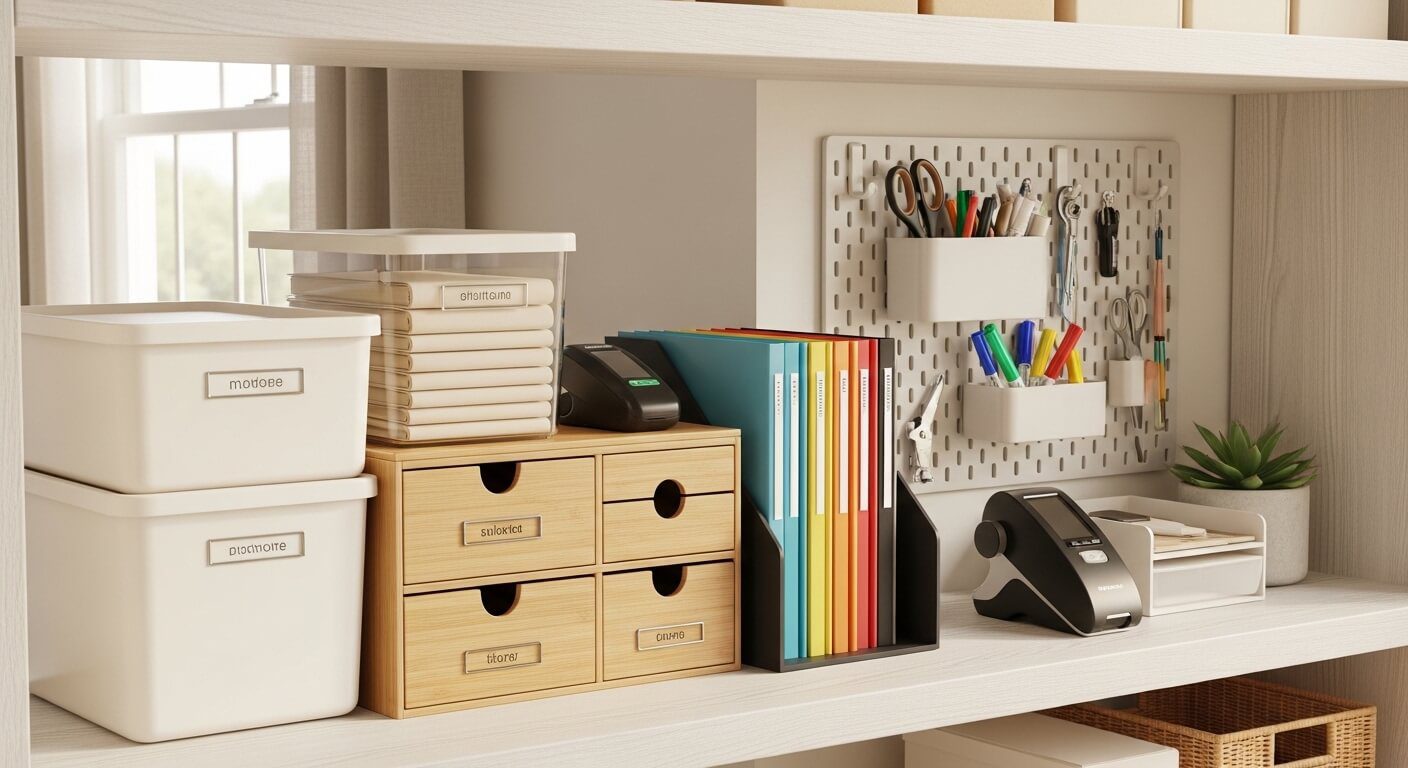

Home Organization Tools: The Complete Guide to Decluttering Every Room in Your House
10 min read
The right home organization tools can genuinely change the way you experience your living space — not in some abstract, lifestyle-magazine sense, but in the very real, daily sense of not feeling low-level stressed every time you walk into your kitchen, bedroom, or home office. Most people who struggle with clutter aren’t disorganized by nature. They’re simply working without the right systems and tools to make order feel effortless and sustainable. Once those tools are in place, maintenance takes minutes rather than hours, and the whole house starts to feel calmer and more intentional.
What makes this topic genuinely interesting is how broad the category is. Organization tools for home use range from a $2 drawer divider to a $40 label maker to a carefully built custom shelving system that costs an afternoon and a trip to the lumber yard. Some of the most impactful tools aren’t products at all — they’re frameworks: how you group items, how you assign zones, how you build habits around putting things back. In my experience, the homes that stay organized aren’t the ones with the most storage products. They’re the ones where the owners thought clearly about their actual workflow before buying anything.
This guide covers everything: the essential tools that work in virtually every room, specialized solutions for home offices and ADHD-friendly environments, secure document storage, budget considerations, and the specific mistakes that cause even well-intentioned organization projects to unravel within a month. Whether you’re starting fresh or refining a system that’s almost working, you’ll leave here with a clear and actionable picture of what the best home organization tools actually are — and how to use them well.
Why the Right Organization Tools for Home Make All the Difference
There’s a meaningful difference between tidying up and actually organizing a space. Tidying is reactive — you clean because something got bad enough that you had to. Organizing is proactive — you design a system so things naturally return to order with minimal ongoing effort. The bridge between those two states is almost always a set of well-chosen physical tools that make the organized behavior easier than the disorganized one.
Think about a junk drawer. Without any organization tools, everything migrates to that drawer because there’s no friction-free alternative. Add a simple set of small containers or a grid organizer inside the drawer, and suddenly there’s a place for batteries, a place for rubber bands, a place for the random screws that appear in every home. The drawer doesn’t get junky because each category has a home. The tool didn’t change the amount of stuff — it changed the behavior around the stuff. That’s the core principle behind every effective organization system.
Research from the American Psychological Association has consistently linked cluttered home environments to elevated cortisol levels — the body’s primary stress hormone. This means that a disorganized home isn’t just inconvenient; it’s actively affecting your wellbeing. Investing in organization tools for home spaces is therefore not a luxury or a vanity project. It’s a genuine quality-of-life improvement with measurable psychological benefits.
📌 Key Takeaway
The goal of any organization tool is to make the organized behavior easier than the disorganized one. If putting something away takes more effort than leaving it out, the system will fail regardless of how good the tools are.
The Best Home Organization Tools for Every Room
Not every room needs the same approach, but there’s a core toolkit of organization tools that perform reliably across virtually every space in a home. These are the items worth buying first — before you specialize by room or function.
Label Maker
The single most impactful organization tool for shared spaces. Labels remove ambiguity about where things belong — for every person in the household.
Clear Storage Bins
Visibility is key. Clear bins let you see contents without opening every container — dramatically reducing the “where did I put that?” problem.
Drawer Dividers
Adjustable or fixed dividers prevent category creep inside drawers — the slow mixing of unlike items that turns organized drawers back into junk drawers.
Shelf Risers
Double your cabinet and shelf capacity without adding a single inch of floor space. Essential for kitchens and pantries with tall cabinets.
Command Hooks & Rails
Renter-friendly vertical storage that puts walls and cabinet doors to work. Ideal for entryways, kitchens, and bathrooms where floor space is premium.
Fabric Baskets
Soft-sided bins for corralling loose items on open shelving. They look intentional on display while hiding the inevitable small-item chaos inside.
Beyond the universal toolkit, room-specific tools matter enormously. In the kitchen, turntable organizers (lazy Susans) for corner cabinets and tension rods for under-sink organization are game-changers. In the bedroom, vacuum storage bags for seasonal items and over-door organizers for shoes or accessories recover significant space without requiring any structural changes. For long-term storage areas like garages and utility closets, a well-chosen set of storage bins with secure lids — properly sized and labeled — creates a system that holds its structure for years rather than weeks.
One thing I’ve learned from organizing and reorganizing my own spaces repeatedly: buy fewer tools, but buy better ones. A $4 drawer organizer that warps within a season costs more in the long run than a $12 bamboo version that lasts a decade. Cheap wire baskets look fine in a product photo but cut hands and snag fabric in real use. Quality tools make the system feel worth maintaining — and that feeling matters more than most people realize.
💡 Pro Tip
Before buying any organization tool, measure your space three times: height, width, and depth. Bins that are 1/4 inch too wide for a shelf are completely useless. Bring measurements (and your phone for product dimensions) when you shop in-store.
Home ADHD Organization Tools: Systems That Actually Stick
Standard organization advice assumes a brain that finds putting things away straightforward and naturally rewarding. For people with ADHD, that assumption breaks down almost immediately. The home ADHD organization tools that actually work are designed around how an ADHD brain genuinely operates — not how we might wish it did. This is a nuance that makes an enormous practical difference, and it’s worth understanding even if you don’t have a formal diagnosis, because ADHD-friendly design tends to make organization easier for everyone.
What organization tools work best for people with ADHD at home?
The most effective home ADHD organization tools share a common design principle: they make the correct behavior the path of least resistance. Open bins without lids instead of covered containers — because the extra step of removing a lid is enough friction to derail the habit. Visual storage everywhere possible — open shelving, clear drawers, glass-front cabinets — because “out of sight” means “forgotten” for many people with ADHD. Color-coded systems that communicate category instantly, without requiring reading or recall. And designated “launch pads” near every exit — a tray or basket where keys, bags, and daily items are always deposited on the way in, so they’re always findable on the way out. According to CHADD (Children and Adults with ADHD), visual organization systems and consistent placement habits are among the most clinically supported approaches for managing household functioning with ADHD.
Specific tools that consistently get recommended in ADHD organization communities include wall-mounted pegboards (everything visible and accessible without opening a single drawer), whiteboard calendars at eye level in high-traffic areas (not a phone app — a physical surface you literally cannot ignore), and large-format labels with simple category words rather than elaborate subcategories. The principle is simplicity at the point of decision: the easier it is to know where something belongs, the more likely it goes there.
Closet spaces deserve special attention here. A cluttered, opaque closet is particularly challenging for ADHD management. Transitioning to a system with clear bins, open sections for frequently used items, and a genuinely thought-through layout can make a dramatic difference. Our guide to closet organization ideas covers exactly this kind of layout planning in detail, with approaches that work especially well for visual thinkers and people who need immediate accessibility.
🔎 Did You Know
Studies published in neuroscience journals have found that visual clutter actively competes for cognitive resources — meaning a disorganized space literally makes it harder to think clearly. ADHD-friendly organization isn’t a workaround; it’s sound design for any human brain.
Secure File Storage Tools for Home Organization
Paper management is one of the most universally neglected areas of home organization, and it’s also one of the most consequential. A misplaced insurance document, a lost lease agreement, or a tax return that can’t be found during an audit — these aren’t minor inconveniences. Secure file storage tools for home organization protect both your peace of mind and your financial and legal standing.
How do I organize important documents at home securely?
The foundation of secure document storage at home is a fireproof and waterproof document safe. These are available starting around $35–$50 for a basic model and are rated to protect paper documents, USB drives, and passports through standard residential fire temperatures (typically 1200–1550°F for up to 30–60 minutes). For active documents you access regularly — bills, insurance cards, car registration — a fireproof expanding file folder inside a locking file cabinet is the most practical solution. The file cabinet provides quick access and basic security; the fireproof folder inside adds a layer of protection against the most common household disasters. For truly critical documents — birth certificates, Social Security cards, property deeds, original wills — a bank safe deposit box is the gold standard. This isn’t an organization tool per se, but it’s the most secure file storage available and costs $20–$100 per year depending on location.
For the ongoing flow of incoming paper — mail, receipts, school forms — a simple three-tray inbox system works reliably for most households: Tray 1 for items requiring action, Tray 2 for items to be filed, Tray 3 for items to shred. Pair this with a weekly 10-minute paper processing habit and you’ll never face a paper mountain again. Digital backup is equally important: scan critical documents and store copies in an encrypted cloud folder. The U.S. government’s official document guidance recommends keeping digital backups of all critical household documents in addition to physical originals.
- 🔒 Fireproof safe — for birth certificates, passports, Social Security cards, property deeds
- 🗄️ Locking file cabinet — for active financial and insurance documents
- 📂 Color-coded expanding files — for sorting by category (medical, taxes, home, auto)
- 🖨️ Document scanner or app — for creating encrypted digital backups
- 🗑️ Cross-cut shredder — for securely disposing of sensitive paper
Home Office Organization Tools: Taming the Work-From-Home Chaos
The home office presents a unique organizational challenge because it sits at the intersection of work demands and domestic life. When the boundaries blur — which they always do — the space tends to accumulate a particular kind of chaos: half-finished projects, charging cables for six different devices, sticky note avalanches, and the inexplicable appearance of household items that have nothing to do with work. Home office organization tools need to address both the physical clutter and the workflow logic underneath it.
What are the most useful home office organization tools for a small desk setup?
For a small desk footprint — which describes most home offices — vertical organization is everything. A monitor stand with built-in storage underneath raises your screen to an ergonomically correct height while creating a shelf for hard drives, small notebooks, or a wireless charger. A wall-mounted pegboard behind the desk puts frequently used items within arm’s reach without touching the desk surface at all. Mesh or bamboo desktop organizers with multiple compartments keep pens, scissors, sticky notes, and small tools sorted without a drawer. And a cable management solution — seriously underrated — transforms a desk from feeling chaotic to feeling calm just by removing the visual noise of tangled cords. Our complete guide to cable management walks through both desk and entertainment center setups in practical detail.
For the paper side of home office work, a two or three-drawer desktop file unit keeps active projects within reach without consuming desk surface. Label each drawer simply: Current Projects, Reference, To-File. This three-category system is simple enough to maintain without any cognitive overhead — which is exactly what you want in a workspace where cognitive energy should be going toward actual work. Combine this with a small desktop scanner for going paperless on everything that doesn’t need a physical original, and you’ve built a home office organization system that would make most professional offices envious.
Don’t overlook the floor and wall space around a home office desk, either. A rolling cart with two or three shallow drawers on wheels can slide under the desk when not in use and roll out when you need craft supplies, hardware, or reference binders. Wall-mounted floating shelves above the desk create a library-like storage zone for books, binders, and decorative items — keeping them off the desk while still within view. If your home office shares space with a bedroom or living area, a room divider with built-in shelving creates both a visual boundary and useful storage simultaneously.
💡 Pro Tip
Assign every item on your desk a specific home before you end each workday. This “desk reset” ritual takes under three minutes and means you start every morning with a clear surface — which research consistently shows improves focus and task initiation from the first minutes of the day.
Cost Breakdown: What to Spend and Where
One of the most common mistakes people make when embarking on a home organization project is either dramatically underspending (buying flimsy tools that fail quickly) or dramatically overspending (purchasing premium products for every category before knowing which solutions actually fit their space and habits). A tiered approach — where you invest more in high-use, high-visibility areas and spend less in utility spaces — gives you the best return on your organization budget.
| Organization Tool Category | Budget Pick | Mid-Range Pick | Premium Pick |
|---|---|---|---|
| Label Maker | $12–$18 | $30–$45 | $60–$90 |
| Clear Storage Bins (set of 6) | $15–$22 | $35–$50 | $70–$100 |
| Drawer Organizer Set | $8–$14 | $20–$30 | $40–$65 |
| Fireproof Document Safe | $35–$55 | $80–$130 | $200–$400 |
| Desktop File Organizer | $12–$20 | $28–$45 | $55–$90 |
| Pegboard Kit (24″x48″) | $20–$30 | $45–$65 | $90–$150 |
| Estimated Full-Home Toolkit | $100–$160 | $240–$365 | $515–$895 |
The smartest spending strategy: start with a label maker and a set of clear bins as your universal foundation — these work everywhere and deliver immediate visible results that motivate you to keep going. Add room-specific tools as you tackle each space. Reserve premium spending for items that take physical wear (file cabinets, storage bins for heavy items) and go budget-friendly on decorative or light-use items like small desktop organizers and bathroom counter trays.
How to Start Organizing Your Home: A Room-by-Room Approach
Knowing which tools exist is one thing. Knowing how to actually deploy them in your specific home is another. The room-by-room approach prevents the overwhelming paralysis that strikes when people try to organize “the whole house” as a single project. It also lets you build momentum — early wins in one room give you the energy and confidence to tackle the next.
Which room should I organize first for maximum impact?
Start with the room you spend the most time in or the space that causes you the most daily friction. For most households, that’s either the kitchen or the entryway. The kitchen is where the most daily decisions are made, where clutter creates genuine functional problems (can’t find the spatula, can’t see what’s in the pantry, can’t cook efficiently), and where good organization tools deliver measurable time savings every single day. An organized pantry — using clear bins, shelf risers, turntable organizers, and proper labeling — can literally reduce the time you spend in the kitchen by 15–20 minutes per day. Our detailed walkthrough of pantry organization covers exactly how to set this up from scratch, including which containers work best for which food categories.
The entryway is the second highest-impact starting point because it sets the tone for your entire home. A clutter-free, well-organized entry — with hooks for bags and coats, a bench with storage, a tray for keys and mail, and a shoe rack — means you start and end every day in a space that feels calm rather than chaotic. From there, work outward: bedroom and closet next (sleep environment quality matters enormously), then home office, then garage and utility spaces.
For bedroom storage, one often-overlooked resource is the space beneath the bed. With the right under bed storage containers, you can store seasonal clothing, spare bedding, shoes, and even books in a way that’s completely hidden and immediately accessible — reclaiming floor space and closet real estate simultaneously.
⚠️ Warning
Resist the urge to buy all your organization tools before you’ve sorted through your belongings. You may be buying containers for items you don’t need to keep. Declutter first, measure your spaces second, then buy only the tools that fit your actual remaining inventory.
Common Mistakes That Derail Home Organization Projects
Even with the right tools and the best intentions, certain patterns reliably cause home organization projects to collapse. Recognizing these in advance is the difference between a system that lasts and one that looks great in week one and is invisible by week four.
- Organizing without decluttering first: Putting clutter in prettier containers is not organizing. Before any storage tool goes in, everything in that space needs to be sorted into keep, donate, and discard. This step is uncomfortable and people avoid it, but skipping it means you’re just hiding the problem in nicer packaging.
- Buying containers before measuring: This is the most common and most avoidable mistake. Bins that are half an inch too tall for a shelf are worthless. Always measure before you shop.
- Creating systems too complex to maintain: If your organization system requires more than one or two steps to put something away, it won’t survive contact with real daily life. Simple is sustainable.
- Organizing for how you think you should live, not how you actually live: If you’ve never successfully kept the dining table clear of mail, designing an elaborate mail sorting system for the home office won’t fix it. Put a small tray near where the mail actually lands. Work with your real habits, not your idealized ones.
- Ignoring vertical space: Most homes use only the bottom 48 inches of their walls for storage. The space above — up to the ceiling in closets and garages — is largely untouched. Shelving, pegboards, and wall-mounted racks in these zones can double or triple effective storage without adding any floor footprint.
- Not involving everyone who lives in the space: An organization system that only one person understands will only be maintained by one person. Brief, clear communication about where things go — and ideally some labeling — means the whole household supports the system rather than quietly dismantling it.
Keeping Your Systems Going: Long-Term Maintenance of Home Organization Tools
The dirty secret of home organization is that no system is set-and-forget. Life changes — new purchases arrive, family sizes shift, seasons rotate, hobbies evolve. A system that was perfect for your household last year may need significant adjustment this year. Building maintenance into your routine, rather than waiting until things become overwhelming again, is what separates homes that stay organized from homes that cycle between organized and chaotic.
The most effective maintenance strategy is a short weekly reset — 15 to 20 minutes on Sunday evening or Monday morning — where you walk through each organized space and return everything that’s drifted back to its designated home. This prevents the slow accumulation of displacement that leads to full-blown reorganization projects. Think of it like doing the dishes each night instead of waiting for the sink to overflow: small, regular maintenance is vastly easier than periodic large-scale intervention.
Seasonally, do a more thorough review. Pull items out of high-traffic storage areas, reassess what’s actually being used, and donate or discard what’s become redundant. This is also the time to check the condition of your organization tools themselves: bins that have cracked, labels that have peeled, dividers that have warped. Replace failing tools promptly — a broken bin that doesn’t stack properly will silently destabilize the whole system around it. Organization tools for home spaces are investments in your daily quality of life, and maintaining them is as logical as maintaining any other home system.
📌 Key Takeaway
The best home organization tools are worthless without consistent habits to support them. A weekly 15-minute reset and a quarterly review are the two habits that reliably keep organized spaces organized — regardless of how good or expensive the tools are.
Frequently Asked Questions
What are the most essential home organization tools to buy first?
If you’re starting from scratch, a label maker and a set of clear storage bins are the two tools that deliver the broadest impact across the most spaces. A label maker removes ambiguity about where things belong for every person in the household, which is the single biggest factor in whether a system gets maintained. Clear bins solve the “where is that thing?” problem by making contents visible at a glance, eliminating the need to open every container when you’re looking for something specific. From there, add drawer dividers for kitchen and bathroom drawers, shelf risers to double cabinet capacity, and command hooks or a small pegboard for vertical storage in high-traffic zones. These five categories of organization tools for home spaces cover the majority of everyday organizational needs at a relatively modest combined cost.
What organization tools work best for people with ADHD at home?
The most effective home ADHD organization tools are those that minimize friction at the moment of putting something away. Open-top bins without lids are more reliably used than covered containers, because the extra step of removing a lid is enough friction to derail the habit for many people with ADHD. Visual storage — clear bins, open shelving, glass-front drawers — is critical because “out of sight” genuinely means “forgotten” for many ADHD brains. Wall-mounted pegboards, color-coded systems, large simple labels, and designated “landing zones” near every exit are among the most consistently recommended tools in ADHD organization communities. The overarching principle is that any friction reduction at the point of decision — whether that’s the number of steps to put something away or the clarity about where it belongs — significantly increases the likelihood that the behavior happens consistently.
How do I organize important documents at home securely?
Secure file storage tools for home organization start with a fireproof and waterproof document safe for your most critical items — birth certificates, Social Security cards, passports, property deeds, and original wills. For active documents you access regularly, a locking file cabinet with color-coded expanding files organized by category (medical, financial, home, auto) provides quick access with basic security. A cross-cut shredder is essential for securely disposing of any document containing personal or financial information — standard paper recycling is not sufficient for sensitive documents. Digital backup is the often-overlooked final layer: scan all important documents and store encrypted copies in a secure cloud storage service. The combination of a fireproof physical safe, a locking file cabinet for active files, and encrypted digital backups represents a genuinely robust home document security system.
What are the best home office organization tools for a small desk?
For a small desk footprint, the most impactful home office organization tools are those that move storage off the desk surface entirely. A monitor stand with built-in shelf space underneath raises your screen to ergonomic height while creating usable storage at desk level. A wall-mounted pegboard behind the desk puts frequently used tools and accessories within arm’s reach without occupying any desk surface. A compact two-drawer desktop file unit keeps active paperwork accessible and sorted without requiring a separate file cabinet. A good cable management solution — whether that’s a cable tray under the desk, cable clips along the back edge, or a simple cable box for the power strip — removes the visual noise of tangled cords, which research shows has a measurable effect on perceived desk cleanliness. And a small rolling cart that slides under the desk when not in use adds significant flexible storage capacity to even the smallest home office.
How much should I budget for home organization tools?
A functional basic toolkit of organization tools for home spaces — label maker, a set of clear bins, drawer dividers, shelf risers, and a few command hooks — can be assembled for $100–$160 at budget price points and still perform reliably for several years. A mid-range full-home toolkit, with better-quality bins, a more capable label maker, a desktop file organizer, and a basic pegboard, typically runs $240–$365. Premium setups with matching containers across all rooms, a quality fireproof safe, and specialty tools for home office and ADHD organization can reach $500–$900 or more. The smartest approach is to prioritize spending on tools that take the most physical wear and use (bins, file storage, pegboards) and go budget-friendly on items that are light-use or purely decorative. Never buy containers before you’ve measured your space and completed an initial declutter — you may be buying storage for items you don’t need to keep.
Which room should I organize first for the biggest impact?
Start with the room that causes you the most daily friction — for most households, that’s the kitchen or the entryway. The kitchen is where the most frequent daily decisions happen, and an organized kitchen (particularly the pantry and main cooking prep zone) can save 15–20 minutes of daily time through easier meal planning and more efficient cooking. The entryway sets the emotional tone of every arrival and departure, and a clutter-free, well-organized entry makes the whole home feel more in control from the moment you walk in. After these two high-impact spaces, tackle the bedroom and closet (sleep environment quality matters significantly for overall wellbeing), then the home office, then utility and storage spaces like the garage. This sequence builds momentum through early, highly visible wins rather than starting in low-visibility areas where results feel less immediately rewarding.
How do I stop my organized spaces from becoming cluttered again?
The most reliable prevention strategy is a short weekly reset — 15 to 20 minutes dedicated to returning everything in your organized spaces back to its designated home. This prevents the gradual displacement of items that leads to full-blown organizational collapse. Pair this with a quarterly review where you reassess what’s actually being used, donate or discard redundant items, and check the condition of your organization tools themselves. The deeper solution is building systems that align with your actual habits rather than your idealized ones — if something consistently ends up in the wrong place, that’s information about where it actually belongs, not a personal failure. Finally, labeling everything clearly and communicating the system to everyone who shares the space ensures that one person’s organizational work isn’t quietly undone by others who don’t know where things go.
Are there free or low-cost home organization tools that actually work?
Absolutely — some of the most effective organization tools cost nothing or next to nothing. Repurposed shoe boxes make excellent drawer dividers for junk drawers and bathroom vanities; cover them in contact paper and they look intentional. Mason jars organize everything from pantry staples to bathroom cotton balls to desk supplies. Tension rods create instant vertical dividers inside cabinets for cutting boards, pot lids, and baking trays. A strip of painter’s tape and a permanent marker replicates a label maker well enough for utility spaces. For paper management, a simple three-tray system (in, to-file, to-shred) requires nothing more than three stackable trays available at any dollar store. The principles that make organization work — clear categories, designated homes for every item, visual access, simple systems — don’t require expensive products. They require thoughtful planning, which costs only time.
Conclusion: Build Your Home Organization System to Last
The most important thing to understand about home organization tools is that they are enablers, not solutions. The label maker doesn’t organize your kitchen — you do, and the label maker makes that organization legible and maintainable for everyone in your household. The clear bins don’t declutter your closet — you make the decluttering decisions, and the bins give those decisions a durable, visible form. This distinction matters because it shifts the focus from buying the right products to building the right systems — and systems, once built thoughtfully and maintained consistently, are what actually change how a home feels to live in.
Start small. Pick one space that’s been bothering you — a single drawer, a pantry shelf, a desktop — and apply the principles from this guide to that one spot. Declutter first. Measure. Choose appropriate tools. Label everything. Live with it for a week and observe what’s working and what isn’t. Then expand from there. This iterative approach produces more lasting results than any weekend overhaul, because you’re learning your own habits and designing around them rather than imposing an idealized system that doesn’t fit your actual life.
Once your core spaces are organized, the natural next step is thinking about the areas that don’t yet have dedicated storage thinking: seasonal items that cycle in and out of use, the space under beds and above closet rods, the home office corner that still feels chaotic. Exploring solutions like thoughtful pantry organization, proper closet organization ideas, and smart under-bed storage for seasonal rotation will keep building on the momentum you’ve created — and turn your home from a source of low-grade stress into a space that genuinely supports how you want to live.