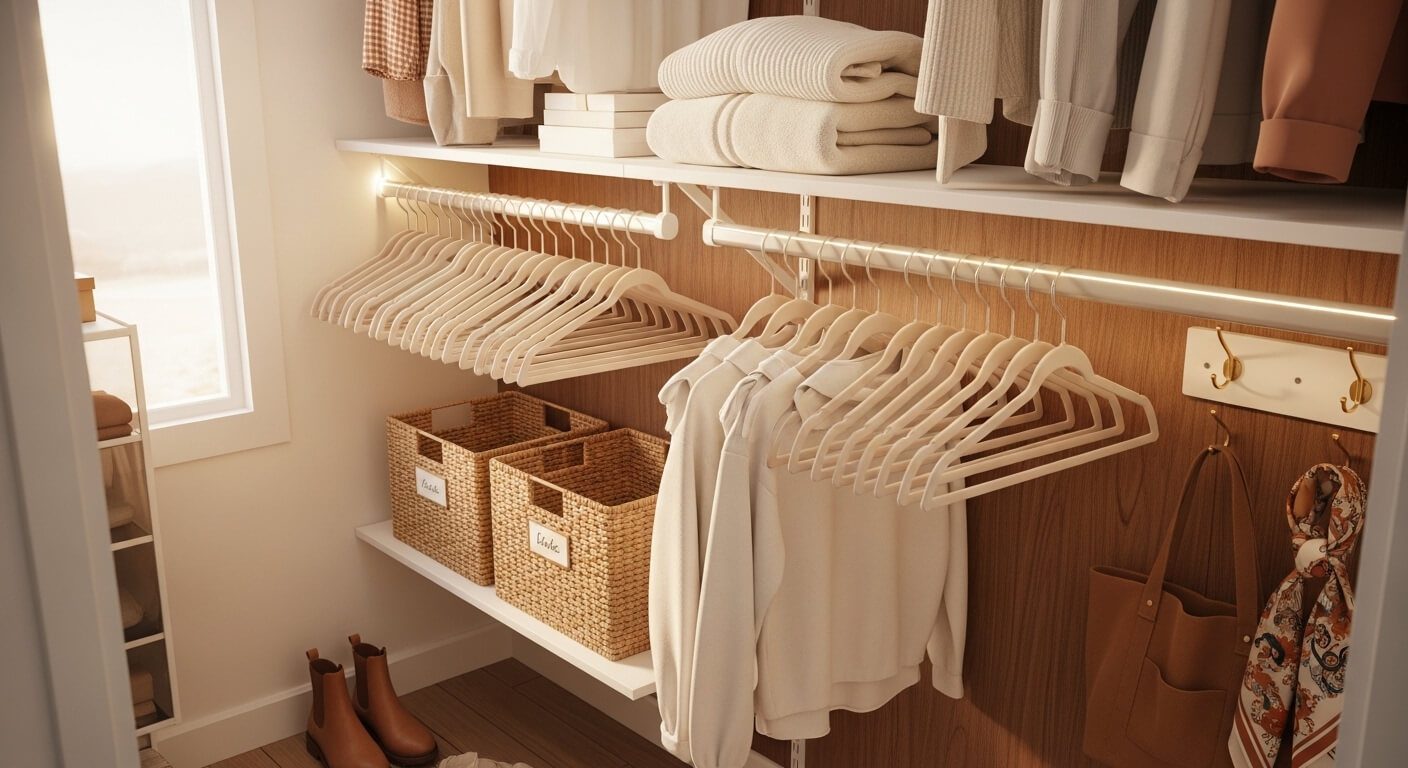

Closet Makeover Ideas Under $100: Closet Organization Ideas That Actually Transform Your Space
Spring is the season of fresh starts, and nothing signals a reset quite like opening your closet to a calm, organized space instead of an avalanche of forgotten scarves. The good news? You don’t need a contractor, a custom build, or a four-figure budget to pull it off. A complete closet makeover — one that genuinely changes how you feel every morning — is entirely achievable with smart closet organization ideas and a budget of less than $100. Whether you’re working with a cramped reach-in, an awkward corner, or a surprisingly roomy walk-in that’s been mismanaged for years, there are targeted, affordable strategies that deliver real results.
The mistake most people make is waiting until they can “do it properly” — meaning spending thousands on built-ins. In my experience, a well-planned cheap closet ideas approach almost always outperforms expensive solutions that weren’t thought through. This guide walks you through every layer of the process: assessing your space, choosing the right products, avoiding the pitfalls that waste money, and keeping everything looking sharp long after the initial weekend blitz. Think of it as your complete spring cleaning playbook, built specifically for the closet.
By the time you’ve worked through these sections, you’ll have a clear action plan, a realistic budget breakdown, and the confidence to start this weekend. Let’s get into it.
Assessing Your Closet Before You Buy Anything
The single biggest mistake in any closet project is shopping before measuring. It sounds obvious, but it derails more makeovers than any other factor. Walk into your closet — or stand in front of your wardrobe — and spend ten minutes just observing. What’s on the floor that shouldn’t be? Where does the clutter actually come from? Which zones feel chaotic and which are surprisingly functional?
Take measurements of width, height, and depth. Note the rod height, any existing shelving, and where the door swings. Photograph everything before you touch it. This baseline will guide every purchase you make and prevent you from buying organizers that don’t fit your space. According to The Spruce’s closet organization guides, the assessment phase alone cuts unnecessary spending by an estimated 30% for DIY home organizers.
Next, sort your wardrobe brutally. Pull everything out and categorize: keep, donate, discard, relocate. You cannot organize clutter — you can only hide it, and it always comes back. Reducing volume before you add structure is the foundation of any lasting closet makeover.
Tools & Materials You’ll Need
Before diving into the actual closet ideas, make sure you have the right tools on hand. The good news: you probably already own most of these. A tape measure, a level, a power drill or strong screwdriver, a stud finder, and a pencil cover 90% of installations. If you’re working with freestanding systems, you may not need any tools at all.
Essential Supplies
For a full DIY closet overhaul, gather the following: velvet hangers (a game-changer for space), tension rods, over-door organizers, stackable bins or baskets, shelf dividers, and a label maker or simple masking tape labels. Add a basic hook rail, a few S-hooks, and some drawer organizers, and you have the toolkit for a complete transformation — typically for under $40 if you shop strategically at dollar stores, IKEA, or during Target’s home organization sales.
Optional but worth considering: a battery-powered LED closet light (under $15 at most hardware stores) and non-slip shelf liners. Both dramatically improve the usability of a reorganized space. The Consumer Reports closet organizer reviews consistently highlight lighting and drawer liners as the highest-satisfaction low-cost additions to home storage spaces.
Top Closet Makeover Ideas Under $100
Here’s where the real transformation happens. These closet makeover strategies are arranged from easiest to slightly more involved — all well within a $100 total budget when combined thoughtfully.
1. Replace Bulky Hangers with Velvet Slim Hangers
This single swap can effectively double your hanging space. Velvet slim hangers take up roughly half the rod space of standard plastic hangers and prevent clothes from slipping. A set of 50 runs between $12 and $18. Do this first — it’s the fastest visible win.
2. Add a Double Hang Rod
Most standard closets have one long rod hung high, wasting the bottom half of the space. A portable double hang rod (under $25) lets you hang shorter items like shirts, jackets, and folded trousers in two rows. This is the backbone of almost every professional wardrobe organizer setup.
3. Install an Over-the-Door Organizer
The back of your closet door is prime real estate that most people never use. Over-the-door organizers — whether clear-pocket shoe holders, multi-hook rails, or wire basket systems — run $10 to $25 and add meaningful storage for shoes, accessories, cleaning supplies, or kids’ items. Look for options that hook over the door without drilling if you’re renting.
4. Use Shelf Risers and Stackable Bins
Fixed shelving almost never matches your actual storage needs. Shelf risers create a second level on any flat shelf, letting you stack folded items, bags, or boxes efficiently. Pair with labeled canvas bins or clear stackable containers to keep everything visible and accessible. This approach is foundational to a good diy closet system.
5. Add a Pegboard or Hook Rail for Accessories
Bags, belts, scarves, and hats are notoriously hard to store neatly. A pegboard panel (available at hardware stores for around $15) or a simple hook rail lets you hang accessories visibly and accessibly. Paint the pegboard to match your closet walls for a clean, intentional look that feels custom without the cost.
6. Use Tension Rods Creatively
Tension rods are wildly underused in closets. Install one low in a deep shelf to create a spot for boots to lean against, add one horizontally to hang spray bottles or cleaning supplies, or use a pair to create a small shelf-within-a-shelf for clutches or folded scarves. A pack of several tension rods costs under $12.
Small Closet Ideas That Punch Above Their Weight
If you’re working with a reach-in closet that feels barely functional, the challenge is less about storage products and more about spatial strategy. Small closet ideas that actually work focus on vertical space, door space, and categorization — not cramming more in.
First, go vertical. Install an additional shelf above the existing one if your ceiling height allows. Many reach-in closets waste 12 to 18 inches of overhead space. A floating shelf for rarely used items — out-of-season clothes, spare bedding, extra pillows — can dramatically reduce the load on your primary storage zone.
Second, embrace the floor. A small shoe rack, a slim rolling cart, or even a decorative basket on the floor is fair game. Just keep it intentional: one or two purposeful floor-level items versus a pile that grows uncontrolled. According to research published through University of Illinois Extension, small-space organization performs best when the number of distinct storage zones is limited to five or fewer — reducing decision fatigue and maintaining long-term order.
Third, use color coding or visible categorization. When a space is small, the eye catches disorder instantly. Grouping by type and color — all whites together, all darks together — creates visual calm even in a packed closet and makes getting dressed genuinely faster.
Cost Breakdown: Budget vs. Mid-Range vs. Premium
One of the most useful exercises before starting any closet project is mapping out what you’re actually spending and where the money goes. Below is a realistic breakdown across three spending tiers — all achievable within the $100 ceiling when you prioritize the budget column.
| Item | Budget (Under $100 total) | Mid-Range ($100–$300) | Premium ($300+) |
|---|---|---|---|
| Velvet Hangers (50-pack) | $12–$18 | $20–$28 (branded sets) | $35+ (luxury felt) |
| Double Hang Rod | $18–$25 (freestanding) | $35–$60 (wall-mounted) | $80+ (custom rail) |
| Over-Door Organizer | $10–$20 | $30–$50 (multi-tier) | $70+ (custom back-door panel) |
| Shelf Risers & Bins | $15–$22 | $40–$75 (IKEA system) | $120+ (elfa/modular) |
| LED Closet Light | $10–$15 | $20–$40 (motion sensor) | $60+ (hardwired) |
| Pegboard / Hook Rail | $12–$18 | $30–$50 (styled rail) | $80+ (custom mount) |
| Estimated Total | $77–$118 | $175–$303 | $445+ |
The budget tier — with selective shopping and a willingness to check discount stores — almost always lands under $100. The key is prioritizing the items that give the biggest visible return: hangers, the double rod, and bins. Everything else is enhancement. For more closet ideas on stretching your home budget, the team at CraftsnComforts.com covers affordable DIY projects year-round.
Common Mistakes to Avoid in a Closet Makeover
Even with a solid plan and a tight budget, certain errors show up repeatedly in DIY closet projects. Knowing them in advance saves both money and frustration.
Buying Before Decluttering
This is the number one mistake. People get excited, order organizers, and then realize they still have too much stuff to fit in an organized system. Always purge first. A ruthless edit almost always reveals more space than any product can provide.
Ignoring Door Swing and Access
Freestanding shelving, rolling racks, and floor-level bins need to account for how your closet door opens. A beautifully organized floor rack positioned exactly where the door swings means it gets knocked daily — and moved permanently to the middle of the room. Measure your door clearance before placing anything on the floor.
Choosing Style Over Function
Those gorgeous Instagram-worthy wicker baskets look beautiful. They’re also harder to clean, they snag delicate fabrics, and they rarely stack well. If aesthetics matter to you — and they should, it helps you maintain the system — choose items that are both attractive and practical. Clear acrylic bins are a reliable middle ground.
Underestimating the Time Investment
A full closet makeover — from pulling everything out to putting it back organized — typically takes a full day, sometimes two. Plan for it. Don’t start on a Sunday night before a Monday morning deadline. Schedule a weekend, recruit a helper if possible, and give yourself permission for it to look worse before it looks better.
Skipping Labels
Labels are the difference between a system that lasts a week and one that lasts a year. They don’t need to be fancy — masking tape and a marker work perfectly. Labels reduce the cognitive load of maintaining organization and make it easy for everyone in a household to follow the same system.
Longevity & Maintenance: Keeping Your Closet Organized
The hardest part of any closet project isn’t the initial transformation — it’s the maintenance. Most organized closets begin to slip within four to six weeks if there’s no system for upkeep. The good news is that a few simple habits can keep your diy closet looking fresh indefinitely.
The One-In-One-Out Rule
Every time a new item enters your closet, one existing item leaves — either donated, sold, or discarded. This rule is simple, sustainable, and the single most effective long-term maintenance strategy. It prevents the slow accumulation that makes closets feel overwhelming again within months of a makeover.
Seasonal Audits
Schedule a brief closet review at the start of each season — four times a year. Pull out anything you haven’t touched since the last season, reassess whether it earns its space, and relocate or remove accordingly. Spring and fall are natural moments to rotate seasonal items like heavy coats, boots, or swimwear into and out of primary storage. The Wikipedia overview of home organization principles notes that seasonal rotation is among the most commonly cited practices of people who describe themselves as consistently tidy.
Five-Minute Weekly Reset
Pick one day a week — Sunday evenings work well — and spend five minutes returning anything that’s drifted out of place. This micro-habit prevents the drift that leads to the chaotic before-state that triggered the makeover in the first place. It’s not about perfectionism; it’s about having a minimum viable system that holds.
Replace Worn Components Proactively
Velvet hangers wear out. Bins crack. Tension rods lose their tension. When something in your system stops working well, replace it immediately rather than tolerating the dysfunction. One broken element tends to cascade — if the shoe rack is collapsing, shoes end up on the floor, then bags pile on shoes, and within a month the floor is impassable. A $12 replacement prevents a $100 redo.
Frequently Asked Questions
Can I really do a full closet makeover for under $100?
Yes, absolutely. The key is prioritizing the items with the biggest impact: a set of velvet slim hangers ($12–$18), a double hang rod ($18–$25), an over-door organizer ($10–$20), and a few stackable bins or shelf risers ($15–$22). Together, these four elements — which cover the most common closet problems — land well within the $100 budget. Shopping at discount stores, checking for sales at Target or IKEA, or ordering from Amazon can reduce the total further.
What’s the single best closet organization idea for a small space?
Adding a double hang rod is the single highest-impact change for most small closets. It immediately converts the dead space below your existing hanging clothes into a full second zone for shorter items. Combined with slim velvet hangers, this one change can effectively double your usable hanging capacity without drilling a single hole or spending more than $35 total.
Do I need to drill or make any permanent changes?
No. A complete closet makeover is entirely achievable without any permanent modifications. Freestanding double rods, tension rods, over-door organizers that hook over the door, and freestanding shelving units require no drilling at all. This makes them ideal for renters or anyone who wants flexibility to change the layout over time. Only wall-mounted shelving or a pegboard installation would require drilling, and neither is necessary for a fully functional system.
How long does a DIY closet makeover take?
Plan for a full day — roughly six to eight hours for a standard reach-in or walk-in closet. This includes the decluttering phase (which is often the longest), measuring, shopping or receiving deliveries, installing the organizational elements, and putting everything back in its designated place. If you’re working with a very large walk-in or doing a more complex setup, a two-day weekend project is realistic. Starting on a Saturday morning gives you buffer time without the pressure of a Monday deadline.
What are the best affordable wardrobe organizer brands?
For budget-conscious shoppers, IKEA’s SKUBB and KOMPLEMENT series offer excellent value for bins, dividers, and shoe boxes. Amazon Basics produces reliable velvet hangers and over-door organizers that hold up well over time. The Container Store’s sale section and Target’s Made By Design line are worth checking for shelf risers and stackable bins. Dollar stores and discount home stores like HomeGoods or TJ Maxx are excellent for baskets, hooks, and decorative bins at a fraction of retail pricing.
How do I keep a small closet organized long-term?
The one-in-one-out rule is the most sustainable long-term habit: every time a new item enters the closet, one item leaves. Pair this with a brief five-minute weekly reset — just returning things to their designated spots — and a quick seasonal audit four times a year. Together, these three habits maintain the organized state indefinitely without requiring a full redo. Labeling bins and zones also reduces the mental effort of maintenance, making it easier for the whole household to participate.
Is it worth buying a full modular closet system vs. individual pieces?
For most budgets under $100, individual pieces outperform modular systems because they let you target your specific problems rather than buying components you don’t need. Modular systems like IKEA PAX or The Container Store’s elfa start around $150–$300 for a basic configuration and offer better long-term customization — but they’re a different category of project. If your closet has unusual dimensions or very specific needs, individual pieces give you more flexibility. If you’re planning a longer-term investment and have a larger budget, a modular system may be worth the upgrade.
Can these closet makeover ideas work in a rental apartment?
Yes, the vast majority of these strategies are renter-friendly. Over-door organizers, freestanding double rods, tension rods, velvet hangers, stackable bins, and freestanding shelving all require no drilling and leave no damage. The only strategies that involve wall contact — pegboard installation or wall-mounted shelving — can be adapted using adhesive hooks rated for appropriate weight loads, or simply skipped in favor of freestanding alternatives. Always check your lease before making any modifications, even small ones.
Conclusion: Your Closet Makeover Starts This Weekend
A transformed closet is closer than it feels. The gap between the chaos you’re opening the door to every morning and the calm, functional space you want isn’t a $3,000 custom build — it’s a clear assessment, a few targeted purchases, and a single focused weekend. The closet organization ideas in this guide are proven, practical, and genuinely budget-friendly. Most people who follow through come out the other side wondering why they waited so long.
Start with the declutter. Measure your space. Pick three ideas from the list above that address your specific frustrations and order or shop for just those items. Resist the urge to do everything at once — a focused, executed plan always beats a comprehensive plan that never starts. Closet makeover projects that begin with one clear priority almost always expand naturally once that first win is visible.
Spring is the perfect moment. The energy is right, the sales are good, and the motivation to refresh is at its seasonal peak. Your organized closet — the one that makes getting dressed genuinely enjoyable — is absolutely within reach. Go make it happen.