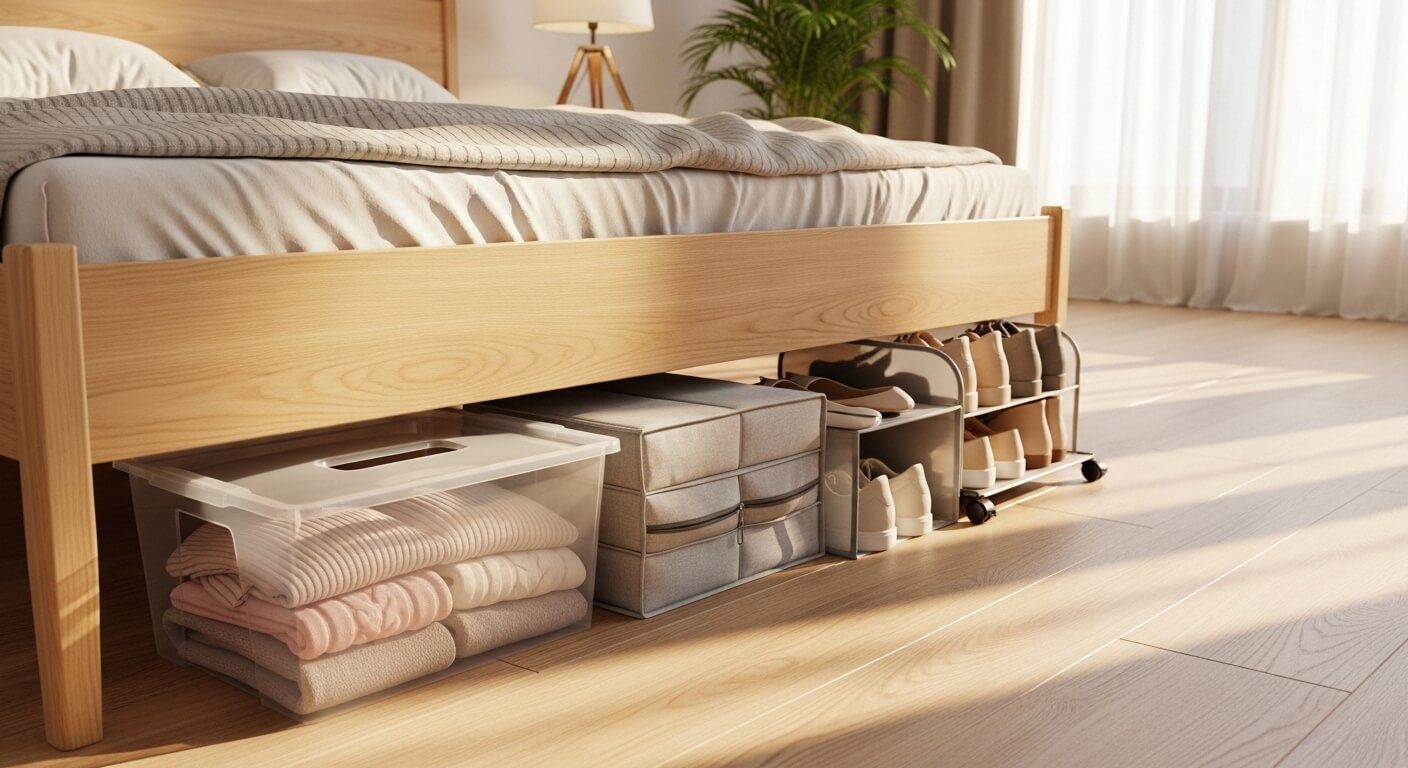

Under Bed Storage: Complete Guide to Maximizing Your Hidden Space
Estimated read time: 9 minutes
Under bed storage is one of the most underutilized spaces in any home — a quiet, dust-prone zone that has the potential to solve some of your most frustrating clutter problems. Whether you’re dealing with a cramped bedroom, a tiny dorm room, or simply a wardrobe that’s bursting at the seams, the space beneath your bed can hold a surprising amount. Most standard bed frames sit 7 to 13 inches off the ground, which means you could be sitting on the equivalent of a small closet every single night.
What separates a chaotic under-bed situation from a genuinely useful one is strategy. Tossing a few boxes under there and hoping for the best doesn’t cut it. The right containers, the right system, and a clear sense of what belongs down there can transform dead space into one of the most hardworking storage zones in your home. In my experience, people underestimate this area until they try it properly — and then wonder how they ever lived without it.
This guide covers everything: from choosing the best under bed storage bins and drawer-style solutions, to specialized setups for dorm rooms and tight apartments, to tips on keeping your under-bed zone organized long-term. We’ll look at practical options across every budget, including popular picks like IKEA under bed storage, and break down the smartest ways to store everything from seasonal clothes to shoes.
Why Under Bed Storage Works (And When It Doesn’t)
The appeal is straightforward: it’s space you already own. Unlike adding a new shelf or investing in a wardrobe system, under-bed storage requires no construction, no wall anchors, and usually very little money. You’re simply making use of a volume that exists in every bedroom with a raised bed frame.
That said, there are limits. Beds with very low profiles — platform beds with frames that sit close to the floor — often leave no usable gap at all. Before buying anything, measure your clearance. You need at least 5–6 inches for flat, shallow bins, and 8–10 inches for proper drawer-style units or tall containers. If you’re working with a high bed or even a loft-style setup, you have considerably more freedom.
The other factor is access. Storage you can’t easily reach tends to become a black hole. If pulling out a bin requires moving furniture or getting on your hands and knees and groping around blindly, you’re unlikely to use it well. Good organization under a bed rewards planning — and that’s exactly what this guide provides. Think of it as a kind of horizontal closet organization project for the floor level of your room.
The Best Under Bed Storage Bins for Every Need
Under bed storage bins are the foundational unit of this whole system. They come in an enormous range of materials, sizes, and designs — fabric zip-up bags, hard polypropylene totes, woven baskets with lids, vacuum-sealed bags for seasonal items. Each has a role.
Fabric bins with zips are typically the most popular. They’re lightweight, collapse when empty, and work well for soft items like extra bedding, seasonal clothing, or blankets. Look for ones with a clear window panel or a label slot on the side — retrieval becomes much faster when you can see or label what’s inside without pulling the whole bin out.
Hard plastic bins offer better protection against dust and pests, which matters if you’re storing items long-term. They’re also sturdier if you plan to stack things inside them. The trade-off is weight and bulk — a large polypropylene bin loaded with winter sweaters is not easy to maneuver. Pair these with a good labeling system (chalk labels work beautifully) and you’ll have no trouble keeping track. Think of the overall approach the same way you’d think about storage bins for any other room — the container shapes the behavior.
| Tier | Price Range | Best For |
|---|---|---|
| Budget | $10 – $25 | Fabric zip bins, basic plastic totes; great for seasonal clothes and bedding |
| Mid-Range | $30 – $70 | Wheeled fabric drawers, lidded canvas organizers, clear-front plastic bins |
| Premium | $80 – $200+ | Solid wood under-bed drawers, custom-built pull-out systems, integrated bed frame storage |
Under Bed Storage with Wheels: Ease and Accessibility
If there’s one upgrade that transforms under-bed storage from a chore into a pleasure, it’s wheels. Under bed storage with wheels — typically small 360-degree rolling casters — means you can pull out a heavy bin with one hand and slide it back effortlessly. No more dragging, no more scraped floors, no more avoiding that bin because it’s too much effort.
Wheeled solutions are especially valuable for items you access regularly: shoes, gym gear, current-season clothing, or hobby supplies. Several brands make purpose-built rolling under-bed drawers with fabric or hard-shell construction. Alternatively, you can add adhesive furniture casters to the bottom of existing bins — a simple DIY upgrade that costs a few dollars and genuinely changes how you interact with the space.
One thing to check: make sure your flooring can handle the rolling motion. On hardwood or tile, smooth-rolling casters glide beautifully. On thick carpet, you may want bins with slightly larger wheels to reduce resistance. Also consider a thin runner mat under the storage area if you want to protect the floor finish over time.
IKEA Under Bed Storage: What’s Worth It
IKEA has built an entire ecosystem around under-the-bed storage, and for good reason. Their offerings range from affordable flat fabric bags (the SKUBB line is legendary for a reason) to integrated bed frames like the BRIMNES and HEMNES that include built-in drawers. If you’re starting from scratch — or if you’re willing to invest in a new bed frame — IKEA under bed storage can be a genuinely complete solution.
The SKUBB storage cases, which come in multi-packs at very low price points, are worth keeping on your radar. They stack neatly, zip shut to keep dust out, and have a small label window on the front. They’re not flashy, but they perform. For a full bedroom overhaul, pairing the HEMNES bed frame (which features two large drawers) with SKUBB organizers inside those drawers gives you a layered system that feels almost custom-built.
What IKEA does less well is heavy-duty protection. Their fabric solutions are not pest-proof, and the plastic-zip construction can weaken over years of use. For true long-term storage of items like heirloom textiles or expensive off-season clothing, consider supplementing with more robust hard-lid containers — the kind of pantry organization mindset applied to your bedroom floor, where every zone has a clear purpose and appropriate container.
Under Bed Shoe Storage: Organizing Your Collection
Under bed shoe storage is one of the smartest applications of this space — and one of the most commonly done wrong. Shoes kicked under the bed in a pile are not “stored.” They’re just hidden. The goal is a system where each pair has a defined spot and can be found, retrieved, and returned without effort.
The most popular format is a long, flat shoe organizer — essentially a low-profile bin or tray divided into individual slots, often with a clear lid so you can identify pairs without pulling the whole unit out. These typically hold 6–12 pairs depending on shoe size and organizer dimensions. For larger collections, two side-by-side units often work better than one long unwieldy one.
An alternative approach that works extremely well: individual shoe boxes (the clear stackable kind) arranged in rows under the bed. Each box holds one pair, labels face forward, and retrieval is precise. It’s more of a boutique-shop aesthetic, and it requires a bit more initial investment, but for anyone with 20+ pairs of shoes, the clarity it provides is worth it. According to the Good Housekeeping organizing team, shoe storage is most effective when it’s near the point of use — which is exactly what under-bed placement achieves.
Dorm Under Bed Storage: Small Space, Big Solutions
What Makes Dorm Room Under Bed Storage Different?
Dorm life is a masterclass in constraint. You’re sharing a small room, dealing with standard-issue furniture you often can’t replace, and managing everything you own in a space that might be 120 square feet total. Dorm under bed storage isn’t optional — for most students, it’s essential. The good news is that dorm beds are almost always raised significantly above the floor (often 12–18 inches or more, especially when lofted), which means you have more vertical clearance than the average home bed.
How to Set Up Dorm Storage Under Bed for Maximum Efficiency
The dorm room under bed storage strategy that works best is a zoned approach. Divide the under-bed area into categories — clothing, shoes, snacks/pantry overflow, study supplies, and seasonal gear — and assign each zone its own container. Wheeled bins are especially useful in dorms because you may need to rearrange frequently and can’t use permanent fixtures. Stackable crates or collapsible fabric drawers also perform well in this environment.
One thing that gets overlooked in dorm storage planning: cable management. Once you have storage bins under the bed, it can become difficult to manage power strips, chargers, and laptop cables that often end up routed along the floor. Keeping those organized — with proper cable management clips or channels — prevents cords from tangling with your bins and makes the whole setup look far more intentional. The New York Times Wirecutter dorm essentials guide consistently highlights under-bed organization as a top priority for incoming students.
What to Store (and What to Keep Out)
Not everything belongs under your bed. The space works best for items that are seasonally rotated, used infrequently, or too large for standard drawer or shelf storage. The classics: extra bedding and pillows, off-season clothing, shoes, gift wrap supplies, and luggage (which often fits perfectly in long, flat under-bed areas).
What to avoid: anything sensitive to humidity or temperature fluctuations. Under beds tend to trap warmer, slightly more humid air — particularly in older homes or apartments with less airflow. Leather goods, fine wool, and anything prone to mold or mildew should be stored with cedar blocks or silica gel packets to mitigate moisture risk. Electronics and anything requiring stable conditions should generally stay elsewhere.
Food is a particular concern in non-dorm settings. While it’s common practice in dorms to keep snacks in under-bed containers, doing so at home can attract pests. If you go this route, use hard-lidded, airtight containers — similar to what you’d use for kitchen drawer organizers — and check regularly. The EPA’s guidance on pest prevention notes that clutter and food access are the primary attractants for common household pests.
Common Mistakes to Avoid
Not measuring before buying. This is by far the most frequent problem. People purchase bins or drawer units online, excited by the photos, and discover on arrival that the clearance under their bed is 4 inches — not the 8 required. Measure height and width before anything else.
No labeling system. Under-the-bed storage becomes a graveyard if you can’t quickly identify what’s inside each bin. Even the simplest system — a piece of masking tape and a marker — transforms how usable the space is. Clear-sided bins eliminate this issue entirely.
Ignoring dust. The area under a bed collects dust faster than almost any other surface in a room. Open bins and fabric bags that don’t seal fully will transfer that dust directly to your stored items. Opt for lidded or zip-closed containers whenever possible, and commit to a quarterly clean-out.
Overpacking. When a bin is crammed so full that you have to fight to close it, you’ll stop using the system. Fill containers to about 80% of capacity — enough room to close easily and retrieve items without causing an avalanche.
Storing things you no longer need. Under-bed storage is not a substitute for decluttering. If you’re storing clothes you haven’t worn in two years “just in case,” the problem isn’t storage — it’s the volume of stuff. Treat any organization project as an opportunity to reassess what actually belongs in your home.
Longevity and Maintenance: Keeping Your Under-Bed System Working
A well-set-up under-bed storage zone doesn’t need constant attention — but it does need periodic care. A few habits will keep it functional and fresh over the long term.
Quarterly rotation. Every three months, pull everything out, wipe down the floor beneath (a microfiber cloth on an extendable duster handles this beautifully), and reassess what’s in each bin. Seasonal rotation is natural: in spring, swap heavy winter gear for lighter summer clothing; in fall, reverse the process.
Pest prevention. Cedar blocks and lavender sachets are your friends in fabric-heavy storage. Cedar naturally repels moths, and both options keep stored clothing smelling fresh. Replace cedar blocks annually — they lose potency as they dry out completely.
Container integrity. Check zippers and lids annually. A bin with a broken zipper or a warped lid that doesn’t seal properly is no longer doing its job. Replace compromised containers rather than continuing to use them.
Dust management. A mattress skirt or bed skirt that reaches the floor does double duty: it conceals the under-bed area aesthetically and reduces the amount of airborne dust that settles in. This is a small investment that noticeably reduces how often you need to clean the under-bed zone. According to Consumer Reports, regular maintenance of storage zones is strongly associated with sustained organization habits over time.
Frequently Asked Questions
What are the best under bed storage bins for everyday use?
Is under the bed storage a good idea long-term?
What dorm under bed storage solutions work in limited clearance spaces?
How much does dorm storage under bed typically cost?
How do I keep stored items from getting dusty under the bed?
Can I use IKEA under bed storage with a non-IKEA bed frame?
What is the best under bed shoe storage for a large collection?
How do I stop under bed storage bins from sliding around?
Final Thoughts: Making the Space Work for You
Under bed storage, done thoughtfully, is one of the most impactful low-cost organization projects available to homeowners and renters alike. It requires no structural changes, minimal investment, and pays dividends every time you find what you’re looking for without searching through an overstuffed closet. The principles are simple: measure first, use the right containers, label everything, and maintain the system seasonally.
If this guide has you thinking about the broader organization potential in your home, there’s much more to explore. A cohesive bedroom storage strategy often extends outward — into closet organization, built-in drawer solutions, and thoughtful furniture choices that serve double duty. The most satisfying homes are the ones where every space has a considered purpose — and the zone beneath your bed is no exception.
Start small if you need to. Pick one category — shoes, or extra bedding — and get the right container for it this week. Once you see how much cleaner and more functional that one change makes your bedroom feel, the motivation to tackle the rest follows naturally. This is one of those projects that genuinely delivers on its promise.