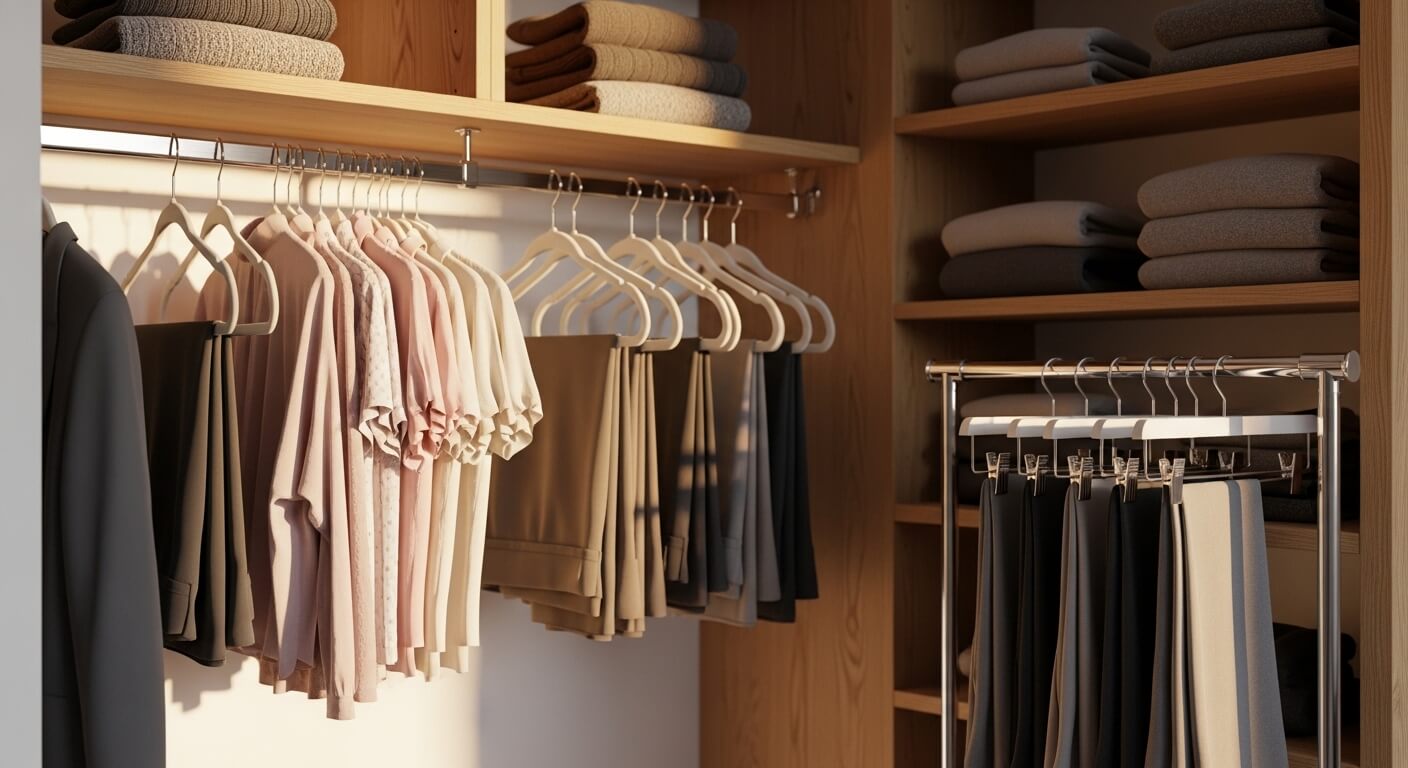

Space Saving Hangers: The Complete Guide to Maximizing Your Closet
Estimated read time: 9 minutes
If your closet feels like it’s staging a slow-motion protest — clothes bunched together, pants sliding off the bar, shirts competing for the same few inches of rod space — then space saving hangers might genuinely change your daily life. These clever tools have become one of the most popular closet upgrades for a good reason: they let you fit more into the same physical space without a single renovation. Whether you live in a studio apartment, share a wardrobe, or simply own too many clothes (no judgment), the right hanger system can double — sometimes triple — your usable closet capacity.
In my experience reorganizing everything from tiny city apartments to sprawling walk-in closets, the biggest bottleneck is almost always the same: people are hanging their clothes one piece per hanger, one hanger per vertical inch. Most closet rods are between 36 and 48 inches wide, which translates to roughly 35–45 standard hangers. That’s not a lot. Space saving hangers break that equation entirely by stacking multiple garments in a cascading or compressed arrangement, multiplying what that same rod can hold.
This guide covers everything you need to know — the different types of space saving clothes hangers, how to choose the right ones for your wardrobe, what works for pants versus shirts, and which options genuinely deliver on their promises. Think of it as your one-stop reference for smarter, calmer, more organized mornings.
Types of Space Saving Hangers for Pants and Clothes
Not all space saving hangers are built the same, and choosing the wrong type for your wardrobe can leave you more frustrated than when you started. Understanding the main categories helps you spend your money on what will actually solve your problem.
Cascading (Drop-Down) Hangers
These are the most common type. A central hook hangs from the rod, and multiple arms extend downward — each holding a garment. You get 5 to 10 clothing items in the vertical space that a single hanger normally occupies. They work brilliantly for tops, light jackets, and folded pants. The key advantage is visibility: because items hang at slightly different heights, you can see each piece without pushing things aside. Pairing cascading hangers with a broader closet organization ideas strategy gives you an even more dramatic result.
Slim Velvet Hangers
These aren’t technically “multi-garment” hangers, but switching from bulky plastic to slim velvet hangers can reclaim 30–40% of your rod space in one afternoon. At roughly 5–6mm thick versus a standard plastic hanger’s 12–15mm, the math adds up fast. They also grip slippery fabrics far better than plastic, meaning fewer clothes on the floor.
Trouser Rack Hangers
Designed specifically as space saving pant hangers, these feature multiple horizontal bars stacked on a single hook. You can drape 5 to 10 pairs of trousers on one hanger. Some versions use open bars (easier access), while others clamp each pair in place (better for heavier fabrics). If pants are your problem, these are the most efficient solution available.
S-Hook Linking Systems
A budget-friendly approach where small S-shaped clips link one hanger to another in a vertical chain. You hang a shirt, clip an S-hook to the bottom, hang another shirt, and continue. It’s effective and costs almost nothing, though the chain can swing and tangle more than dedicated multi-hangers.
Skirt and Scarf Hangers
These specialty pieces hold multiple skirts, scarves, or ties on tiered loops. They’re particularly useful if you own a lot of accessories or lightweight garments that tend to pile up in a drawer. One skirt hanger holding eight items occupies the same rod space as a single shirt hanger.
Do Space Saving Hangers Really Work? The Honest Answer
This is the question most people have before they commit to buying a set. The short answer is: yes, they work — but with important caveats that most product listings won’t tell you.
Do space saving hangers really work for all wardrobe sizes?
Cascading and trouser rack hangers do dramatically increase how many garments fit on a single rod. A well-organized rod using these tools can hold 2 to 3 times the garments of the same rod using standard hangers. That’s not marketing exaggeration — it’s geometry. However, results depend heavily on how full your closet is before you start. If you genuinely own more clothes than your closet can hold in any configuration, hangers alone won’t solve the problem. You also need to address smart storage bins for off-season items and accessories.
Where space saving hangers fall short is wrinkle management. Hanging five shirts on a cascading hanger means the bottom shirts may wrinkle more than if each had its own space. This is a real tradeoff. For dress shirts and anything that creases easily, use them sparingly or only for less formal pieces.
According to the Good Housekeeping Institute, the single biggest improvement people make in closet organization comes not from buying more furniture but from upgrading the efficiency of their existing rod space — which is exactly what these hangers address.
Best Space Saving Hangers: What to Look For Before You Buy
With dozens of options available, choosing the best space saving hangers comes down to four factors: material, weight capacity, garment type compatibility, and ease of access. A hanger that’s great for someone with a casual wardrobe may be completely wrong for someone with heavy wool suits.
Material matters. Velvet-coated hangers are the gold standard for preventing slippage. Metal hangers (usually chrome or rose gold) are slim and durable but can leave marks on delicate fabrics. Plastic hangers are cheap but thick — unless they’re the newer ultra-slim plastic versions, which are a reasonable middle ground.
Weight capacity is underrated. Cascading hangers are only as good as the hook at the top. Cheap versions have flimsy hooks that bend under the weight of several garments stacked together. Look for steel or reinforced plastic hooks with a swivel function, which makes them far easier to use on a crowded rod.
Ease of access is the difference between a system you maintain and one you abandon. If removing a single shirt requires lifting four others out of the way, you’ll stop using it. The best cascading hangers are designed so each arm tilts or slides independently.
Cost Comparison: Budget vs. Mid-Range vs. Premium
| Budget ($5–$15) | Mid-Range ($16–$35) | Premium ($36–$80+) |
|---|---|---|
| Plastic cascading hangers | Velvet slim hangers (50-pack) | Premium chrome trouser racks |
| Basic S-hook linking sets | Steel cascading multi-hangers | Designer closet systems with integrated hangers |
| Works for light garments only; hooks often bend | Best value for most wardrobes; durable hooks | Long-lasting, beautiful finish; suits heavy fabrics |
| ~35 garments/rod | ~70 garments/rod | ~90+ garments/rod with max efficiency |
For most households, the mid-range category offers the best return. Velvet hangers in the $20–$30 range for a 50-pack are widely regarded as the most impactful single upgrade you can make to a standard closet — and they’re the kind of purchase that genuinely sticks around for years.
Space Saving Pants Hangers: A Dedicated Deep Dive
Pants are one of the hardest clothing categories to store efficiently. They’re bulky, prone to creasing, and don’t stack well in drawers. Space saving hangers for pants solve this in a way that general multi-garment hangers often don’t — by holding pants in a flat, parallel arrangement that minimizes wrinkles while maximizing density.
The most popular space saving pants hangers are the multi-bar trouser racks that hold 5 to 10 pairs on a single swiveling hook. Each pair drapes over a horizontal bar, and you can pull out any individual pair without disturbing the others. This is a significant functional advantage over the cascading style, where everything hangs in a vertical chain.
If you wear pants daily for work, consider a dedicated rack hanger per clothing category: one for dress trousers, one for jeans, one for casual chinos. This approach mirrors the logic of pantry organization — grouping like items together makes retrieval fast and keeps the system self-maintaining.
One lesser-known option is the pants loop hanger, which uses individual fabric loops to hold each pant leg rather than draping over a bar. These are particularly good for wide-leg trousers and linen pants that crease easily on narrow bars. They’re harder to find but worth the search if fabric preservation is a priority.
Space saving clothes hangers designed for pants also interact well with your broader organizational strategy. If you’re already organizing cables and cords with proper cable management solutions, applying that same systematic thinking to your wardrobe will feel natural.
How to Use Space Saving Hangers: A Step-by-Step Approach
How to make space saving hangers work in any closet
The process starts before you buy a single hanger. Pull everything out of your closet, do a ruthless edit, and then categorize what remains. You cannot organize clutter — you can only move it around. Once you know exactly what you’re working with, you can calculate how many rods, how much linear footage, and what mix of hanger types you actually need.
Start with your heaviest, largest items — winter coats, blazers, heavy dresses. Give these standard hangers with good support. Then move to your everyday wearables — shirts, casual pants, lightweight jackets. This is where cascading hangers and trouser racks make the biggest difference.
A useful rule: arrange clothes by color within each category once they’re on the space-saving hangers. This sounds like a minor aesthetic choice, but it dramatically reduces the time you spend hunting for something specific in the morning. Combined with the vertical efficiency of multi-garment hangers, color organization turns your closet into something that functions almost like a retail display.
How to use space saving hangers without causing wrinkles
The wrinkle question is real. The solution is to never hang more garments on a cascading system than the lowest item has breathing room. As a rule of thumb, the bottom-most shirt on any cascading hanger should hang at least 4–5 inches above the shelf or floor below. If it’s compressed, you’ll get wrinkles. Also, avoid hanging more than 5 garments on a cascading system if they’re heavier fabrics like denim or wool. Lighter cotton and synthetic blends can tolerate larger stacks more gracefully.
For households with less closet depth, consider supplementing rod-based hangers with under bed storage for off-season clothing, freeing your closet rod entirely for current-season garments that genuinely benefit from hanging.
Common Mistakes People Make with Space Saving Clothes Hangers
Buying too many too fast. It’s tempting to buy a 200-piece mega-kit immediately. But until you’ve lived with a small set for a few weeks, you won’t know which types work for your actual habits. Buy 20–30 to start, test them, and then scale up.
Mixing hanger types randomly. Using five different hanger styles in one closet section creates visual chaos and makes the system feel harder to maintain. Pick one or two hanger types per zone and stay consistent.
Ignoring rod strength. Older closets often have rods rated for 30–40 pounds. Doubling the number of garments on that rod can exceed its weight capacity — especially with heavier clothing. Check your rod’s rating, and if needed, add a center support bracket before loading it up.
Skipping the edit. No hanger system solves the problem of owning more clothes than you need. The most effective step you can take is removing items you haven’t worn in a year before optimizing with better hangers.
Forgetting vertical space below hanging clothes. The area below your hanging garments is often dead space. A small rolling cart, stackable storage bins, or a second short rod can make this space almost as useful as the primary rod above it.
Longevity and Maintenance: Getting the Most from Your Hanger System
Good hangers, treated well, can last a decade or more. Cheap ones, overloaded and ignored, might warp within a season. A few simple habits make a significant difference.
For velvet hangers, avoid overloading them with wet or damp garments. The velvet surface can absorb moisture and breed odor over time. Always let clothes dry fully before returning them to the closet. Every six months, wipe down velvet hangers with a slightly damp cloth and let them air-dry before reloading.
Metal and chrome hangers should be checked periodically for rust, especially in humid climates. A light coat of clear silicone spray on the metal parts prevents rust without affecting the garments. For plastic hangers, check the hooks annually — stress cracking at the hook is the first sign that a hanger is about to fail under load.
Multi-bar trouser hangers with swiveling mechanisms benefit from occasional lubrication of the pivot point. A single drop of lightweight machine oil keeps them rotating smoothly and prevents the metal fatigue that comes from forced movement.
Finally, periodically reassess your hanger system as your wardrobe evolves. A system built around 40 shirts may need adjustment when your lifestyle shifts. Treating your closet organization as a living system — one you revisit and refine — is what separates lasting organization from temporary tidying. The same principle applies whether you’re optimizing your wardrobe or working on broader closet organization ideas throughout your home.
Frequently Asked Questions
Do space saving hangers really work for large wardrobes?
How to make space saving hangers at home?
How to use space saving hangers without wrinkling my clothes?
What are the best space saving hangers for pants specifically?
Are space saving pants hangers safe for delicate fabrics?
How many clothes can space saving hangers actually hold?
Do slim velvet hangers count as space saving clothes hangers?
Can I use space saving hangers in a wardrobe with a short rod?
Final Thoughts
Space saving hangers are one of the highest-impact, lowest-cost improvements you can make to your home organization. Whether you choose cascading multi-garment hangers for shirts, dedicated trouser racks for your pants collection, or simply swap out bulky plastic for slim velvet alternatives, the result is a closet that’s easier to navigate, visually calmer, and genuinely more functional every single morning.
The key is treating your closet as a system, not just a collection of separate purchases. Combine the right hangers with a thoughtful editing process, smart storage for off-season items, and consistent habits, and you’ll find that your current closet — without any renovation — can hold significantly more than you ever thought possible. From there, it’s natural to extend the same systematic thinking into other areas: pantry organization, storage bins for seasonal swaps, and even broader closet organization ideas that transform your entire home into a more ordered, comfortable space.
Start small. Pick one category — pants, shirts, or a single closet section — and test a set of space saving clothes hangers there first. The results will speak for themselves.