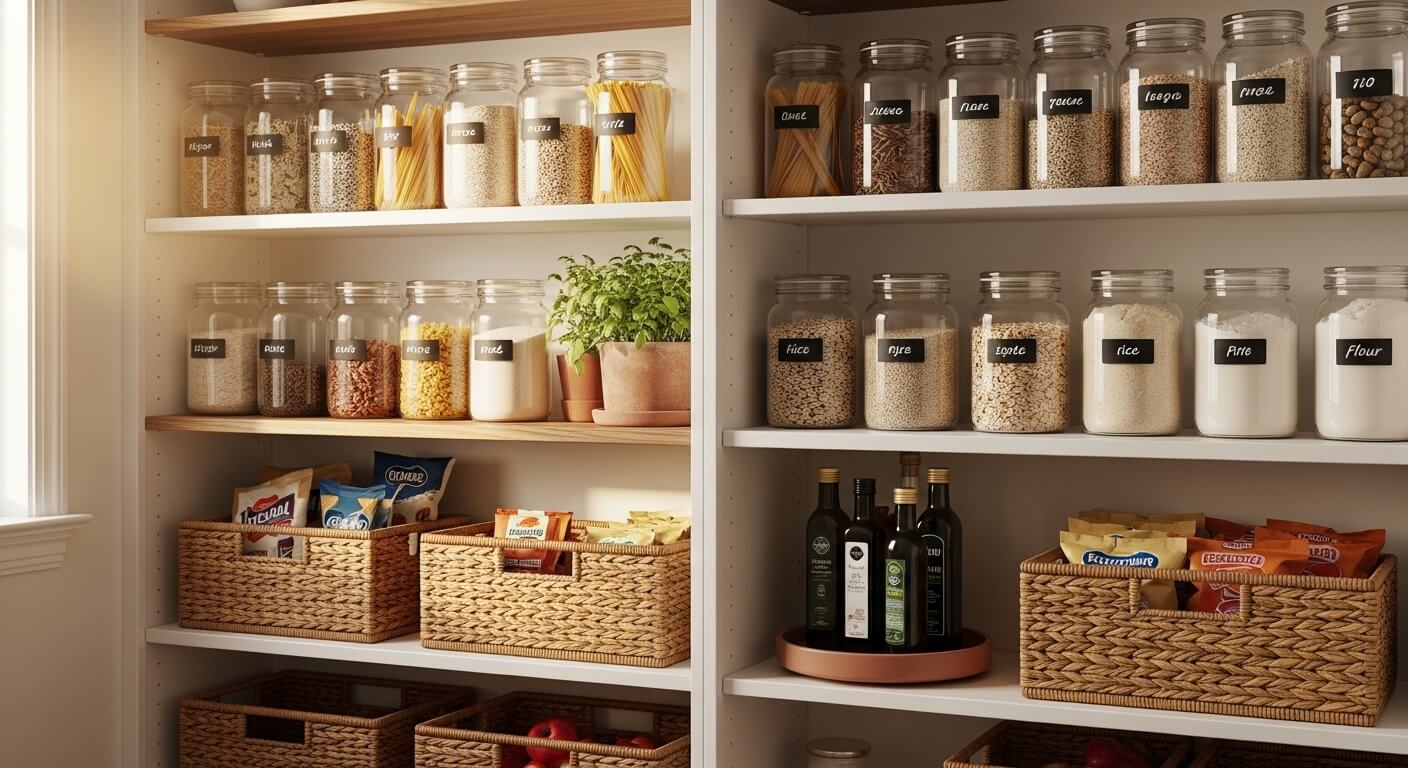

Pantry Organization: The Complete Guide to a Kitchen You’ll Actually Love
⏱ Estimated reading time: 11 minutes
Pantry organization is one of those projects that sounds simple but quietly transforms your entire kitchen routine. When your pantry is chaotic — cans tumbling, half-open bags hiding behind boxes, mystery items lurking in the back — cooking becomes a chore before you even pick up a spatula. A well-organized pantry, on the other hand, saves you money, reduces food waste, and makes meal prep feel almost effortless. It’s genuinely one of the highest-return home improvements you can make, and it costs far less than most people assume.
Whether you’re working with a sprawling walk-in pantry organization setup or trying to squeeze every inch out of a narrow closet, the principles are the same: visibility, accessibility, and consistency. The goal isn’t to create a picture-perfect Instagram shelf that falls apart in a week. The goal is to build a system that actually works for your household, your shopping habits, and your cooking style.
In this guide, I’ll walk through everything from choosing the right bins and baskets to zone-based systems that make grocery put-away take under five minutes. I’ll cover small pantry organization ideas for tight spaces, budget-friendly options from the dollar store, and premium solutions worth the investment. By the end, you’ll have a clear, actionable plan for your specific space — no guesswork required.
Why Pantry Organization Matters More Than You Think
Most people tackle pantry organization as a reactive project — they only do it when they can’t find what they need or when expired food is discovered months too late. But treating it as a proactive system changes everything. Studies from the USDA estimate that American households throw away between 30–40% of the food supply, and much of that waste begins right at the pantry level — food that was bought, forgotten, and eventually expired.
A proper pantry organization system is your first line of defense against this cycle. When you can see everything you own at a glance, you naturally rotate stock, use what’s actually there, and buy only what you need. That visibility also changes how you cook. Meal planning becomes faster when you’re not mentally excavating your shelves. Weeknight dinners get easier when staples are grouped, labeled, and accessible.
Beyond the practical side, there’s a psychological dimension to an organized pantry that people often underestimate. A clean, logical space just feels different. You walk in, you see order, and even the process of cooking feels lighter. One thing I’ve learned after reorganizing my own kitchen twice is that the pantry sets the tone for the whole cooking experience. Get that right, and everything else flows better.
Good pantry organization also supports better kitchen drawer organizers and cabinet systems — when each zone of your kitchen has a clear purpose, clutter stops migrating from one space to another. It’s the kind of organization that compounds over time.
Choosing the Right Pantry Organization Bins
Bins are the backbone of any functional pantry. But walk into a home goods store and you’ll find approximately four hundred options — wicker, acrylic, fabric, stackable, labeled, unlabeled — and no obvious way to choose. The key is to match your bin type to your pantry content and your cleaning style, not just what looks good in the store.
Clear pantry organization bins are almost always the right call for food items. When you can see through the container, you know at a glance when you’re running low on pasta or canned tomatoes. Decanting dry goods — flour, sugar, rice, lentils — into uniform clear canisters creates an immediate sense of calm and makes measuring far easier. Square canisters pack more efficiently than round ones, leaving almost no wasted shelf space.
What Are the Best Bins for a Small Pantry?
For tight spaces, the best pantry organization bins are stackable, modular, and proportional to your shelf depth. Deep shelves swallow small containers, so measure your shelf depth before buying anything. A good rule: bins should fill roughly 80% of shelf depth so they’re accessible without being unreachable. Shallow pull-out bins or sliding drawers are excellent for shelves deeper than 18 inches — they eliminate the “black hole” at the back of the shelf.
Fabric bins with structure (stiff sides) work well for snacks, chips, and bulky items that don’t stack. Wire baskets are ideal for fruits, vegetables, and onions — anything that needs airflow. If you’re building an organized pantry closet, look for bins that can be mounted on the door as well. Over-the-door organizers add a surprising amount of storage without taking up floor or shelf space.
If you’re also working on other storage areas, the same logic applies: the right storage bins can make or break a system. Consistency in bin type within a zone makes the space feel cohesive and easier to maintain.
Small Pantry Organization: Making Every Inch Count
Small pantry organization is less about having the right products and more about being ruthless with how you use vertical space. Most people use only the bottom two-thirds of their pantry shelves — everything above eye level is either empty or a dumping ground for rarely-used items. That’s a significant amount of real estate you’re leaving on the table.
Start by adding a shelf riser or can organizer on existing shelves. A simple two-tier riser can double your visible storage on a single shelf, letting you see canned goods, jars, and bottles at a glance instead of stacking them in depth. Lazy Susans on corner shelves are another small pantry organization idea that dramatically improves access — spin to find, no digging required.
What Are the Best Small Pantry Organization Ideas for Apartment Kitchens?
Apartment kitchens often have no dedicated pantry at all — you’re working with one or two cabinet shelves and maybe a small closet. In that case, small pantry organization ideas shift toward vertical storage outside the cabinet: over-door shoe organizers repurposed for spices and packets, magnetic spice racks on the fridge, or a freestanding narrow utility shelf that fits between the fridge and the wall. A 12-inch wide shelving unit can hold an astonishing amount of pantry goods when organized with uniform bins.
For a true pantry closet, consider adding a pegboard panel on one wall. Hooks and small baskets mounted on pegboard can hold measuring cups, bags of nuts, protein bars, or any small, frequently used items that would otherwise clutter a shelf. It keeps things visible and off the main shelving, freeing that space for bulkier items.
Small pantry organization ideas also benefit from the same principles used in closet organization ideas — zones, vertical thinking, and reducing clutter to only what you actually use. A pantry, like a closet, only stays organized when you edit regularly.
Building a Pantry Organization System That Lasts
The difference between a pantry that stays organized for years and one that devolves into chaos within a month usually comes down to one thing: whether you built a system or just cleaned up. A pantry organization system means every item has a defined home, every zone has a clear purpose, and restocking follows a predictable pattern. Without that structure, entropy takes over quickly.
The most reliable framework is zone-based organization. Think of your pantry in functional zones: breakfast items, baking ingredients, snacks, canned goods, grains and pasta, sauces and condiments, and specialty items. Each zone gets its own shelf or area. When items come home from the grocery store, they go directly into their zone — no deliberation, no reshuffling.
Labeling is non-negotiable in a real system. You don’t need fancy custom labels (though they look great). A label maker producing uniform text on clear tape works perfectly. Label every bin, every basket, every shelf edge if needed. Labels serve two purposes: they tell you where things go, and they tell everyone else in the household where things go. The pantry only works as a system if the whole family participates.
How Do I Find Pantry Organization Systems Near Me?
If you’re looking for pantry organization systems near me — local options rather than ordering online — the best bets are The Container Store, IKEA’s kitchen storage section, HomeGoods, and Target’s organizational bins aisle. IKEA’s KALLAX and PAX systems can be adapted beautifully for walk-in pantry organization, especially if you want custom-depth shelving. For pantry closet organization ideas that require a more tailored fit, many local hardware stores carry adjustable wire shelving systems you can cut to any width. Home Depot and Lowe’s both offer free in-store measurement consultations for closet systems.
A solid pantry organization system also interacts with the rest of your kitchen. Well-organized kitchen drawer organizers mean that your pantry doesn’t have to absorb overflow utensils or gadgets — every storage space can specialize, which keeps all of them more functional.
Fresh Pantry Organization Ideas by Pantry Type
Not every pantry is the same, so pantry organization ideas need to be tailored to the actual space. Here’s how to approach each common pantry type.
Walk-in pantry organization ideas center on using all four walls strategically. Install floor-to-ceiling shelving on the back and side walls, reserving the entrance wall for a pegboard or hooks. Use the highest shelves for rarely-used bulk items or seasonal products (holiday baking supplies, large entertaining platters). Keep everyday staples at eye level and below for maximum accessibility. A small stepstool kept inside the pantry solves the top-shelf accessibility issue without compromising the system.
Kitchen pantry organization ideas for open or semi-open cabinet pantries focus on consistent containers and clear labels. Because these spaces are more visible, aesthetics matter more. Uniform clear canisters with labels, matching bins, and a cohesive color palette (all white, all natural wood tones, or all black accents) create a visually clean look even if the pantry is technically small. The Good Housekeeping Institute regularly tests and recommends organization products that balance aesthetics with real-world usability.
Pantry closet organization ideas borrow heavily from bedroom closet design. Adding a combination of shelving, drawers, and door storage turns even a small closet pantry into a highly efficient space. Drawer inserts at mid-height are especially useful for snack bars, loose packets, and small items that fall to the back of shelves. A shoe-pocket organizer on the inside of the door handles small jars, seasoning packets, and condiment bottles with surprising elegance.
For the rare home with under-stair pantry storage, custom pull-out drawers built to fit the triangular space are the gold standard. A more budget-friendly approach uses wheeled bins on tracks — you pull out the entire bin to access contents, then slide it back under. It’s the same principle used in under bed storage solutions, where the storage slides out rather than requiring you to reach blindly into the back of a dark space.
Cost Breakdown: Pantry Organization on Any Budget
One of the most common barriers to tackling pantry organization is the assumption that it has to be expensive. It doesn’t. A thoughtful small pantry organization system can be built for under $30, and even a full walk in pantry organization ideas overhaul rarely needs to exceed $300 unless you’re installing custom cabinetry. Here’s a realistic breakdown.
| Item / Element | Budget (Under $50 total) | Mid-Range ($50–$200) | Premium ($200+) |
|---|---|---|---|
| Storage Bins & Baskets | Dollar Tree / Dollar store bins, repurposed shoeboxes | OXO, Madesmart, or Rubbermaid clear bins | Yamazaki, iDesign, or The Container Store collections |
| Canisters & Decanting | Repurposed glass jars, simple plastic canisters | OXO Pop containers (set of 10–12) | Glass canisters with bamboo lids, matching sets |
| Shelf Risers / Expanders | Stackable can risers from dollar store | Bamboo or metal shelf risers (2-pack) | Built-in pull-out shelf risers |
| Labels | Chalkboard stickers + chalk marker | DYMO label maker | Custom printed labels, laser engraved acrylic |
| Door Storage | Over-door shoe pocket organizer | Spectrum Diversified or Rev-A-Shelf door rack | Custom door-mounted pull-out systems |
| Lazy Susans | Basic plastic spinning trays | Bamboo or stainless two-tier lazy susan | Custom corner turntable units |
| Shelving System | Existing shelves + rearrangement | ClosetMaid or Rubbermaid wire shelving | Custom wood shelving or IKEA PAX adaptation |
Is Dollar Tree Pantry Organization Actually Worth It?
Dollar tree pantry organization has become genuinely popular, and for good reason — the quality has improved considerably. Dollar Tree carries a rotating selection of bins, baskets, lazy susans, and organizers that are perfectly adequate for light-use areas like snack bins, chip baskets, or temporary organizing while you figure out your system. The limitation is durability. Dollar store organization bins work well for dry goods and lighter items, but they tend to buckle or crack under the weight of canned goods or heavy jars over time. Use them strategically: for snacks, for the kids’ shelf, or for designated low-traffic zones. Invest more in the zones that take the most wear.
Dollar tree pantry organization ideas — using their bins as drawer dividers, their bins for spice corralling, or their baskets for bread and produce — are a smart way to test a layout before committing to expensive containers. Think of the dollar store as your prototyping lab. Once you know exactly what sizes, shapes, and quantities you need, you can upgrade selectively.
Common Pantry Organization Mistakes to Avoid
Even well-intentioned pantry organization projects fall apart when a few key mistakes sneak in. The most common one: organizing before editing. People spend hours arranging items, buying bins, and building systems — only to realize half the pantry is occupied by expired, duplicate, or unwanted products. Always purge before you organize. Every item should earn its place.
The second major mistake is buying bins before measuring. Pantry organization bins that are even slightly too tall waste vertical space, and bins that are too shallow fall short of the shelf back and look messy. Measure height between shelves, depth from front to back, and width of shelf openings before purchasing anything. Write those dimensions on your phone. Refer to them in the store. Without this step, you will make at least one expensive return trip.
Over-decanting is another trap. Decanting everything into matching canisters looks beautiful but creates practical problems. Nutritional labels disappear. Expiry dates vanish. And when you have twelve identical canisters and your memory fails you, you’re guessing what’s what. Decant items you buy consistently and in large quantities — flour, sugar, rice, oats, pasta. Leave everything else in original packaging inside labeled bins.
Neglecting vertical space is perhaps the single most expensive mistake in small pantry organization. Most people stack items two or three deep on shelves, creating an inaccessible zone where food gets lost. Use shelf risers, stackable bins, and wire racks to create vertical layers within a single shelf height. And don’t forget that the pantry door itself is usable real estate — a well-chosen door organizer can hold dozens of small items that would otherwise crowd a shelf.
Finally, skipping cable management in a pantry with lighting is a common oversight in newer, more elaborate setups. If you’ve added LED strip lights or plug-in lighting inside your pantry (a great idea for visibility), managing those cords properly matters. The same techniques used in cable management around entertainment setups apply here — cord clips, adhesive hooks, and cable channels keep lighting tidy and safe.
Keeping Your Pantry Organized Long-Term
The hardest part of pantry organization isn’t the initial setup — it’s the maintenance. A pantry that looks perfect on day one can slide back into chaos within two weeks if no habits are built to support it. Sustainability is the whole game.
Build restocking into your routine. When you return from grocery shopping, don’t just pile new items in front of the old ones. Take an extra 90 seconds to place new purchases at the back of their zone, pushing older items forward. This is the first-in, first-out method, and it’s the simplest way to prevent expired food from accumulating at the back of your pantry without thinking about it.
Do a quarterly reset — not a full reorganization, just a 20-minute check. Pull everything from one zone at a time, wipe the shelf, check expiration dates, and return items neatly. A quarterly reset prevents the slow accumulation of clutter that leads to the “I need to redo the whole pantry” situation six months later. It’s far easier to maintain a system than to rebuild one.
Label maintenance is part of long-term success too. If a canister gets repurposed for a different ingredient, update the label immediately. If a bin category shifts — you stopped buying chips, so that bin is now for popcorn — relabel it the same day. Labels that no longer match their contents break the system’s logic for everyone in the household.
If you have a large family or a busy household, consider assigning pantry responsibility to specific people for specific zones. Kids can be responsible for the snack bin — they learn to restock it, keep it tidy, and notice when it runs low. Ownership of a zone creates accountability in a low-stakes way that builds real organizational habits over time.
Frequently Asked Questions
How do I start pantry organization from scratch?
What are the best dollar tree pantry organization ideas?
Can dollar store pantry organization really work long-term?
What are the most effective small pantry organization ideas for tight spaces?
What’s the best pantry organization system for a family of four or more?
How should I organize a walk-in pantry?
How often should I reorganize my pantry?
Do I need to decant everything into matching canisters?
Your Next Step Toward a Pantry That Actually Works
Pantry organization is one of the most rewarding home projects you can take on — not because it’s dramatic, but because it quietly improves your life every single day. Every meal you cook, every grocery run you do, every morning you reach for cereal and actually find it exactly where it should be — all of that becomes a little easier, a little faster, a little less frustrating. That’s the real return on a well-built system.
Start small if the full overhaul feels overwhelming. Pick one shelf, one zone, one problem area and solve it completely. Build from there. The habits you build around a partial system will naturally extend to the rest of the pantry as the benefits become obvious. You don’t have to redo everything in a weekend to start seeing results.
As you continue refining your home organization, the pantry naturally connects to the rest of your storage systems. Well-organized closets, tidy storage areas, and functional kitchen spaces all reinforce each other. If you’ve been thinking about tackling bedroom clutter, closet organization ideas follow many of the same principles covered here — zones, vertical thinking, and consistent labeling. And if floor and under-furniture storage is your next frontier, a solid approach to under bed storage can free up significant space throughout your home. The more organized your home becomes as a whole, the easier each individual space is to maintain.