
Lazy Susan Organizer: The Complete Guide to Every Type, Use & Setup
⏱ Estimated read time: 9 minutes
A lazy susan organizer is one of the most underrated tools in a well-organized home. Whether it lives inside a deep cabinet, spins on your kitchen counter, or maximizes a tricky corner shelf, this simple rotating platform transforms wasted, hard-to-reach spaces into fully functional storage. Yet so many people own one collecting dust — or never buy the right type to begin with. That gap is exactly what this guide closes.
Over the years, I’ve tested lazy susans in kitchens, pantries, bathroom cabinets, and even office supply closets. The difference a well-chosen turntable makes is genuinely striking. Items that used to disappear behind taller bottles suddenly become front and center with a single spin. No more knocking over half your spice collection to grab the one jar hiding at the back.
This guide covers everything — cabinet and pantry versions, corner cabinet solutions, organizational bins, budget picks, and what separates a long-lasting buy from a wobbly disappointment. Whether you’re organizing a cramped rental kitchen or doing a full pantry overhaul, you’ll leave knowing exactly which lazy susan fits your space and how to set it up for maximum impact.
What Is a Lazy Susan Organizer?
At its core, a lazy susan organizer is a rotating tray or platform — usually circular — that allows you to spin stored items 360 degrees to access them easily. The name itself is believed to date back to early 20th-century American households, where they appeared on dining tables to pass food without reaching. The concept migrated into cabinetry and pantry organization during the mid-century home improvement boom, and it’s never left.
Modern lazy susans come in an enormous range of materials — acrylic, bamboo, wire, stainless steel, and plastic — and in diameters from around 6 inches for compact countertop use all the way to 28 inches for full cabinet installations. Some spin on a central bearing, others use a ball-bearing ring underneath for silky-smooth rotation. The right material and mechanism depends on what you’re storing and where.
What makes lazy susans so compelling from an organizational standpoint is their ability to eliminate “dead zones.” In any deep shelf or cabinet, items pushed toward the back are functionally invisible — you forget they exist. A turntable brings everything into rotation, quite literally, so nothing gets buried or ignored. This is why good pantry organization almost always incorporates at least one lazy susan somewhere in the layout.
Lazy Susan Cabinet Organizer: Choosing the Right Type for Your Space
Cabinet installation is where lazy susans really shine — and where most shoppers get confused. A lazy susan cabinet organizer can take several different forms depending on your cabinetry style, the depth of your shelves, and what you plan to store.
Single-tier vs. two-tier. Single-tier models are flat rotating discs — ideal for lower cabinets where you store heavier items like small appliances, canned goods, or bottles. Two-tier (or “double-decker”) versions stack two spinning levels, which is perfect for maximizing vertical space in pantry cabinets. If your cabinet is taller than 14 inches, a two-tier model almost always makes better use of the available height.
Full-circle vs. half-circle (kidney/pie-cut). A full-circle lazy susan sits freely inside the cabinet. A half-circle or “kidney shelf” version attaches to the door and cabinet wall, common in older built-in cabinetry. If you’re buying aftermarket (adding to existing cabinets), you’ll almost always want a freestanding full-circle design — it’s easier to install, adjust, and move.
Material matters here more than it does on countertops. Inside a cabinet, you want something that handles spills, doesn’t scratch easily, and can bear weight without flexing. High-density acrylic and stainless steel are excellent choices. Bamboo looks beautiful but can warp with prolonged moisture exposure, so avoid it near the sink cabinet. Wire-frame versions have become popular for pantry cabinets because they allow visibility from every angle — you can see your storage bins without pulling the tray out.
For general kitchen cabinets, a 12-inch to 16-inch full-circle acrylic or stainless turntable is the sweet spot for most households. It handles jars, bottles, and condiments without tipping, and it wipes clean easily. If you’re organizing a deeper pantry cabinet (24 inches or more), consider two stacked single-tier trays of different diameters — a 12-inch on top of a 16-inch — to create a tiered effect that maximizes both depth and height. Good storage bins paired with a lazy susan make this approach particularly effective.
Corner Lazy Susan Cabinet Organizer: Solving the Hardest Storage Problem in Any Kitchen
Ask any kitchen designer what the most problematic space in a standard kitchen layout is, and they’ll tell you the same thing: the corner cabinet. That deep, dark, L-shaped void where things go to be forgotten. A corner lazy susan cabinet organizer is specifically designed to reclaim that space — and done right, it’s genuinely transformative.
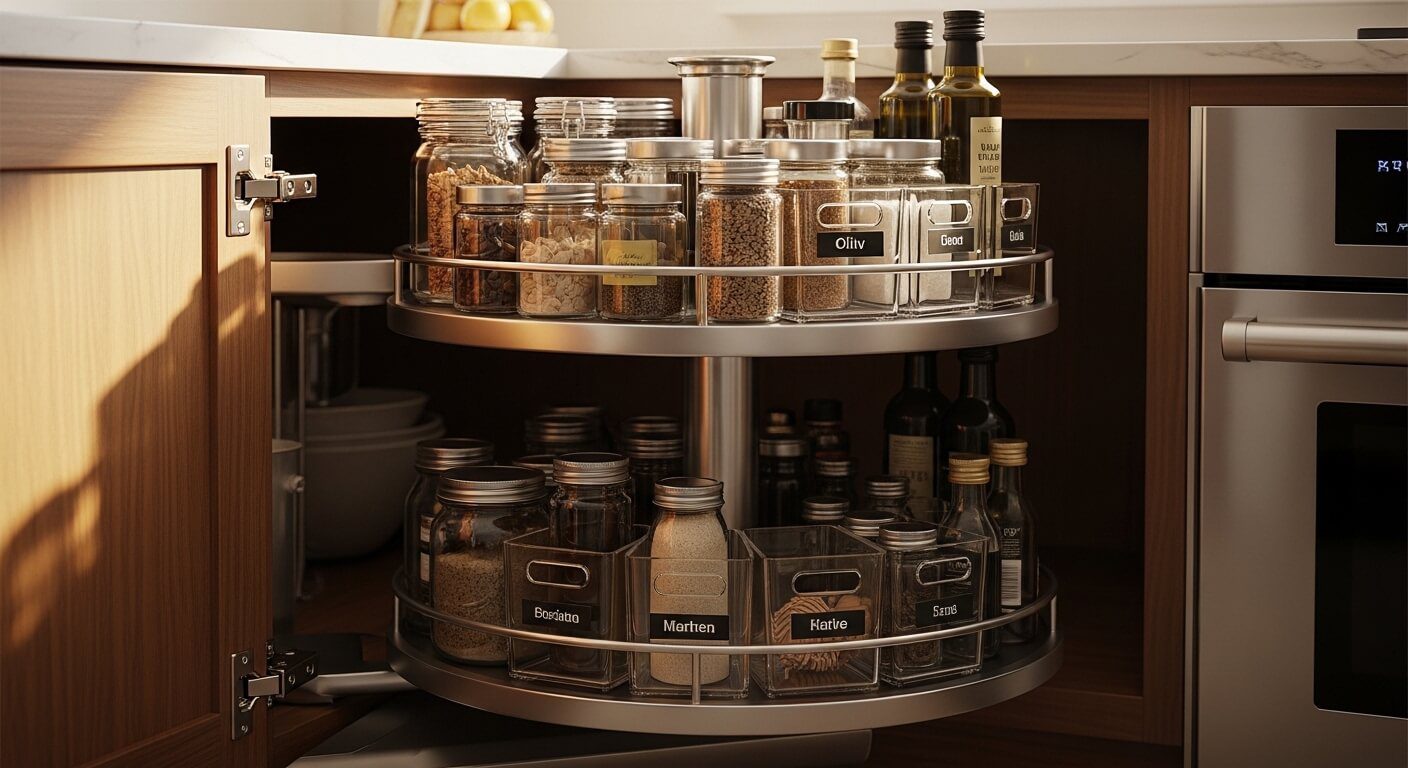
The corner cabinet lazy susan comes in two primary configurations. The first is a full-circle two-tier model that spins freely on a center pole anchored to the cabinet floor and ceiling. The second is a kidney-shaped or “pie-cut” version built into the cabinet door as two half-circle shelves that swing out when you open the door. Both work, but they suit different cabinet styles.
Freestanding two-tier lazy susans for corner cabinets — often called “carousel” organizers — are the most versatile because they don’t require modification to your existing cabinetry. They typically range from 18 to 28 inches in diameter, and many come with adjustable heights between the two tiers. Shorter bottom tier heights (around 8–10 inches) are great for shorter items like cans and jars; taller configurations (12–14 inches between tiers) handle bottles, pitchers, or appliances stored upright.
One underrated trick for corner cabinet lazy susan organizers: don’t try to organize everything by item type. Instead, group by frequency of use. The front quarter of the rotating tray (the section that faces you when you open the cabinet door) should hold the things you grab daily. Occasional-use items can live toward the back — you just spin to reach them when needed. This frequency-based zoning makes corner cabinets feel intuitive rather than chaotic.
For renters or anyone who doesn’t want to install a pole-mounted unit, there are excellent freestanding lazy susan platforms with raised edges that sit on the cabinet floor without any drilling. These aren’t as space-efficient as built-in versions, but they’re 100% removable and surprisingly stable with a non-slip base underneath.
Lazy Susan Organizer Bins: The Upgrade That Makes Everything Work Better
A bare lazy susan tray will get you 60% of the way to a well-organized space. Lazy susan organizer bins get you the rest of the way. Bins solve the one persistent problem with open turntables: small items tipping over, rolling around, or sliding off the edge when the tray spins.
The best lazy susan bins are sized in multiples that tessellate neatly on a circular base. Look for rectangular bins that can be arranged like pie slices radiating from the center — this uses the circular surface most efficiently. Square bins tend to leave awkward gaps and shift position when spinning. Round-bottomed containers are the worst choice, since they’ll roll freely the moment you touch the tray.
Material-wise, clear acrylic or transparent BPA-free plastic bins are almost always the right call for pantry and cabinet use. Transparency means you can see what’s inside without opening or pulling anything out. Labels are great, but visual identification from a distance makes the whole system faster. For bathroom or vanity lazy susans, consider mesh or metal bins that allow water to drain freely and resist the humidity that makes enclosed plastic bins feel slightly grimy over time.
Lazy susan bins also work brilliantly in closet organization setups — particularly on upper shelves where reaching and searching are the primary pain points. A spinning tray with four or five labeled bins for accessories, belts, or small folded items turns an awkward overhead shelf into a genuinely accessible storage zone. In my experience, once people try bins on a closet shelf lazy susan, they start looking for every other underutilized shelf in the house to repeat the system.
For desk or office setups, lazy susan organizer bins have found a particularly strong niche for cable management. A spinning tray with bins designated for chargers, adapters, batteries, and USB hubs is a clean solution that beats cable baskets — and much better than the drawer-of-doom approach. If you’re already working on better cable management in your workspace, a desk-height lazy susan with compartmented bins is a logical complement.
Dollar Tree Lazy Susan Organizer: What You Can Actually Achieve on a Budget
Is the Dollar Tree Lazy Susan Organizer Worth It?
The Dollar Tree lazy susan organizer became a legitimate organizing trend on social media, and for good reason. At around $1.25 for a small plastic turntable, the price barrier is essentially zero. For bathroom counters, small spice shelves, or craft table organization, the value is surprisingly solid. They’re lightweight, functional, and entirely disposable if they don’t work out — which removes the usual anxiety around committing to an organizational system.
That said, the Dollar Tree versions have real limitations. They’re typically only 6 to 8 inches in diameter, made from thin polypropylene, and spin on a basic single-ball bearing that can feel slightly sticky under heavier loads. They’re not rated for glass bottles, heavy jars, or anything that would put sustained weight on the center pivot. Where they genuinely excel is as bathroom organizers for lightweight items — cotton rounds, small tubes, travel-sized bottles — and as spice organizers for medium-weight jars on an open shelf (not inside a cabinet, where their small diameter limits utility).
One smart hack: buy four or five Dollar Tree lazy susans and use them together in different spots as a “trial run” before investing in a higher-quality 12-inch acrylic or bamboo version. Put one in the bathroom, one on the kitchen counter, one inside your cleaning supply cabinet. After a week, you’ll know exactly which location benefits most from a permanent, quality upgrade. This phased approach — test cheap, then upgrade strategically — is one of the best habits in home organization.
Lazy Susan Cost Breakdown: Budget vs. Mid-Range vs. Premium
| Tier | Price Range | Best For | Key Features |
|---|---|---|---|
| Budget | $1 – $15 | Countertop, bathroom, trial use | Plastic or acrylic, 6–10″, basic bearing, lightweight loads |
| Mid-Range | $16 – $45 | Pantry, kitchen cabinet, bins | Stainless/acrylic, 12–16″, smooth ball-bearing, raised edge, easy-clean |
| Premium | $50 – $120+ | Corner cabinet, full pantry systems | Two-tier, 18–28″, heavy-duty bearing, modular bins included, rated 50+ lbs |
Mid-range lazy susans are where most people will find the best balance. A quality 12-inch stainless steel turntable in the $20–$35 range will outlast cheaper versions by years. Premium two-tier corner cabinet systems are worth the investment if your corner cabinet is a genuine organizational nightmare — and in most kitchens, it is.
Keep in mind that lazy susans also pair well with other under-shelf and drawer organizational systems. If you’re building out an entire pantry, combining lazy susans with a tiered storage approach across multiple shelf heights will give you a cohesive system rather than a collection of unrelated pieces.
Common Lazy Susan Mistakes (And How to Avoid Them)
Wrong diameter for the space. This is the most common mistake. People buy a 12-inch tray for a 20-inch cabinet and leave 4 inches of dead space on either side. Measure your interior cabinet width, subtract 1 inch for clearance, and choose the largest diameter that still spins freely.
Ignoring weight ratings. Most budget plastic lazy susans are rated for 10–15 lbs maximum. A few glass bottles and heavy jars can easily exceed that. Overloaded bearings create wobble, scratching, and early failure. Always check the weight capacity before loading up.
Grouping items by category instead of frequency. Organizing by “all spices together” or “all cleaning products together” sounds logical, but it’s less functional than organizing by how often you reach for things. Daily-use items at the front, weekly-use at the back — spinning is effortless, so this doesn’t make weekly items inaccessible.
No containment strategy. Dropping loose items directly onto a bare tray means they migrate and tip every time the tray spins. Add bins, dividers, or at minimum non-slip liner to keep items stable and in zone.
Buying a full set without testing first. Organizational systems that look perfect in product photography don’t always translate to your specific cabinet dimensions and item sizes. Start with one tray, live with it for two weeks, then expand.
Lazy Susan Care & Longevity: Keeping Your Organizer in Top Shape
A quality lazy susan should last five to ten years or more with basic care. The most common failure point is the bearing — either the central pivot gets gritty from accumulated debris, or a ball-bearing ring gets bent under excess weight. Both are preventable with a little maintenance.
Cleaning routine. Every two to three months, empty the tray completely and wipe down both the top surface and the underside. A damp cloth with a mild dish soap solution handles most residue. For acrylic models, avoid abrasive scrubbers that scratch the surface. Let it dry fully before reloading — moisture trapped under bins accelerates any warping in bamboo models.
Bearing maintenance. If your lazy susan develops a sticky, uneven spin, turn it upside down and inspect the center bearing. A small amount of silicone spray lubricant — not WD-40, which attracts grime — applied to the pivot or ball-bearing ring typically restores smooth rotation instantly. Do this once a year as preventive maintenance even if the spin feels fine.
Weight management. Periodically take everything off the tray and reassess. It’s easy to gradually overload a lazy susan as you add items over time. If the tray has started to wobble or the bearing sounds rough, reduce the load before the bearing fails completely.
Frequently Asked Questions
What is the best size lazy susan organizer for a standard kitchen cabinet?
Is the Dollar Tree lazy susan organizer actually useful, or is it a gimmick?
How do I choose the right lazy susan organizer bins for my turntable?
What is the best corner lazy susan cabinet organizer for a blind corner?
Can I use a lazy susan organizer outside of the kitchen?
How do you organize a corner cabinet lazy susan organizer efficiently?
What material is best for a lazy susan cabinet organizer?
How do I stop items from sliding off my lazy susan when it spins?
Final Thoughts: Small Investment, Major Organizational Payoff
A lazy susan organizer isn’t a glamorous purchase. It’s not the kind of thing you post on social media or feel excited about in the store. But put the right one in the right space and you’ll notice it every single day — in the smooth pull of a pantry door, the absence of frustrated rummaging, the small but real satisfaction of a space that simply works.
Start with the space that causes you the most daily friction. For most households, that’s either the kitchen cabinet where spices and condiments live, or the dreaded corner cabinet. Get the right size, add bins if needed, and live with it for a couple of weeks before expanding the system. What usually happens is that one well-organized spot creates momentum — you start seeing opportunities in the bathroom cabinet, the linen closet, the garage shelf.
If you’re building out a more comprehensive organization system, exploring deeper strategies around pantry organization, closet organization ideas, or even under-bed storage will give you the full picture of how a layered approach can transform your home. The lazy susan is rarely a standalone solution — it’s a building block in something bigger.