
Label Maker Ideas: The Expert Guide to Organizing Every Corner of Your Home
Label maker ideas might sound like a niche topic, but anyone who has ever opened a junk drawer, stared at an unlabeled bin, or lost track of which container holds the cumin versus the coriander knows exactly why labeling is a genuine life skill. A label maker is one of those tools that seems modest until you actually start using it — and then you can’t imagine how you organized anything without it. The clarity it brings to a space is almost immediate and surprisingly satisfying.
What makes label makers so powerful is their flexibility. They’re not just for pantries. A good labeling system touches almost every room: the garage, home office, kids’ playroom, medicine cabinet, bathroom shelves, craft room, and beyond. The moment items have a named home, they tend to actually return to that home. Household chaos drops. Hunting time drops. The low-grade stress of a disorganized space quietly disappears.
This guide covers the full spectrum — from practical room-by-room label ideas to creative and funny label maker ideas for those who want their organization to have a little personality. Whether you’re just getting started or looking to take an existing system to the next level, there’s something here for every space and every style.
Why Label Makers Are a Home Organization Game-Changer
There’s a reason professional organizers carry label makers in their toolkit like a surgeon carries a scalpel. Labeling does something that no amount of bins, baskets, or beautiful storage boxes can do alone: it creates a shared language for your space. When everyone in a household knows where things belong — because it’s literally written on the container — the system sustains itself. Without labels, the most beautifully organized pantry will drift back into chaos within two weeks.
The psychology here is real. According to research published in Psychology Today, visual clutter creates low-level chronic stress. Labels reduce visual noise by signaling “this is taken care of” — the brain can release the cognitive load of tracking where things are. It’s a small change with a surprisingly large psychological payoff.
The best label maker ideas work because they’re specific without being over-complicated. A label that says “BATTERIES — AA & AAA” is more useful than one that says “MISC ELECTRONICS.” Specificity is what makes people actually put things back. The more friction you remove from the “correct” behavior, the more consistently it happens — for yourself and everyone else sharing the space.
Room-by-Room Label Maker Ideas for Every Space
Every room in your home has different labeling needs. Here’s a practical breakdown of the best ideas for label maker use across each major zone:
Pantry
Spices, dry goods, baking supplies, snacks by category. Expiry date labels on decanted items save a lot of guesswork.
Closet
Shelf zones, storage boxes, seasonal bins, shoe boxes. Labels by category (“BELTS”, “WINTER SCARVES”) instantly speed up getting dressed.
Bathroom
Medicine cabinet shelves, product baskets, first-aid kit sections, and backup supply bins under the sink.
Home Office
File folders, cable management labels, desk drawer zones, and printer/office supply storage.
Kids’ Room
Toy bins by type (LEGO, cars, art supplies), book shelves by reading level, school supply drawers.
Garage & Workshop
Tool pegboards, hardware bins (screws by size), seasonal gear boxes, sports equipment zones.
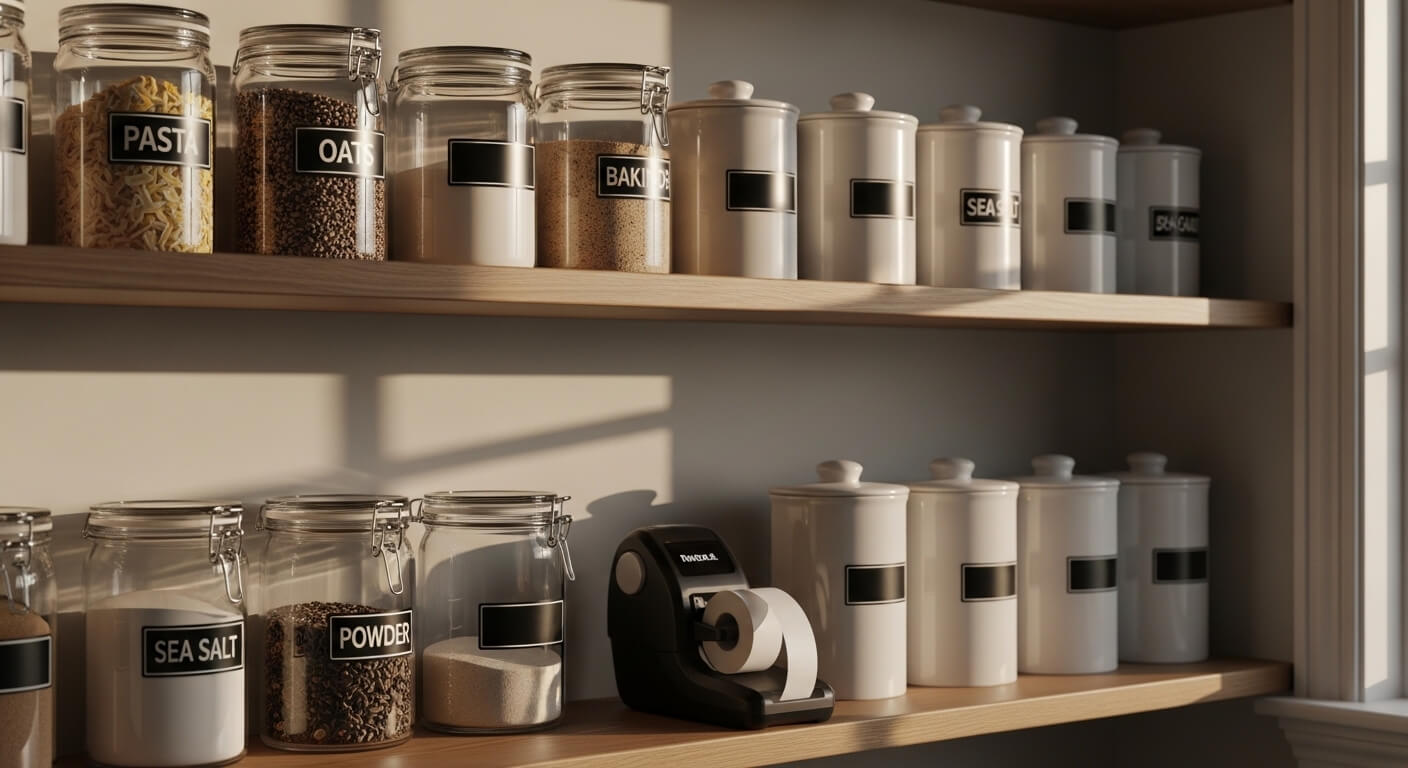
The pantry is where most people start their labeling journey — and for good reason. Proper pantry organization with clear labels on every container and shelf zone makes meal prep dramatically faster and grocery shopping smarter because you can see exactly what you have at a glance. Beyond just labeling containers, consider labeling the shelf zones themselves: “BAKING,” “BREAKFAST,” “CANNED GOODS,” “SNACKS.” When the shelf itself has a name, nothing drifts out of its category.
How Do I Decide What Text to Put on Labels?
The golden rule: label for the least informed person in the household. If your eight-year-old needs to find the craft scissors, the label should make sense to them. Use nouns, not abbreviations. “PASTA — DRIED” beats “DRY G” every time. For shared storage areas especially, clarity always wins over brevity. One thing I’ve learned from organizing spaces for friends and family: if you have to explain a labeling system for more than thirty seconds, the system is too complicated. Good labels are self-explanatory.
For storage bins throughout the home — whether in a mudroom, under-stair closet, or basement — labels on the front-facing side are far more useful than labels on top. You’ll read them far more often when scanning a shelf than when lifting a lid. Sturdy storage bins with clearly printed front labels are the backbone of any functional home organization system.
Funny Label Maker Ideas: When Organization Gets a Sense of Humor
Not every label needs to be strictly utilitarian. Some of the most beloved label maker ideas floating around home organization communities are the ones that inject a little personality into otherwise boring storage. Funny label maker ideas have become genuinely popular — a quick scroll through any home organization hashtag will surface dozens of examples that made someone laugh while they were cleaning out a drawer.
The hilarious funny label maker ideas tend to work best in personal spaces: a home bar, a dedicated junk drawer, a snack cabinet, or a garage tool zone. They set a tone without disrupting actual function. Here are some fan favorites in the community:
- “DAD’S STUFF — TOUCH AND PERISH” — classic garage pegboard label
- “MYSTERY CABLES” — for the drawer everyone has but no one understands
- “WINE: MEDICINAL PURPOSES” — home bar shelf label
- “FUTURE CLUTTER” — on a blank basket waiting to be filled
- “THINGS I’M SAVING FOR REASONS I’VE FORGOTTEN” — junk drawer section
- “BATTERIES — PROBABLY DEAD” — the universal kitchen drawer experience
- “THE GOOD SCISSORS (DO NOT USE FOR TAPE)” — every household needs this
- “SNACKS: EMERGENCY ONLY” — pantry top shelf, out of reach of children
These hilarious funny label maker ideas are genuinely functional — they tell you exactly what’s in the container and they make the person looking for something smile. That combination is surprisingly rare. Humor in a labeling system also makes the system more memorable, which means people are more likely to put things back correctly.
DYMO Label Maker Ideas: Making the Most of a Classic Tool
DYMO is arguably the most recognized label maker brand in the world, and for good reason — their machines are reliable, their tape variety is extensive, and the label output is crisp and professional. DYMO label maker ideas span a wide range because their machines handle everything from narrow file-folder labels to wide address labels, in colors from clear to metallic.
For the pantry and kitchen, the DYMO LabelWriter series (which prints on adhesive paper labels rather than embossed tape) is particularly powerful. You can print full jar labels with font variations, icons, and consistent sizing across an entire pantry — the result looks like something from a magazine spread. The key is creating a template and printing a batch rather than labeling one item at a time.
DYMO embossing label makers — the classic handheld dial-and-squeeze variety — are perfect for the garage, utility room, and kids’ spaces. The embossed labels are nearly indestructible, which matters when you’re labeling a tool pegboard or a bin that gets dragged around regularly. Some ideas for DYMO embossed labels that work particularly well: circuit breaker panels (a safety essential), garage shelving zones, utility room storage, camping and outdoor gear boxes, and holiday decoration storage bins.
For home offices where cable management is a real headache, DYMO flag labels or small wrap-around labels are a revelation. A label on every power cord, charger, and cable means you’ll never unplug the wrong thing again. This pairs beautifully with any cable management system — because a neatly routed cable that’s also labeled is the ultimate desk organization upgrade.
Brother Label Maker Ideas: Versatility for Every Room
Brother label makers are the go-to choice for people who need more versatility and design flexibility than the classic DYMO embossing style offers. The Brother P-Touch series in particular supports a wide range of tape widths (3.5mm up to 24mm), multiple font styles, borders, symbols, and colored tapes — which opens up significantly more creative possibilities for ideas for label maker projects around the home.
Brother label makers shine in the home office and craft room. The ability to use colored tape lets you create color-coded systems: red tape for urgent files, blue for client projects, green for tax documents. This visual coding layer adds a second dimension of organization on top of the text label itself. According to Harvard Business Review’s productivity research, color-coded filing systems reduce retrieval time for documents by up to 20% compared to text-only systems.
For the closet, Brother’s wider tape options allow for beautifully formatted shelf-front labels on fabric bins and baskets. A 24mm label in a clean sans-serif font, with a subtle border, looks genuinely designed rather than improvised. Pairing Brother labels with a thoughtful closet organization approach — dedicated zones, uniform bins, consistent labeling — creates a bedroom closet that looks like something from a professional organizer’s portfolio.
Brother label makers also work exceptionally well for under-bed storage labeling. Flat storage containers under a bed are essentially invisible once slid in place, which means an unlabeled one is also completely inaccessible in any practical sense. A clear, large-font label on the front pull edge — “WINTER BEDDING,” “EXTRA PILLOWS,” “HOLIDAY DECOR” — transforms those containers from forgotten dead zones into genuinely useful storage. This applies to any under bed storage setup: the label is what makes the space actually functional rather than just theoretical.
Label Design Tips: Font, Size, Color, and Tape Type
Even with the best label maker in hand, poor design choices can undermine the whole system. A few principles make the difference between labels that look professional and labels that look like they were made in thirty seconds (even if they were).
Font size matters more than people expect. A label you can’t read from three feet away is a label you’ll ignore. For shelf labels on bins and baskets, use the largest font your tape width allows — typically 18pt or above on standard 12mm tape. For file folders and narrow cable labels, 9–12pt is fine because you’ll be reading them up close. The ideas for label maker use that look best in photos always feature bold, generously sized text.
All-caps versus title case: All-caps labels look clean and intentional in most home organization contexts, particularly for category labels (“PASTA,” “BAKING,” “TOOLS”). Title case (“Pasta Jars,” “Baking Supplies”) works better for more descriptive multi-word labels where all-caps gets hard to read quickly.
Tape selection for environment: Standard laminated tape for most indoor applications. Extra-strength adhesive for garage, outdoor gear, or anything that gets handled frequently. Clear tape on dark containers for a minimal, floating-text look. White tape on light-colored containers where clear tape won’t show. Fabric tape for soft bins and cloth baskets.
Consistency is everything. A labeling system where half the labels are one font and half are another, some are caps and some aren’t, some have borders and some don’t — that system creates visual noise rather than reducing it. Pick a style and commit to it across the entire space you’re organizing. One font. One capitalization style. One tape color per zone. The result will look intentional, not improvised.
Label Maker Cost Breakdown: Budget to Premium
Label makers span a wide price range, and the right choice depends entirely on how much labeling you plan to do and in what contexts. Here’s a realistic breakdown:
| Label Maker Type | Budget ($) | Mid-Range ($$) | Premium ($$$) |
|---|---|---|---|
| Handheld Embossing (DYMO classic) | $8–$18 | $20–$35 | N/A |
| Handheld Tape (Brother P-Touch) | $20–$35 | $40–$70 | $90–$150 |
| Desktop LabelWriter (DYMO) | $50–$80 | $90–$150 | $180–$350 |
| Bluetooth/App-Connected | $35–$55 | $60–$100 | $120–$200 |
| Tape Refills (per roll) | $5–$9 | $10–$18 | $20–$35 (specialty) |
| Label Paper (LabelWriter, 250 ct) | $12–$18 | $20–$30 | $35–$60 (specialty) |
For most households doing a one-time home organization project, a mid-range handheld tape label maker ($40–$70) covers essentially every need. Bluetooth-connected models that link to a smartphone app are particularly good value in the mid-range tier — they give you vastly more font, symbol, and template options than the machine’s physical buttons alone. If you’re labeling a pantry from scratch and want that magazine-quality jar label look, a desktop DYMO LabelWriter is worth the investment.
Common Label Maker Mistakes to Avoid
A few missteps account for most failed labeling projects. Knowing them in advance saves a lot of frustration:
- Labeling before organizing: This is the big one. If the space isn’t sorted and decluttered first, labels just lock in a messy system. Always organize the physical space before applying a single label.
- Using generic labels: “MISC,” “STUFF,” “OTHER” — these labels tell you nothing. If a category is genuinely too vague to name, the problem is the category, not the label. Combine or split the category until it has a meaningful name.
- Ignoring tape compatibility: Not all tape brands work in all machines. DYMO D1 tape and Brother TZe tape are not interchangeable. Always verify tape compatibility before buying in bulk.
- Placing labels where they can’t be seen: Labels on top of bins you stack, labels on the back of containers, labels on surfaces that face the wall. Label the side that faces outward from where you stand when accessing the item.
- Never updating labels: A labeling system is a living document. When contents change, update the label. An outdated label is actively misleading — it’s worse than no label in some ways because it points you to the wrong location.
- Inconsistent tape widths: Mixing 6mm and 18mm tape on the same shelf creates visual chaos. Pick one width per category of label (shelf labels vs. bin labels vs. file labels) and stay consistent.
Frequently Asked Questions About Label Maker Ideas
What are the most useful label maker ideas for a kitchen pantry?
The pantry is where label makers deliver the highest daily return on investment. Start by labeling every decanted dry good container with both the item name and its expiry date or “purchased” date — this is especially useful for things like baking powder or yeast that look identical across jars but have very different shelf lives. Beyond containers, label the shelf zones themselves (“BREAKFAST,” “BAKING,” “CANNED GOODS,” “SNACKS”) so items always return to the right area. Add a “RESTOCK” label to a designated area where you place items running low before a grocery run. The goal is a pantry where anyone can navigate independently — even houseguests or babysitters can find what they need without asking.
What are some funny label maker ideas that actually work for real organization?
The best funny label maker ideas are ones that deliver humor without sacrificing clarity — the label still tells you exactly what’s inside or where something belongs. “BATTERIES — PROBABLY DEAD” is funny but also accurate and useful. “THE GOOD SCISSORS (DO NOT USE FOR TAPE)” is a household policy statement disguised as a label. “MYSTERY CABLES” is humorous but also the most honest name for that particular drawer. The key is that the label still communicates function. Purely abstract humor labels — something so inside-joke that a new person couldn’t figure it out — don’t work as organizational tools. Keep the joke, keep the clarity, and you’ve got hilarious funny label maker ideas that actually make the system work better because people smile when they see them and remember them.
What is the best DYMO label maker for home organization?
For most home organization needs, the DYMO LabelManager 280 or 360D offers the best balance of features and value in the handheld category — comfortable grip, backlit display, multiple font options, and compatibility with the full D1 tape range. For pantry enthusiasts who want printed paper label sheets rather than embossed tape, the DYMO LabelWriter 450 connects to a computer and prints high-quality address and jar labels from templates, giving results that look genuinely professional. For pure durability and simplicity — garage, utility room, tool labeling — the classic DYMO embossing label maker is nearly indestructible and costs under $20. Match the machine to the primary use case rather than buying the most feature-rich model by default.
What makes Brother label makers different from DYMO for home use?
Brother P-Touch label makers offer significantly more tape width variety (from 3.5mm up to 36mm on some models), a broader font and symbol library, and colored tape options that DYMO’s embossing range doesn’t match. This makes Brother particularly strong for design-conscious labeling projects where aesthetics matter — closet systems, craft rooms, home offices. Brother’s app-connected models (P-Touch Cube and Cube Pro) let you design labels entirely from your phone with access to a much larger symbol set than the physical keyboard allows. DYMO’s advantage is their LabelWriter desktop printer range, which uses paper labels rather than tape for a very different (and often more elegant) pantry-label aesthetic. Both brands are excellent; the choice comes down to whether you want printed paper labels or laminated tape labels as your primary output.
How do I label storage bins under the bed effectively?
Under-bed storage containers present a specific challenge: they’re slid in and invisible from above once stored, so the only practical label placement is on the front face or the pull tab edge — wherever you’ll see it when you’re crouched down looking under the bed. Use a wide tape (18mm or 24mm) in a large, bold font so it’s readable in low light. Categories work better than hyper-specific names here: “WINTER CLOTHING,” “EXTRA BEDDING,” “HOLIDAY DECOR” rather than “Blue Cable Knit Sweater Set.” If you use multiple identical flat containers, add a number or color code so you know which one to pull without dragging everything out. Clear bins with front labels are the gold standard for under-bed storage — you see the label and the contents simultaneously.
Can I use a label maker for cable management and home office organization?
Absolutely — the home office and cable management are genuinely some of the highest-value label maker applications in the house. Wrap-around cable labels or flag-style labels on every cord behind a desk mean you’ll never unplug the wrong thing again during a furniture rearrangement. Label the power strip ports to match the device plugged into each slot. In filing systems, labels on every folder, box, and drawer section reduce the time spent hunting for documents to nearly zero. For a more visual system, use colored Brother tape to create a color-coded filing system where each color represents a category (finances, medical, work, home). Even the circuit breaker panel — which most people leave confusingly labeled with the builder’s cryptic shorthand — becomes genuinely useful once you re-label it clearly with what each breaker actually controls.
What tape type should I use for bathroom and kitchen labels?
Always use laminated tape in any area exposed to moisture, humidity, steam, or frequent wiping — that means kitchens and bathrooms without exception. Non-laminated matte paper labels will absorb moisture, curl at the edges, and peel within weeks in these environments. Standard laminated TZe (Brother) or D1 (DYMO) tape handles normal kitchen and bathroom conditions well. For labels directly on containers that get washed or wiped down regularly, look for “extra-strength adhesive” variants — they bond significantly better to glass, ceramic, and plastic than standard tape. Clear laminated tape over a dark container (black jars, dark wood boxes) creates a clean floating-text appearance that many people find more aesthetic than white tape labels in a styled kitchen or bathroom setting.
How many labels does a typical home organization project actually need?
This varies enormously, but a full single-room labeling project — pantry, closet, or home office — typically requires between 30 and 80 individual labels depending on the level of detail. A complete whole-home labeling project for an average 3-bedroom household can run 150–300 labels across all rooms, storage areas, garage, and office. This is why buying tape in multi-packs rather than single rolls makes financial sense for any serious organization project — a single tape roll typically yields 20–35 labels depending on label length, and running out mid-project is genuinely disruptive to maintaining momentum. If you’re using a DYMO LabelWriter for pantry jars, a pack of 250–500 label sheets is a better starting point than a single roll of 130.
Building a Labeling System That Actually Sticks
The best label maker ideas are the ones you actually implement and maintain. A labeling system doesn’t have to be perfect or complete on day one — start with the space that causes the most daily frustration (usually the pantry or a chaotic storage closet), get it labeled properly, and let the satisfaction of that win motivate the next project. Organization builds momentum. One well-labeled pantry tends to inspire a labeled closet, which inspires labeled storage bins throughout the house, which eventually leads to a home that genuinely functions the way it should.
Whether you lean toward clean and minimal labels or the hilarious funny label maker ideas that give your household’s personality a place in the organization system, the underlying goal is the same: a home where everything has a name, a place, and a reason to return there. The label maker is just the tool that makes that vision legible. Give every space a language, and watch how much calmer and more functional your home becomes — one small strip of tape at a time.
If you’re ready to take your organization further, the same principles that make label maker systems work power every other aspect of home organization — from building out a smart pantry organization system to tackling a full closet organization overhaul. Labels are the final layer on top of those systems — the detail that transforms good organization into great organization.