
Kitchen Drawer Organizers: Your Complete Guide to a Clutter-Free Kitchen
⏱ Estimated read time: 9 minutes
If there is one thing that can silently derail your entire kitchen routine, it is a chaotic, overstuffed drawer. Kitchen drawer organizers are the single most underrated upgrade you can make to your home — not because they are glamorous, but because they work. The moment you stop rummaging through tangled spatulas and mystery gadgets and instead reach directly for what you need, your whole relationship with cooking changes. It sounds small. It absolutely is not.
Most kitchens have between four and eight drawers, yet the majority of households treat them as a dumping ground. The good news is that restoring order does not require a renovation, a huge budget, or even a full weekend. With the right drawer organizers for your kitchen, you can transform those chaotic compartments in under an hour. I have helped reorganize dozens of kitchens — from tight apartment galley setups to sprawling open-plan layouts — and the process is almost always the same: the right system, the right sizing, and a little bit of intention.
This guide covers everything you need to know: the different types of kitchen cabinet drawer organizers available, how to choose between budget-friendly and premium options, material comparisons from bamboo to acrylic, where to buy them (including some surprising options in Canada), and how to maintain them long-term. Whether you are starting from scratch or refining a half-hearted drawer setup, you will find exactly what you need here.
Types of Kitchen Drawer Organizers You Need to Know
Not all drawer organizers are created equal — and the type that will serve you best depends entirely on what lives in your kitchen drawers. The broadest categories are expandable trays, modular inserts, built-in peg systems, and deep-drawer organizers. Each one solves a different problem.
Expandable trays are the most common entry point. They typically stretch from about 12 inches to 21 inches wide, which means they can fit inside a wide variety of standard drawer sizes. They come with fixed compartments for cutlery — forks, knives, spoons, serving utensils — and often include a small section for miscellaneous items. For a basic utensil drawer, an expandable tray is usually all you need.
Modular inserts are a completely different approach. Rather than buying one piece that tries to do everything, you buy individual bins and slot them together like building blocks. This is perfect for storage bins you already own, since modular systems let you incorporate different container sizes into a cohesive layout. They are particularly popular in spice drawers, junk drawers, and deep kitchen tool drawers where a one-size tray simply does not cut it.
Built-in peg systems — often associated with Scandinavian kitchen design — use a grid base with removable pegs you position yourself. You essentially design your own compartments. These are the most flexible and the most expensive, but for a custom kitchen with non-standard drawer dimensions, they can be a genuinely elegant solution.
Deep-drawer organizers deserve their own mention because standard shallow trays are a terrible fit for pots, pan lids, and larger tools. If your kitchen has tall drawers (more than 5 inches deep), look specifically for stackable or tiered inserts that take advantage of all that vertical space — something most people forget to consider.
Best Kitchen Drawer Organizers by Material: Bamboo, Acrylic, and Beyond
The material of your drawer organizer affects not just aesthetics but durability, ease of cleaning, and how it holds up over years of daily use. The four dominant materials you will encounter are bamboo, plastic/acrylic, wood composites, and stainless steel, and each has real trade-offs worth understanding.
Are bamboo kitchen drawer organizers actually worth the price?
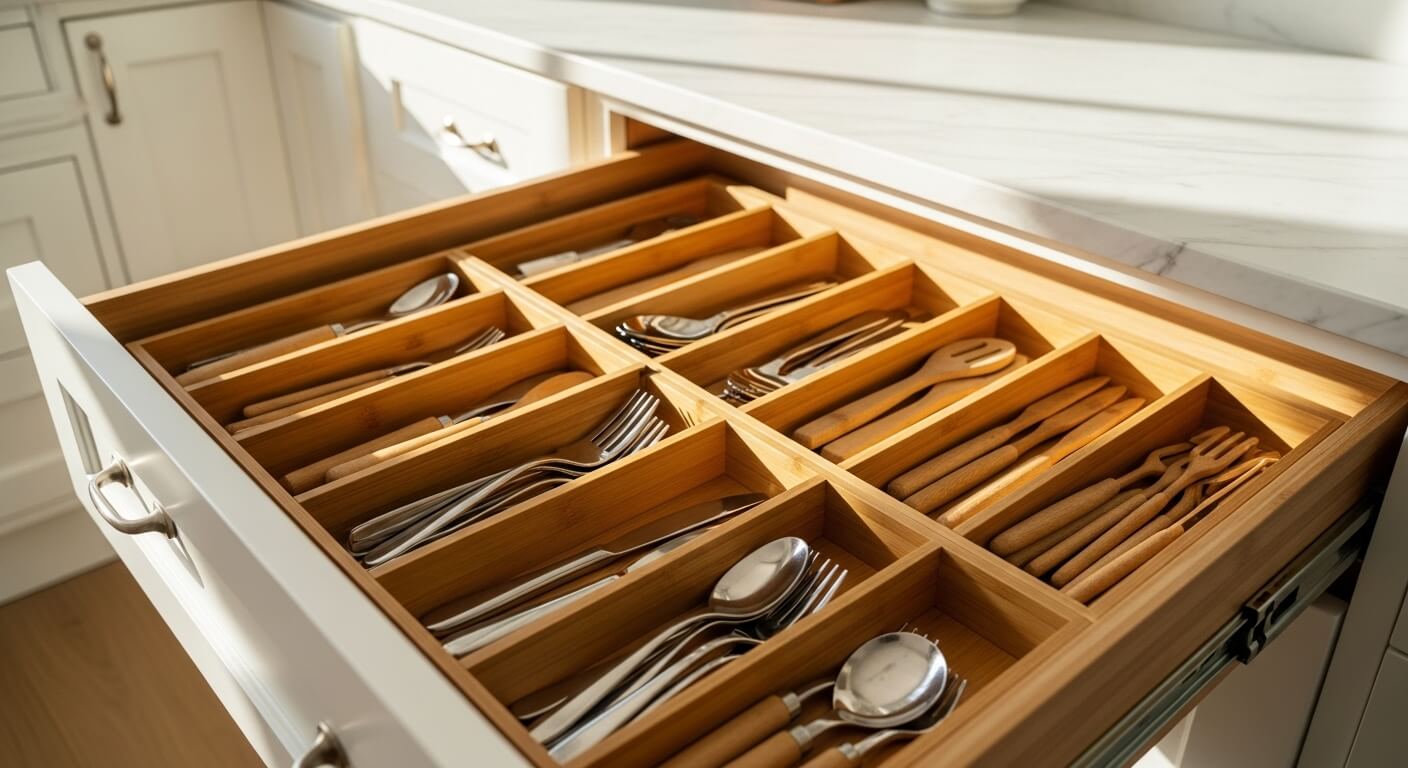
Bamboo kitchen drawer organizers have had a genuine surge in popularity, and for good reason. Bamboo is a renewable resource, naturally antimicrobial, and looks genuinely beautiful in both modern and traditional kitchen settings. The warm grain texture adds warmth that acrylic or plastic simply cannot replicate. In terms of durability, well-made bamboo organizers can last a decade or more when kept dry. The downside: they do not tolerate moisture well. If your drawers get splashed or you wash them under running water, bamboo can warp and crack over time. Hand-wipe only, and they will reward you for years.
Acrylic and clear plastic organizers have the advantage of transparency — you can see exactly what is in each compartment without lifting anything. They are dishwasher-safe (usually), lightweight, and available in the widest range of sizes. The trade-off is that cheaper acrylic scratches easily and can yellow over time, especially with exposure to sunlight. If you are going the acrylic route, invest in thicker-walled versions from reputable brands rather than the thinnest possible option.
Stainless steel organizers are less common in home kitchens but absolutely worth considering for longevity. You will often see them in commercial kitchens for a reason — they are nearly indestructible, non-porous, and wipe clean in seconds. For a sleek, modern kitchen with a lot of metal hardware, stainless organizers can look stunning. They are heavier, which may matter in soft-close drawers, and they are typically the most expensive option.
How to Measure Your Drawers Before You Buy
This is the step that most people skip — and the most common reason organizers get returned. Before you buy anything, measure the interior of your drawer in three dimensions: width, depth (front to back), and height. These measurements are not always what you expect.
The width and depth of the drawer’s interior are almost always slightly smaller than the exterior cabinet dimensions due to the frame and drawer slide hardware. In my experience, most standard kitchen drawers sit between 18 and 21 inches wide and 16 to 20 inches deep. Deep drawers — the tall ones typically used for pots and lids — can be anywhere from 6 to 12 inches tall. Always measure to the interior floor of the drawer, not to the top of the drawer box.
Leave a small gap — about a quarter inch on each side — so that the organizer slides in and out without binding. If you are using modular inserts, you can fill a drawer almost exactly to its dimensions since the individual pieces can be mixed and matched to fit snugly.
If you manage a larger kitchen organization project — perhaps redoing your pantry at the same time — thinking about pantry organization systems alongside drawer solutions can help you develop a cohesive approach to the entire kitchen rather than piecemeal fixes that look and function differently from space to space.
Cost Breakdown: What to Expect at Every Budget
One of the questions I get asked most often is simply: how much should I spend? The honest answer is that you can get genuinely good results at every price point — but what you get for your money varies considerably. Here is a realistic breakdown of what to expect at each tier.
| Category | Budget ($5–$20) | Mid-Range ($20–$60) | Premium ($60–$150+) |
|---|---|---|---|
| Materials | Thin plastic, lightweight bamboo | Thick acrylic, solid bamboo, wood composite | Solid hardwood, stainless steel, custom peg systems |
| Typical Products | Basic cutlery trays, simple bins | Expandable trays, modular sets, IKEA inserts | OXO, Rev-A-Shelf, Hafele peg systems |
| Longevity | 1–3 years with daily use | 4–8 years | 10+ years, often lifetime with care |
| Best For | Renters, temporary setups, testing layouts | Most homeowners, standard kitchen sizes | Custom kitchens, long-term investments |
| Where to Buy | Dollar stores, Amazon basics, Walmart | IKEA, Canadian Tire, Target, The Container Store | Specialty kitchen stores, direct brand websites |
For most households, the mid-range category offers the best value. You get genuine durability without overspending on a single drawer upgrade. That said, if you are redoing a kitchen you intend to stay in for ten-plus years, investing in the premium tier for your most-used drawers — particularly the main utensil drawer and the junk drawer — pays dividends in both function and resale value.
Where to Buy Kitchen Drawer Organizers: Your Best Options
Where to buy kitchen drawer organizers for every budget
The sheer number of places selling drawer organizers can be overwhelming, but a few standouts consistently deliver on quality and variety. In the United States and Canada, The Container Store remains the gold standard for variety — their OXO, iDesign, and house-brand lines cover virtually every drawer type and size. Prices are higher, but the quality control is excellent and the staff know their products well.
For online shopping, Amazon is the obvious first stop — but the quality range is enormous. Stick to brands with thousands of verified reviews and clear measurements listed in the product description. Be especially cautious of products that list measurements vaguely or only in centimeters without imperial equivalents — often a sign of an overseas listing with inconsistent quality control.
Canadian tire kitchen drawer organizers: what is available?
Canadian Tire is a legitimate option for shoppers in Canada, and the selection has improved considerably over the last few years. Their Mastercraft and private-label organization lines offer solid expandable trays and basic modular bins at prices that are competitive with Amazon after currency conversion. The main limitation is variety — if you have a non-standard drawer size or want a specific aesthetic, Canadian Tire’s in-store selection may not have what you need. Their online store (canadiantire.ca) carries a broader range and allows ship-to-store for free. For basic cutlery organizers and straightforward kitchen drawer inserts, it is absolutely worth checking before defaulting to an online marketplace.
Home Depot and Lowe’s carry drawer organization products in their kitchen hardware sections — these tend to skew toward the more functional and utilitarian end, with heavy representation from Rev-A-Shelf, a brand well-regarded among kitchen renovators. If you are doing a larger kitchen project and want products that integrate with your cabinet hardware, this is a smart place to browse. You can also find interesting solutions for cable management in those same aisles if you are tackling office or kitchen desk drawers at the same time.
IKEA Kitchen Drawer Organizers: A Realistic Assessment
IKEA kitchen drawer organizers occupy a unique space in the market — they are genuinely well-designed, made to fit IKEA’s own cabinetry dimensions perfectly, and priced at a point that makes outfitting an entire kitchen affordable. If you have a KALLAX, SEKTION, or METOD kitchen, the UPPDATERA and VARIERA series are almost certainly the most efficient choice you can make.
The UPPDATERA line in particular has earned a dedicated following. The drawer inserts come in both bamboo and light grey plastic, with compartment configurations for cutlery, knives, and spices. They are sized to nest perfectly within IKEA drawer widths without modification, and the finish quality — particularly on the bamboo variant — is notably better than you might expect at the price point.
That said, IKEA organizers are not ideal for non-IKEA kitchens. Their sizes follow metric standards and are optimized for IKEA drawer depths. If your kitchen is from a different manufacturer, you may find that IKEA inserts are either slightly too short (leaving awkward gaps) or too long (requiring the drawer to be modified or left partially empty). Always verify measurements before assuming IKEA’s options will translate to a non-IKEA cabinet.
One often-overlooked IKEA product is the STÖDJA bin — a simple, stackable plastic container that works beautifully in deep drawers for grouping condiment packets, small gadgets, or snack bars. It is similar in spirit to the approach used in thoughtful closet organization ideas, where grouping by category in clear containers makes retrieval intuitive and fast.
Double Kitchen Drawer Organizers and Specialty Solutions
What are double kitchen drawer organizers and when do you need them?
Double kitchen drawer organizers — sometimes called two-tier or stacked drawer inserts — are designed for deep drawers where standard flat trays waste the available vertical space. They function essentially as a drawer within a drawer: a lower layer holds less-frequently used items, while an upper sliding or removable layer keeps daily-use items immediately accessible. This design is particularly common in European kitchen systems and is gaining traction in North American renovations.
The most practical use case is a deep spice drawer. Rather than a single flat tray with spices all in one layer (making the back row nearly invisible), a double organizer lets you see two full rows of labels at once. Kitchen organization experts at BBC Good Food consistently recommend this approach as one of the highest-impact changes a home cook can make.
Knife drawer inserts are another specialty category worth knowing. A proper knife block insert — usually made from wood or high-density foam with individual slots — protects your blades from dulling through contact with other utensils. According to Serious Eats, in-drawer knife storage is actually preferable to countertop blocks in terms of blade preservation because knives are stored horizontally with no pressure on the edge. If you own quality knives, this one insert is worth every penny.
Pegboard-style drawer inserts, popularized by brands like Rev-A-Shelf and Häfele, use a grid base with removable pegs you reposition as your storage needs change. They are the most adaptable solution available and are particularly popular in kitchen cabinet drawer organizer configurations for pots, lids, and cookware — items with irregular shapes that defy standard tray compartments. The investment is higher, but the flexibility is unmatched.
Common Mistakes People Make With Drawer Organizers
Even well-intentioned organization projects go sideways. After helping dozens of people tackle their kitchen drawers, I have noticed the same errors come up repeatedly — and they are all very fixable once you know what to watch for.
Buying before measuring. This is far and away the most common mistake. It seems obvious in retrospect, but the excitement of buying new organization tools frequently leads people to skip the five-minute step of measuring their actual drawers. The result is either an organizer that does not fit or one that fits but leaves large empty gaps that collect crumbs and debris.
Organizing without decluttering first. An organizer cannot fix a drawer that simply has too many things in it. Before installing any tray or insert, pull everything out of the drawer and make three piles: keep, donate or toss, and relocate. You will almost always find gadgets you forgot you owned, duplicates of items you re-bought because you could not find the original, and things that genuinely should live somewhere else entirely.
Underestimating drawer depth. As mentioned earlier, deep drawers with shallow inserts waste enormous amounts of vertical space. Think about the full three-dimensional volume of the drawer, not just its footprint.
Choosing style over function. Bamboo looks gorgeous. But if your drawer regularly gets water splashed into it — near the sink, for example — bamboo is the wrong material choice, no matter how beautiful it is. Match the material to the environment, not to your aesthetic wishlist.
Ignoring the junk drawer. Most households have at least one catch-all drawer. Rather than giving up on it, give it the same systematic treatment as every other drawer — just with smaller, simpler bins. The goal is not to eliminate randomness but to give randomness a structure. Think of it the same way you would approach under bed storage — the stuff that does not have a perfect home still deserves a designated spot.
Longevity and Maintenance: Making Your Organizers Last
The best kitchen drawer organizer in the world will not serve you well if it is never cleaned. Drawer inserts accumulate crumbs, moisture, and cooking residue faster than most people realize — and in a kitchen environment, that debris can create odors and even attract pests if left too long.
For plastic and acrylic organizers, a monthly wipe-down with a damp cloth and a small amount of dish soap is sufficient for routine maintenance. Once or twice a year, remove the organizer completely, wash it thoroughly (most are dishwasher-safe on the top rack), and wipe down the bare drawer before reinstalling. This is also a good opportunity to reassess whether your current organization system is actually working for your daily habits.
Bamboo organizers require a gentler approach. Never soak them in water and never put them in the dishwasher. A damp cloth wipe-down is all they need for routine cleaning. Every six months or so, applying a very light coat of food-safe mineral oil to the bamboo surface will prevent drying and cracking and keep the finish looking fresh. According to FDA food contact safety guidance, food-safe mineral oil is appropriate for wood and bamboo surfaces that contact food items.
For modular plastic bins and peg-system bases, the main maintenance consideration is the pegs themselves — they can work loose over time. Check them quarterly and press any loose pegs firmly back into place before items start shifting around in the drawer. If a peg breaks, most reputable brands sell replacement peg sets separately, so you do not need to replace the entire system.
One practical tip that rarely gets mentioned: line the bottom of your organizer (or the drawer itself) with a thin non-slip mat or even a sheet of shelf liner. This prevents the organizer from sliding during drawer operation, reduces noise, and provides an additional layer between the organizer and the drawer floor that makes cleaning even easier.
Finally, reassess your drawer organization layout every year or so. Life changes — new cooking habits, new tools, a bigger family or an empty nest — and what worked perfectly two years ago may no longer serve your actual needs. Organization is not a one-time event. It is a living system that should evolve alongside how you actually use your kitchen. Good organizational systems, whether for kitchen drawers or for broader closet organization ideas, share this quality: they are designed to be updated, not just installed.
Final Thoughts on Kitchen Drawer Organizers
A well-organized kitchen drawer is one of those small-but-significant improvements that changes the texture of everyday life. You do not notice it dramatically — you just notice that cooking feels easier, mornings feel less frantic, and you stop wasting time hunting for the right tool. That is the quiet magic of kitchen drawer organizers done well.
Start with your most-used drawer, measure carefully, choose a material that fits your kitchen environment, and do not overthink the system. Even a simple expandable tray in the right drawer will make a meaningful difference on day one. Once you see how effective drawer organization is, the rest of the kitchen almost organizes itself.
If you are on a broader home organization journey, the same principles that make drawer systems work — categorization, right-sized containers, regular maintenance — apply equally to pantry organization and even to storage solutions beyond the kitchen, like under bed storage for seasonal items. A thoughtful approach to storage bins and containers throughout the home creates a kind of systemic order that is genuinely life-improving — not just aesthetically, but practically.