
Cleaning Supply Storage: Complete Guide to an Organized, Efficient Home
Getting your cleaning supply storage right is one of those changes that quietly transforms how your entire home feels. Think about the last time you reached under the kitchen sink and had to wrestle past a tangle of spray bottles, half-empty jugs, and rogue scrub brushes just to grab what you needed. Good cleaning supply storage isn’t a luxury — it’s a practical necessity that saves you time, money, and genuine frustration every single week.
The challenge is that cleaning products come in wildly different shapes and sizes. Tall mop handles, squat dish soap bottles, slim microfiber cloths, bulky vacuum attachments — there’s no single solution that handles everything perfectly. That’s exactly why this guide covers the full spectrum: from a dedicated cleaning supply storage cabinet to portable caddies, drawer organizers, mounted systems, and clever repurposed containers. Whether you’re working with a spacious laundry room or a narrow closet the size of a phone booth, there’s a workable strategy here for you.
One thing I’ve learned after years of experimenting with home organization: the best system is the one you’ll actually maintain. Complicated setups with color-coded labels for every subcategory sound great in theory, but they collapse the moment life gets busy. This guide focuses on realistic, durable solutions — the kind that hold up on a Tuesday night when you’re cleaning up after dinner and just need to grab a product fast without thinking too hard.
Why Cleaning Supply Storage Matters More Than You Think
Most people underestimate the downstream impact of poor cleaning supply organization. When your supplies are scattered across three different rooms with no logical system, you end up buying duplicates of products you already own (because you couldn’t find them), letting cleaning tasks slide because gathering supplies is too much effort, and storing incompatible chemicals dangerously close together. According to the U.S. Consumer Product Safety Commission, improper chemical storage in homes contributes to thousands of accidental poisoning incidents every year — many of which are entirely preventable with better organization.
Beyond safety, there’s a real efficiency argument. Studies on household behavior have consistently shown that the friction involved in a task — how hard it is to start — determines whether we actually do it. If grabbing your bathroom cleaner requires opening three cabinets and moving five things out of the way, you’re going to clean the bathroom less often. Reduce the friction, and the task suddenly feels far less daunting.
A well-thought-out storage plan also protects your products. Cleaning chemicals stored in areas with extreme temperature fluctuations — like an uninsulated garage — can degrade faster, lose effectiveness, and in some cases become hazardous. Proper storage extends product life and saves money over time. If you’re already working on broader pantry organization in your home, applying the same zone-based logic to cleaning supplies will feel like a natural next step.
Cleaning Supply Storage Cabinet: Built-In and Freestanding Options
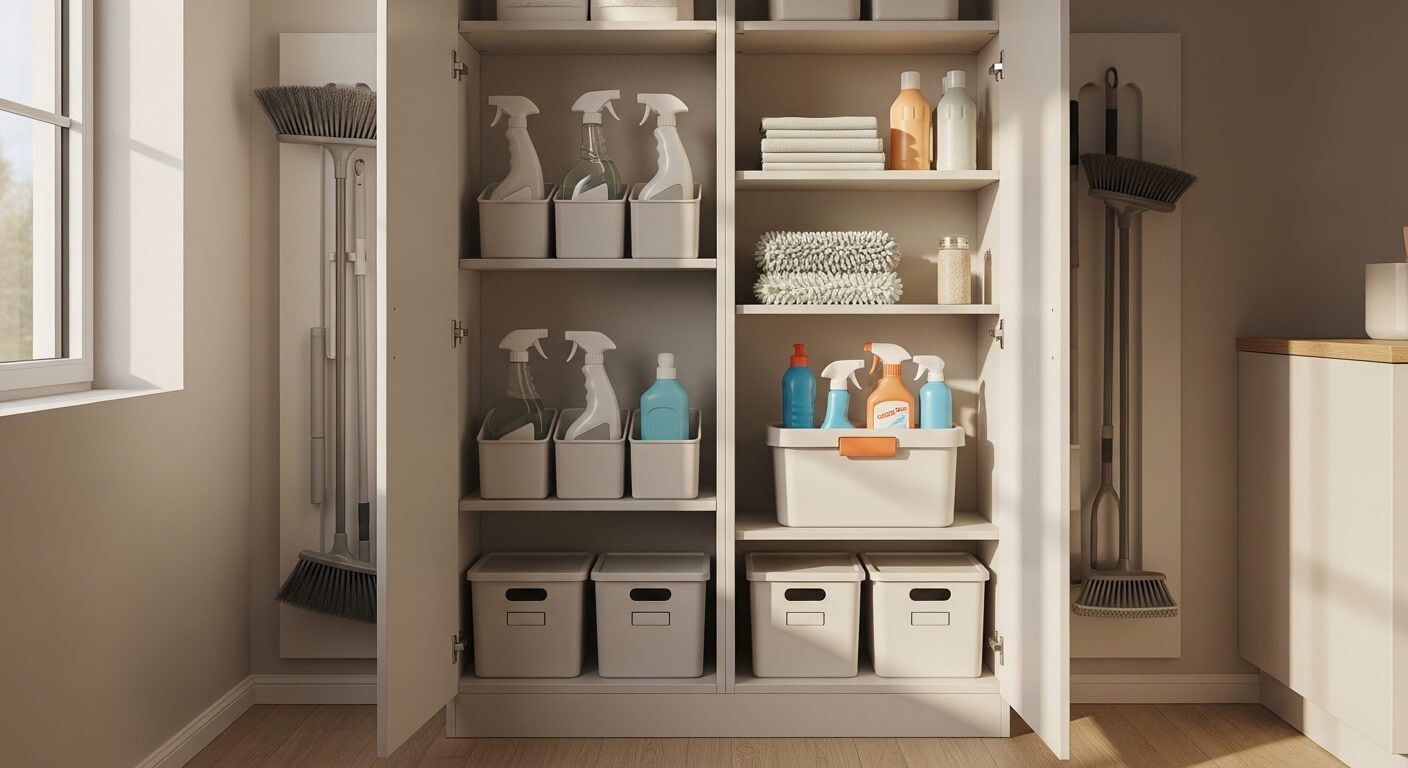
A dedicated cleaning supply storage cabinet is the gold standard for homes where organization is a priority. Cabinets offer the great advantage of concealment — everything is neatly hidden, the visual clutter disappears, and you can lock hazardous products away from curious children or pets. The question is whether you go built-in, freestanding, or somewhere in between.
What Should You Look for in a Dedicated Cleaning Cabinet?
Height is probably the single most important factor. Mops, brooms, and long-handled brushes need vertical clearance — ideally at least 60 inches of usable interior height. Look for cabinets with adjustable shelving so you can reconfigure as your supply collection evolves. A cabinet with a tall open section for long tools, a middle shelf for medium-sized bottles and sprays, and a lower section with a door-mounted rack for small items is the trifecta. Pegboard panels installed on the inside of cabinet doors are a clever addition, letting you hang small tools, gloves, and spray bottles without wasting a single inch of shelf space.
Freestanding metal utility cabinets (often marketed as garage storage) work brilliantly for this purpose, especially in laundry rooms. They’re typically deeper than kitchen cabinets, handle moisture well, and cost anywhere from $80 to $250 depending on quality. For a more polished look in a visible area, tall bathroom linen cabinets adapted for cleaning supply use can look intentional and attractive.
If you have a hallway closet that isn’t being used efficiently, converting it into a cleaning supply storage cabinet with adjustable wire shelving, a tension rod at the top for hanging spray bottles, and a few sturdy hooks on the back of the door can create a surprisingly capable organizational hub. This approach works especially well alongside broader closet organization ideas that maximize every cubic inch of available space.
Cleaning Supply Storage Organizers: Systems That Actually Work
The organizer market for cleaning supplies has matured considerably in recent years. Where once your only option was a basic plastic bin, you can now find purpose-built cleaning supply storage organizers with compartments sized specifically for spray bottles, rolling carts with removable bins, wall-mounted panel systems, and tension rod dividers that work inside any cabinet.
Which Type of Organizer Works Best for Under-Sink Storage?
Under-sink storage is notoriously awkward due to the plumbing that cuts through the usable space. Stackable pull-out drawers designed specifically for under-sink use are the smartest solution — they let you access items in the back without unloading everything in front. Look for ones with a notched back panel that accommodates pipes. A turntable (lazy Susan) on the open shelf space beside the pipes allows you to spin bottles to the front without reaching deep into the cabinet. Add a tension rod mounted horizontally across the upper portion of the cabinet to hang spray bottles by their trigger necks, and you’ve suddenly doubled your storage capacity without spending much at all.
Wall-mounted panel systems — popularized by brands in the garage organization space — translate beautifully to laundry rooms and utility spaces. These systems use a pegboard or slatted wall panel with interchangeable hooks, baskets, and shelves. You can customize the layout entirely, rearranging components as your needs change. The initial investment runs $60–$150 for a quality system, but the long-term flexibility is unbeatable.
Rolling utility carts deserve a special mention. A three-tier rolling cart — particularly popular in kitchen and craft organization spaces — works remarkably well for cleaning supplies. Dedicate the top tier to daily-use items (all-purpose spray, dish soap, paper towels), the middle to weekly-use products, and the bottom to specialty or seasonal cleaners. The rolling function means you can wheel it right to where you’re working. If you’ve already explored storage bins for other areas of your home, you’ll find similar principles apply here.
Choosing the Right Cleaning Supply Storage Caddy
A portable cleaning supply storage caddy might be the single most impactful purchase you make for your cleaning routine. The caddy concept is simple: you load it once with everything you need for a full cleaning session, carry it from room to room, and put it back in its home base when you’re done. No more running back to the supply closet between every task. No more forgetting the bathroom scrubber when you’re already upstairs.
What Features Make a Cleaning Caddy Worth Buying?
The best caddies balance capacity with portability. A caddy so large you can’t comfortably carry it is self-defeating. Look for sturdy handles — ideally ergonomic grips rather than thin plastic handles that cut into your palm when loaded. Deep side pockets or slots for spray bottles are essential, as bottles tend to tip and spill in open-top caddies. A central handle design, where the handle runs down the middle dividing the caddy into two sections, offers excellent balance. Materials matter too: melamine foam, thick polypropylene, or stainless steel all handle exposure to cleaning chemicals far better than cheap thin plastics that can warp, stain, or crack over time.
For multi-story homes, keeping a separate caddy stocked and ready on each floor is a strategy that genuinely changes your cleaning habits. The small upfront cost of a second caddy is quickly recovered in time savings. Load them identically — same products in the same positions — so muscle memory kicks in and you’re never hunting for anything.
Cleaning Supply Storage Box and Bin Ideas for Every Space
Sometimes a cleaning supply storage box is exactly what a situation calls for — particularly for supplies that need to be grouped together but don’t need frequent access. Think: the seasonal carpet cleaner, the specialty wood polish, the once-a-year silver cleaning kit. Grouping these in a clearly labeled box keeps them out of your daily workflow while ensuring you can find them when needed.
Clear storage bins are the obvious choice for visibility, but don’t overlook handled bins — the kind with an open top and a rope or plastic handle. These function brilliantly in pantry-style closet shelving, where you can grab the whole bin, carry it to the kitchen, use what you need, and return it without having to reorganize a single thing. Lidded bins work well for supplies that shouldn’t be exposed to dust or light. The container and storage industry has expanded significantly to meet growing consumer demand for home organization solutions — which means there are genuinely excellent products available at every price point.
For under-bed storage situations — which works surprisingly well for bulk extra supplies like spare sponges, backup paper towel rolls, or large refill containers — flat, wheeled bins are ideal. If you’re already using under bed storage for linens or seasonal items, adding a slim cleaning supply bin on the opposite side of the bed frame maximizes the space without creating clutter.
| Storage Solution | Budget ($10–$40) | Mid-Range ($40–$120) | Premium ($120+) |
|---|---|---|---|
| Cabinet | Wire shelving unit, repurposed bookcase | Freestanding metal utility cabinet | Custom built-in with door hardware |
| Organizer System | Tension rods, basic bins, lazy Susan | Under-sink pull-out drawers, wall pegboard | Modular wall panel system with accessories |
| Caddy | Plastic divided caddy | Ergonomic handled caddy, heavy-duty plastic | Stainless steel or bamboo premium caddy |
| Storage Box/Bin | Dollar store handled bins, repurposed containers | Clear stackable bins with lids, labeled sets | Matching lidded bin sets with custom labels |
| Rolling Cart | Basic 3-tier plastic cart | Metal rolling cart with locking casters | Stainless steel professional utility cart |
Clever Cleaning Supply Storage Ideas for Small Homes
Small-space living demands creative thinking. When you don’t have a dedicated utility room or even a large closet to spare, you have to extract storage from places that don’t announce themselves as storage spaces. These cleaning supply storage ideas are specifically designed for apartments, studio living, and homes where every square foot counts.
Over-the-door organizers are perhaps the most underused tool in small-space organization. A sturdy over-the-door shoe organizer — the kind with clear plastic pockets — mounted on the back of a bathroom door or inside a cabinet door creates instant, visible storage for spray bottles, sponges, gloves, and small cleaning tools. The pockets are see-through, so you always know what’s there and what needs restocking.
Tension rod dividers inside deep kitchen cabinets let you stand cutting boards, baking sheets, and yes — cleaning supplies — vertically, making them individually accessible instead of stacked. A second tension rod mounted higher in a cabinet creates a hanging zone for spray bottles. This single $4 solution, used twice, can transform a chaotic under-sink cabinet.
Magnetic strips mounted on cabinet walls hold metal-topped spray bottles, small metal tins, and even some stainless-steel tools. Think of how a knife magnetic strip works in a kitchen — the same principle applies to lighter cleaning tools in a utility space. Combined with proper cable management for any electric cleaning devices you own (steam cleaners, robot vacuums, cordless vacuums), this approach keeps even a tiny utility nook completely tidy.
The Zone Strategy: Organizing Cleaning Supplies by Location
One of the most impactful shifts you can make in how you store cleaning supplies is moving away from a centralized supply closet model toward a zone-based model. The idea: supplies live closest to where they’re used. Kitchen cleaners under the kitchen sink. Bathroom supplies under the bathroom vanity. Glass cleaner and dusting supplies in a hall closet near your main living areas. Outdoor and heavy-duty products in the garage or laundry room.
This isn’t about having duplicates of everything — it’s about strategic placement of specific products. You might have one all-purpose spray per zone, but the specialty tile grout cleaner lives only in the bathroom zone. The oven cleaner lives in the kitchen zone. The furniture polish lives in the living room zone. When everything is where you expect it to be, the friction of cleaning drops dramatically and tasks that used to feel overwhelming start feeling routine.
Labeling each zone matters more than most people realize. Even if you live alone and know exactly where everything is, labels make restocking effortless and eliminate the creeping disorder that sneaks in when products get returned to the wrong spot after use. Simple printed labels applied to bins, baskets, and shelves take ten minutes to create but pay dividends for months. The Purdue Extension research on home organization consistently shows that labeled systems maintain order significantly longer than unlabeled ones.
Safety, Labeling, and Child-Proofing Your Cleaning Supply Storage
No discussion of cleaning supply storage is complete without addressing safety. Cleaning products contain some of the most potent chemicals found in the average home. Improper storage doesn’t just create mess — it creates genuine risk. There are a few non-negotiable rules that should shape every storage decision you make.
Keep hazardous products locked. If you have children under 12 or pets in the home, any cabinet containing bleach, ammonia-based cleaners, oven cleaners, or drain chemicals must have a child lock at minimum. A proper lock is better. The investment is $8–$15 for a cabinet lock set — an easy trade-off against potential medical emergencies.
Never mix storage of incompatible chemicals. Bleach and ammonia-based products should never sit side by side — if containers leak or break, the resulting fumes are dangerous. Keep these product categories in separate zones wherever possible, or at minimum separated by substantial physical distance within a cabinet.
Ventilation matters. Cleaning chemicals off-gas even through sealed caps. Storing large quantities in a small, unventilated space — like a completely sealed cabinet in a bathroom with no window or exhaust fan — can allow fume buildup over time. Cabinets with louvered doors or small ventilation gaps are preferable for chemical storage.
Common Mistakes People Make with Cleaning Supply Storage
Even well-intentioned organizers fall into predictable traps. Recognizing these mistakes before you build your system saves significant time, money, and frustration down the line.
Mistake 1: Buying storage before auditing supplies. It’s tempting to rush out and buy bins, organizers, and a caddy before taking stock of what you actually have. The result is usually containers that are the wrong size, duplicates of products you already owned (but couldn’t find), and an expensive reorganization that has to be redone three months later. Always start with a full audit: pull everything out, dispose of expired or empty products, and only then design your storage around what remains.
Mistake 2: Prioritizing aesthetics over function. Matching bins that look gorgeous on Instagram might not work for spray bottles that don’t fit through narrow openings. Wicker baskets that stain with chemical drips. Fabric-covered boxes that absorb moisture. Your storage needs to handle the realities of its contents — choose materials that are water-resistant, wipeable, and structurally suited to what they’ll hold.
Mistake 3: No designated “incoming” spot. When you bring home new cleaning supplies, where do they go? If the answer is “wherever I can find space,” that’s how a well-organized system degrades within weeks. Designate a specific incoming shelf or bin and make restocking a deliberate act of placing new items in the correct zone.
Mistake 4: Ignoring vertical space. Most under-sink and closet storage only uses the bottom half of the available height. Wall-mounted hooks, hanging organizers, tension rod systems, and over-door racks all tap into the vertical dimension. In a 36-inch deep closet, using the full 72 inches of height can triple your effective storage capacity.
Mistake 5: Building a system too complex to maintain. Twelve subcategories, color-coded zones, individual slots for every item — impressive at setup, abandoned within a month. Build the simplest system that solves your actual problems. Complexity is the enemy of consistency.
Keeping Your System Fresh: Longevity and Maintenance Tips
The best cleaning supply storage system is one you actively maintain, not one you set up once and expect to stay perfect forever. Life changes — you add new products, phase out old ones, move to a new home, or simply develop different cleaning habits. Building maintenance into your routine is what separates temporarily organized people from genuinely organized ones.
Schedule a quarterly audit of 15–20 minutes. During this time: remove everything from your storage zones, wipe down shelves and bins (cleaning the cleaning supply storage is deeply satisfying), discard empties or expired products, and restore everything with intention. This regular reset prevents the slow accumulation of clutter that eventually overwhelms any system.
Replace damaged bins and organizers promptly. A cracked bin that’s been repaired with tape, a caddy with a broken handle, a cabinet door with a failing hinge — these small structural failures are the beginning of a system breakdown. The discomfort of using damaged organizational tools trains you to stop using the system properly. A $12 replacement bin is worth buying immediately.
Finally, involve everyone in the household in understanding the system. A storage system only one person understands will only be maintained by one person. A ten-minute walkthrough with family members — showing where each category lives, how the zones work, and where to return things after use — dramatically increases how long any system stays functional. Organization is ultimately a shared household behavior, not a solo project.
Frequently Asked Questions About Cleaning Supply Storage
What is the safest way to store cleaning supplies in a home with young children?
The safest approach combines physical barriers with strategic placement. Install cabinet locks on every cabinet that contains cleaning chemicals — not just the ones at ground level, since children can climb. Store the most hazardous products (bleach, oven cleaner, drain unclogger) in a high, locked location that requires an adult to access deliberately. Never transfer cleaning chemicals into unlabeled or food-look-alike containers, as this is a leading cause of accidental ingestion. Additionally, keep the Poison Control Center number (1-800-222-1222 in the U.S.) visible in your home so you’re prepared if an incident occurs despite precautions.
How do I organize cleaning supplies in a small apartment with no storage closet?
Small apartments require creative use of overlooked vertical space. Over-the-door organizers mounted on bathroom or kitchen doors can hold a surprising quantity of cleaning products without occupying floor space. A narrow rolling cart stored in a gap between the refrigerator and wall, or beside the washing machine if you have one, works well as a mobile cleaning station. Under-sink cabinets in both the kitchen and bathroom, optimized with tension rods and pull-out organizers, can hold far more than their appearance suggests. For apartments with no closets at all, a tall narrow cabinet styled as furniture can hold cleaning supplies while looking intentional rather than industrial.
Should I store all cleaning supplies in one central location or distribute them around the home?
A zone-based distribution system generally outperforms a single centralized approach for most households. The core idea is that supplies used in a specific area live in or near that area — bathroom cleaners under the bathroom sink, kitchen products under the kitchen sink, and so on. This reduces the friction of starting cleaning tasks because you’re never running to another room to gather supplies. That said, a central deep storage location for bulk refills, specialty products, and backup supplies makes sense alongside zone-based daily-use storage. Think of it as a hub-and-spoke model: zones for daily access, a central hub for less-frequent needs.
What should I look for in a cleaning supply storage cabinet?
When evaluating a cleaning supply storage cabinet, prioritize interior height first — you need at least 60 inches of clearance for full-length broom and mop handles. Adjustable shelving is essential, as fixed shelves rarely accommodate the range of sizes in a typical cleaning supply collection. Look for water-resistant or moisture-tolerant materials (metal, sealed wood, or high-density plastic) rather than untreated particleboard that swells when exposed to chemical drips. Door-mounted organization features — hooks, racks, or pegboard panels — double usable space. Finally, consider whether a locking mechanism is appropriate for your household, particularly if children or pets are present.
What is the best cleaning supply storage caddy for someone who cleans multiple rooms?
For multi-room cleaning, a center-handled divided caddy in the 11–13 inch range hits the sweet spot between capacity and portability. Look for deep side pockets or slots that keep spray bottles upright rather than tipping, an ergonomic handle with a comfortable grip since you’ll be carrying it frequently, and a material that won’t absorb chemical spills — polypropylene, stainless steel, or thick melamine foam all work well. If your home has two or more floors, seriously consider buying two identical caddies and keeping one stocked per floor. The upfront cost is minor compared to the time and effort saved over months of cleaning.
How do I store cleaning supplies in a rented home where I can’t drill holes or mount things permanently?
Renters have more options than ever thanks to the expansion of non-permanent mounting solutions. Command strips and hooks hold surprisingly well and can support small organizers, lightweight hanging bins, and tool hooks without damaging walls. Over-the-door systems require no drilling whatsoever and work on virtually any standard door. Freestanding shelving and rolling carts require no wall contact at all. Tension rods inside cabinet interiors require no mounting and can be repositioned freely. For heavier loads, suction-cup mounted organizers on tile surfaces hold reliably with the right application technique. The renter-friendly organization space has grown considerably, and high-quality solutions are available at most price points.
How often should I reorganize or audit my cleaning supply storage?
A quarterly audit of 15–20 minutes is the minimum that keeps most systems functioning well. During each audit: remove all products, wipe down storage surfaces, discard empties and expired items, and restore the remaining products with intention. If your household is larger or you go through products quickly, a monthly five-minute scan — just checking for empties and out-of-place items — prevents buildup between full quarterly audits. Major reorganizations are worth doing when your household circumstances change significantly: moving home, a new family member, a change in cleaning habits, or after discovering a new organizational approach that clearly suits your needs better.
Can I store cleaning supplies and food products in the same pantry or cabinet?
This is strongly inadvisable, even when there appears to be ample space. Cleaning chemicals off-gas volatile organic compounds (VOCs) that can contaminate nearby food items, particularly those in porous packaging like flour, oats, or coffee. There is also a meaningful risk of accidental cross-contamination if a chemical container leaks. The visual similarity between some cleaning product packaging and food packaging creates additional confusion risk. Ideally, cleaning supplies should occupy an entirely separate storage zone from all food — different cabinet, different room if possible. If space absolutely forces proximity, use a sealed, dedicated bin for cleaning supplies with a clear label, and store it on the lowest shelf of the pantry so any potential leaks cannot contaminate food items stored below.
Final Thoughts: Build a System That Works for Real Life
Great cleaning supply storage isn’t about perfection — it’s about creating a system that reduces friction, keeps your household safe, and actually gets maintained over time. Start with an honest audit of what you have. Choose solutions appropriate to your space and budget (the cost breakdown table above is a useful reference). Implement zones that match how your household actually moves and cleans. And then revisit the system quarterly to keep it honest.
The most important insight to carry forward: the best system is always the one you’ll use consistently. A simple well-maintained setup beats an elaborate abandoned one every single time. If you’re tackling broader home organization alongside your cleaning supply setup, exploring topics like maximizing closet organization, building a smarter pantry organization system, and finding the right storage bins for every corner of your home will give you a comprehensive, cohesive approach. Each of these areas builds on the others — and together, they create a home that genuinely works for the life you’re living.